



High engine compresion

Thread Starter
Heel & Toe


Joined: May 2007
Posts: 18
Likes: 0
From: Houston Tx
 High engine compresion
I decided it was time to do a major tune up on the 340hp 62 and thought I would run a compression test on the engine while I had everything easily accessible. I was shocked when I found the cylinder pressure ranged from 235 psi to 250 psi. My guess is that whoever built the engine last used high compression domed pistons but used a standard cam. I can’t think of anything else that would give you this much compression. I have not pulled the heads but they appear correct and it does have the correct exhaust manifolds. Any thoughts?

Race Director


Joined: Jun 2006
Posts: 17,901
Likes: 751
From: Inverness FL
St. Jude Donor '07
I decided it was time to do a major tune up on the 340hp 62 and thought I would run a compression test on the engine while I had everything easily accessible. I was shocked when I found the cylinder pressure ranged from 235 psi to 250 psi. My guess is that whoever built the engine last used high compression domed pistons but used a standard cam. I can’t think of anything else that would give you this much compression. I have not pulled the heads but they appear correct and it does have the correct exhaust manifolds. Any thoughts?

Bill

Safety Car


Joined: Feb 2003
Posts: 4,068
Likes: 27
From: St. Joseph Mo

Advanced
Joined: Nov 2006
Posts: 54
Likes: 0
With my engine rebuild many years ago, I used the higher compression domed pistons. The machine work had no decking of the block or shaving of the heads, and I think a standard head gaskets. I can't remember what the cam was but it was not stock by any means. My compression is at 180 pounds per cylinder. I'm thinking decking and shaving is a strong possibility with your engine.
Lowell
Lowell
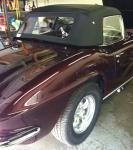
Burning Brakes


Joined: Aug 2001
Posts: 1,104
Likes: 1
From: Frederick Md
Decking and head cutting
With my engine rebuild many years ago, I used the higher compression domed pistons. The machine work had no decking of the block or shaving of the heads, and I think a standard head gaskets. I can't remember what the cam was but it was not stock by any means. My compression is at 180 pounds per cylinder. I'm thinking decking and shaving is a strong possibility with your engine.
Lowell
Lowell
In order to increase compression by cutting the heads, you need to remove 10 CCs from the head to increase compression by 1 point. That amounts to a cut of .060.
I would need to puzzle out how much you would need to cut the deck, but by the time you did all this the manifold would start to fit baddly.
So, the cam and the pistons would be my things to look at.
If you pull a head, you can CC the combustion chamber to see if they are close.
Under 200 cranking compression would be my target.
Thread Starter
Heel & Toe
Joined: May 2007
Posts: 18
Likes: 0
From: Houston Tx
I did immediately check my compression gage I connected it to my air compressor and verified that the compression gage read the same as the tank pressure. The two gages were within a couple of pounds from 10 – 120 psi

Race Director


Joined: Nov 2000
Posts: 10,340
Likes: 664
From: Beverly Hills (Pine Ridge) Florida
Also note that if the block was bored, and then pistons with the same dome volume were used, compression ratio will also rise.
But have to agree that a short duration cam, along with a high static compression ratio is probably the cause.
Any problems with knock?
Plasticman
But have to agree that a short duration cam, along with a high static compression ratio is probably the cause.
Any problems with knock?
Plasticman
Last edited by Plasticman; Aug 15, 2008 at 04:59 PM.
Corvette Stories
The Best of Corvette for Corvette Enthusiasts

Top 10 Most Explosive Corvettes Ever Made: Power-to-Weight Ratio Ranked!
Joe Kucinski
150 hp to 1,250 hp: Every Corvette Generation Compared by the Specs That Matter
Joe Kucinski
8 Coolest Corvette Pace Cars (and Replicas) of All Time
Verdad Gallardo
Top 10 Corvette Engines RANKED by Peak Torque (70+ Years of Muscle!)
Joe Kucinski
Corvette ZR1X Will Be Pacing the Indy 500, And Could Probably Race, Too!
Verdad Gallardo
Top 10 Corvettes Coming to Mecum Indy 2026!
Brett Foote
Top 10 C9 Corvette MUST-HAVES to Fix These C8 Generation Flaws!
Michael S. Palmer
10 Revolutionary 'Corvette Firsts' Most People Don't Know
Joe Kucinski
5 Reasons to Upgrade to an LS6-Powered Corvette; 5 Reasons to Stay LT2
Michael S. Palmer
Thread Starter
Heel & Toe
Joined: May 2007
Posts: 18
Likes: 0
From: Houston Tx
NO problems with knock. When I first got the car 2 years ago the timing was advanced to about 17 degrees and it did knock. I set the timing back to 10 degrees and the knock went away. It does run a little hot (about 200) in the 95 degree Texas summer and sometimes it can have a bit of a hot start problem.
Mike
Mike

Team Owner


Joined: Nov 2005
Posts: 28,183
Likes: 2,872
From: Beach & High Desert Southern California
If the block was ever rebuilt in the past it's likely that the block was decked to raise the compression to the factory book specification. This was common for people looking to have the rebuilt engine match the book specification (match the advertised compression from GM, rather than the usual factory result). This would put you close to the 230psi numbers with a mild cam, or with a modern short duration high intensity cam with similar 0.050 duration numbers as the original 097' cam.
The loss of stamp pad numbers and the finish on the pad are tell-tale indicators of the block being decked. If the VIN numbers are gone and the pad reflects circular-arc machine marks, it's been decked.
If the engine did not ping with the 10-degrees initial and the installed distributor curve, it's not likely to ping after a good tune up.
A good tune-up test for performance however would be to read the total advance at 3500 rpm with the vacuum advance plugged. The factory centrifugal advance curve would limit the total advance to about 36-38 degrees in this configuration. There is a timing help paper authored by Lars that will guide you through getting the most performance out of the timing without detonation (and remember to reconnect and test the vacuum advance when nearly complete).

The loss of stamp pad numbers and the finish on the pad are tell-tale indicators of the block being decked. If the VIN numbers are gone and the pad reflects circular-arc machine marks, it's been decked.
If the engine did not ping with the 10-degrees initial and the installed distributor curve, it's not likely to ping after a good tune up.
A good tune-up test for performance however would be to read the total advance at 3500 rpm with the vacuum advance plugged. The factory centrifugal advance curve would limit the total advance to about 36-38 degrees in this configuration. There is a timing help paper authored by Lars that will guide you through getting the most performance out of the timing without detonation (and remember to reconnect and test the vacuum advance when nearly complete).
