When you click on links to various merchants on this site and make a purchase, this can result in this site earning a commission. Affiliate programs and affiliations include, but are not limited to, the eBay Partner Network.
Only looking to use you as a source of information. I like your approach to things because it's no-nonsense and tries to maximize results. Although your earlier comment about needing high ZDDP break-in oil for a roller cam cuts your credibility as an "expert".
I looked at your timing program from your earlier post and to me, an amateur compared to you, it looks "funky" (15 degrees timing steady all the way to 4000 and then a LINEAR increase to a whopping 42 degrees). You say that you developed a program to optimize the spark program. Did you verify by plugging your program's recommendation into EA PRO? It's mechanics that determine spark advance and as I stated earlier, it's all about timing the point of max cylinder pressure to the sweet spot which is AROUND 14 degrees ATDC. Did you use your rod length and crank throw in inventing your software program?
One more thing: I'm going by conventional wisdom and according to that, you are being very conservative on this engine's DCR. Why didn't you design for more DCR, closer to 8.5 - 8.7? If engine temp, spark timing, quench, and fuel mixture are optimized then 8.75 is not dangerous using 93 octane fuel. If you stated this engine's quench earlier, then I missed it.
I agree, I'm not an expert at assembling and break-in, but I do consider myself an expert in engine blueprinting. I define blueprinting as determining what parts to use to achieve the minimum allowable clearances, and to maximize performance, given the restrictions set. This is due to my extensive background in modeling and simulation, acquired from my job over 30 years as an aerospace engineer.
Last edited by bdhulderman; Feb 3, 2018 at 11:58 AM.
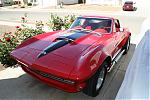
Well, I got my '66 off the lift and drove it to get some fuel today, which gave me the opportunity to do some lift work on the other cars that were nagging me. The Colorado I got to haul my engine for my '66 around, had hopefully just a bad oil pressure sending unit that I replaced. Stupid thing would randomly flash the engine oil light and make what sounded like a seatbelt warning sound, scaring the heck out of us. Also it all of a sudden started leaking profusely from the power steering reservoir soon after we took it down to the shop to replace the tire pressure sensor. Turns out the high pressure side fitting of the pump was loose. So I tightened that, hopefully that will take care of that. Susie's '71 had a transmission cooling line leak that I fixed. Man, that lift of mine has been a Godsend. Thought I'd put her on top tonight. Got my vacuum pump for the engine evac coming Wednesday. I'm thinking now that I'll need 2 breathers on the other side to reduce the vacuum for when I run on the street, and bought plugs for them when I'm racing. I'm putting in vacuum gauge that I can see in the car for monitoring my vacuum as I'm driving for the different conditions. I had to get an electric tachometer that will fit in the cluster for my '66. It has shift light that I can program, analog needle, and will hook right up to my HEI distributor tach drive input. I already messed up my mechanical tach running it up to over 7000 rpm.
From: Las Vegas - Just stop perpetuating myths please.
Ya know most owners will make quite an effort to control crankcase pressure but almost no one will install a vacuum gauge or a combination vac/boost gauge to monitor thier system. It so simple to connect a gauge to a valve cover or lifter valley or oil pan but it's not normally done. H
Now of course you wouldn't want the gauge on the hood of a nice C2 or inside the passenger compartment. But a temporary tape on gauge on the windshield will give you enough information to set up a good system.
On my beat up camaro I can mount a chrome or polished gauge right on the hood but that's me. . Right now it has a manifold vacuum gauge on the dash pad right where most others mount their aftermarket tach. So the plan is for a hood mounted vac gauge once I install an exhaust evacuation system for the crankcase. But it would be useful to monitor how well the PCV valve is working currently.
Ya know most owners will make quite an effort to control crankcase pressure but almost no one will install a vacuum gauge or a combination vac/boost gauge to monitor thier system. It so simple to connect a gauge to a valve cover or lifter valley or oil pan but it's not normally done. H
Now of course you wouldn't want the gauge on the hood of a nice C2 or inside the passenger compartment. But a temporary tape on gauge on the windshield will give you enough information to set up a good system.
On my beat up camaro I can mount a chrome or polished gauge right on the hood but that's me. . Right now it has a manifold vacuum gauge on the dash pad right where most others mount their aftermarket tach. So the plan is for a hood mounted vac gauge once I install an exhaust evacuation system for the crankcase. But it would be useful to monitor how well the PCV valve is working currently.
Good luck.
Man, that car now is a freakin' beast! I just barely touch the throttle and it wants to rocket. I can't wait to get it down to the chassis dyno and tune it some more over just my engine building program settings.
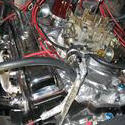
Here's an engine shot of where I'm at so far. Still have to mount the crankcase vacuum pump this weekend. I'll have plenty of airflow for the powerplant and can actually shut my hood.
Got the new electric tachometer mounted in the couple of hours I had after work. I decided to leave my other tach in the instrument cluster, but put the new tach where the clock was. That clock never did work right and drew too many amps, probably needs to be rebuilt again. Later this week I'll wire the tach up and program/calibrate it to turn on the shift lights where I want them. I'll be able to optimize that with my software I developed, once I have the rear wheel torque vs. RPM, to minimize my 1/4 mile time.
Ok, the latest progress on the beast. I received an alternator bracket today, that I ordered the other day, to hopefully be able to mount the crankcase vacuum pump, and it actually worked! It's real solid in there after shimming it to what I think will be the correct pulley location. Now alternator, power steering pump, and vacuum pump are at least one pulley away from each other. I got a crankshaft mandrel, as part of the vacuum pump hardware, which allows me to put the correct pulley diameters at the correct axial locations. I had to shim my power steering pump forward about an inch, now that the vacuum pump is right over it, to be able to check the fluid level, which I can now do. It's coming together, but this little stuff is killing me!
Had a pretty productive day today working on my car on my day off work. I'm getting pretty good now at putting on the braided hose connectors. I put in all the lines for the crankcase vacuum pump: valve cover to pump input and pump output to breather tank. I'm also putting on the crankshaft mandrel and pulley's. 1st pulley is 5" for alternator, 2nd 3" for vacuum pump, to give me 60% of engine rpm to it, and 3rd is 5" for power steering pump to also drive my Hydratech braking system. I should be able to put on the belts this weekend and test out the vacuum generated by the pump from idle to 7500 rpm. They recommend 12 in Hg max for pump vacuum in the crankcase that I'll be measuring from the passenger side valve cover to a vacuum/pressure gauge I mounted in the cab. A vacuum relief valve I can adjust at the pump to limit it to 12. PCV valve is gone, and in it's place is a plug. I'll have one breather on the driver's side valve cover to reduce the vacuum for in-town driving, or plug for racing on the track. It's coming together!
I still have quite a bit of work to do. I need to put in my 6-point roll bar, which is going to take some time, and take it down to the chassis dyno place to do some more tuning. I would think this year.
Here's the latest engine bay photo. Still need to get my belts on, but getting close. Also here's the new 150 dB electric horn I put in. Not as loud as my train horn that I no longer had room for the tank, but still better than stock. Susan was out on the street in the truck and honked just before I did.
Guys, I removed several posts by 2 members that could have been sanctioned for hjacking. Please take your personal unrelated conversation to PM or a new thread.
Got all the belts on! Took me a few tries at O'Reilly's auto parts to get the right sizes, but I have plenty of room and they stay on throughout the rpm range.
Ok, here's a crankcase vacuum test. They recommend 10-12 in Hg max vacuum, and it looks like I get the max of about 10 at 6500 rpm. I'll try tuning the vacuum relief valve a little more, but it's looking pretty good. And the great thing about it, no more oil leaks!!
From: Las Vegas - Just stop perpetuating myths please.
Awesome sounding machine. Glad to see you installed the vacuum gauge to monitor the evac system. I'm thinking you may want to check the gauge calibration as a dedication vacuum pump should be able to pull 12"Hg even a low RPM.
Well I didn't see any positive press in the video and that's not only a good thing but you may want to switch to a vac only gauge instead of a combo gauge for more accuracy. Also keep in mind that vacuum line could become a source of harmful gas into the cockpit if blowby occurs. You may want to remove it after system testing.
Got all the belts on! Took me a few tries at O'Reilly's auto parts to get the right sizes, but I have plenty of room and they stay on throughout the rpm range.
Ok, here's a crankcase vacuum test. They recommend 10-12 in Hg max vacuum, and it looks like I get the max of about 10 at 6500 rpm. I'll try tuning the vacuum relief valve a little more, but it's looking pretty good. And the great thing about it, no more oil leaks!!
Awesome sounding machine. Glad to see you installed the vacuum gauge to monitor the evac system. I'm thinking you may want to check the gauge calibration as a dedication vacuum pump should be able to pull 12"Hg even a low RPM.
Well I didn't see any positive press in the video and that's not only a good thing but you may want to switch to a vac only gauge instead of a combo gauge for more accuracy. Also keep in mind that vacuum line could become a source of harmful gas into the cockpit if blowby occurs. You may want to remove it after system testing.
Thx for sharing.
Another thing I need to do is to make sure the engine is sealing up, like the valve cover plugs I'm using, and dipstick, etc. I'm sure I'm losing some vacuum through those.
Designer Imagines A Corvette That Looks More Like a Corvette Than the Corvette
Slideshow: A Jaguar designer's personal project imagines what a modern front-engined Corvette might look like if Chevrolet revisited the golden age of the Stingray.







 I had to get an electric tachometer that will fit in the cluster for my '66. It has shift light that I can program, analog needle, and will hook right up to my HEI distributor tach drive input. I already messed up my mechanical tach running it up to over 7000 rpm.



 . Right now it has a manifold vacuum gauge on the dash pad right where most others mount their aftermarket tach. So the plan is for a hood mounted vac gauge once I install an exhaust evacuation system for the crankcase. But it would be useful to monitor how well the PCV valve is working currently.