When you click on links to various merchants on this site and make a purchase, this can result in this site earning a commission. Affiliate programs and affiliations include, but are not limited to, the eBay Partner Network.
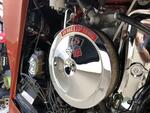
I know, who cares as long as they do. No part of my can is being used. Wide open, not one port is used.
Why did I go looking? About every 10 outings my lights will just pop up outa nowhere. Then drop back down. At first I thought weak springs and the wind got them pushed up. I tried to open (lift) by hand and those springs are tight. No issues with performance at all.
These are the two ports in the center.
Driver side port.
Sitting here laughing, thinking ...who cares, If it ain't broke don't fix it cuz you will break it. Kinda curious though.
Maybe someone bypassed the vacuum reservoir. Its only purpose is to allow you to move the lights with the engine not running. The system will work perfectly without a reservoir,......when the engine is running.
before you pull the seat. lack of Vacuum to the relay valve. (vacuum valve that controls direction of vacuum to the canister that opens and closes the door). lack of Vacuum will cause the relay to drop, switching vacuum to lift the door. hook up the vacuum reservoir. After testing to make certain it doesn't leak.
I don't know the answer to this specific issue, but it might be that the 'fail-safe' state for the headlamp vacuum circuit would be for the lights to fail in the UP position...so that you could still have lights, even though the system had some internal failure.
O.K. I do understand how the system works . sorry for the short reply earlier. I was on my lunch break.
up front just under the reinforcement strip , (open your hood, just in front of the open hood mounted up under there). are 2 vacuum relays. inside each vacuum relay is a sliding "Dog bone". with vacuum to the top of the relay , it pulls on a diaphragm with raises the dog bone directing vacuum to the rear of your headlight actuator , causing the headlight to close and or stay shut. yes your springs on your door help as well. lack of vacuum to the top of the relays allows the internal spring to push the dog bone down. directing vacuum to the front of the actuator. pulling the rod outward and opening the headlight door.
if your switch were hooked up backwards. How could this matter? with lights off vacuum go's through the switch. with lights on vacuum is cut. no matter which way the hoses are installed, off is off.
winking headlight doors are a common problem without a vacuum tank. you floor it, vacuum drops. relay switches because spring inside over comes lack of vacuum. vacuum comes back as soon as you release the throttle. before the relay can switch back, vacuum go's to the actuator front side. starting to lift the door, just then the relay overcomes the spring and sends vacuum to the rear of the actuator. closing the door.
winking headlight doors caused by lack of a vacuum tank. It is NOT just there so you doors will operate with engine off.
when you open your throttle wide . your Vacuum drops off.
hook your tank back up and the winking will stop.
It is possible that the head lamps were opening slowly through the reserve tank so the last owner by passed it to have direct flow? But as stated when you tromp on it the vac. drops and up pops the weasel. The can gives you ample reserve since you are normally not WOT long unless your at the race track.
Marshal
The headlamp vacuum is divided into two separate systems--control and operation. When headlamp door(s) "wink" by first going up and then immediately back down for no reason the problem is almost certainly in the control half of the system as this is exactly what happens when it looses and then regains vacuum.
The control half of the system is made up of the headlamp switch, override switch, the vacuum source and a small vacuum line that leads to the two vacuum relays. While the vacuum relays also have connections for the operating half (the three large hoses) the type halves of the system are kept completely separate with a leak in one half not affecting the other. The control part typically holds vacuum for days if not weeks. It is NOT connected to the vacuum tank so your "winks" should not have anything to do with the fact that your tank is disconnected. The operation half of the system can (and relatively rapidly does) lose all vacuum but this alone cannot cause the "wink".
This vacuum check valve prevents the problem from happening during wide-open throttle. It is installed near the vacuum connection at the rear of the intake manifold and shortly after an air filter (half black/half white plastic thing). Both the filter and check valve MUST be installed and working properly. Pay attention to which direction the filter is installed (the reason for the two colors) as if you reinstall backwards anything trapped by the filter will immediately be sucked into the engine A hand vacuum pump is best to test a check valve: cap one connection on the side with two, pump down the other connection and it should hold indefinitely. You can test by hand/mouth by putting a hose on one connection, covering the other with your finger and sucking on the hose. If you can suck any air the check valve is bad.
there is merit to the check valve. however, I have purchased many. replacements. aftermarket etc. still haven't found one that truly holds. as tested with a vacuum guage.
true, there are 2 circuits, however the control circuit gets it's vacuum from a tee in the line that heads off to the vacuum reservoir. a perfectly sealing check valve could stop the winking. a vacuum tank would be more likely to work consistently. The factory did put it there for a reason.
Thank you for such a comprehensive answer! I even get it, I think. I'll re-do the system and include the tank.
I converted to electric and have a brand new full vacuum hose kit still in the box. I'll even throw in my old vacuum parts in case you can use them. PM me if interested I'll make you a good deal.
It has 100% correct diagrams and excellent explanation of the simple (if frequently misunderstood) C3 headlamp door vacuum system.
Note that one side of the dual connection check valve leads directly to the vacuum tank. This is the operation side of the system
The other leads directly to the headlamp switch. This is the control side of the system.
The control side of the system does not have any connection to the vacuum tank even in the event that either side fails. Just like the vacuum operated HVAC system the control side of the headlamp door system does not have access to a vacuum reservoir because there is no need. Both DO however rely on a properly functioning check valve that WILL maintain vacuum indefinitely to prevent uncontrolled operation while vacuum drops during heavy acceleration.
The ONLY reason for the vacuum reservoir is to allow you to turn off the engine with the headlamps on and have enough vacuum to unlock and lower the doors when you turn them off.
Again, a properly functioning check valve is critical to proper operation of the headlamp door system! The millions upon millions of cars that used and still use vacuum control in their HVAC systems rely on a check valve as well--but unlike in C3s they most likely have only two connections with one to the vacuum source and the other shared by one or more vacuum operated systems. The third connection is only there for an additional but utterly separate vacuum "storage" system that allows limited operation with the vacuum source (engine) off.
Our three port vacuum check valves are different than the normal because the two ports on the one side must seal against each other as well against the vacuum source on the other side. This is why the valve must be tested properly in the manner I described.
The reality is that "vacuum systems are simpler than electrical systems". As long as the engine is running, you have vacuum 'power'....a ready supply of [negative] energy which can be harvested for many simple tasks. All components are simple; they don't catch fire when they have a problem; no need for electric cable or wiring--just run some rubber tubing; vacuum operated 'motors' are just diaphragm cans which can open/close doors, make/break switches, whatever. Chevrolet engineers did not "reverse course" on electrically operated headlamps for no good reason (the C2 had electric open/close headlamps). They did it because the system was better, more reliable, cheaper and easier to fix.
These days, however, wiring is 'king'. You only need 6-10 computers to operate a modern vehicle.......
These days, however, wiring is 'king'. You only need 6-10 computers to operate a modern vehicle.......
LOL, when I started swapping a LS1 into my 2000 S10 pickup back in 2004 I wanted to retain the OEM functions and I learned that even that little truck had a PCM, BCM, SIR, ABS, and IPC computers and this was on a 2000 S10 pickup.... Probably closer to 12+ in cars today with all the proximity sensor crap, OnStar type services, GPS, and so on.
Well, it seems that all is fixed. Thanks to SVASSH for a new vac system. But it still didn't work. With the help of you guys and the diagrams, I worked through diagnostics and got to the big tank. Nope, not a leak, but PLUGGED up with mud or something. The two ports to the relays were fine....open. But the main vac port wouldn't go either way. I put a mirror and flashlight in there and saw what looked like mud. ????? I ran a guitar string through the port and bingo!!! Blew it out as good as I could with compressed air. Hooked everything back up and it works as advertised. I hope the filter will catch any crap that comes from the tank. I'll be watching it.
Thank you guys for making me use my brain as hard as that can be at times.










 Why do my lights work?
















 A hand vacuum pump is best to test a check valve: cap one connection on the side with two, pump down the other connection and it should hold indefinitely. You can test by hand/mouth by putting a hose on one connection, covering the other with your finger and sucking on the hose. If you can suck any air the check valve is bad.