




355 2 bolt 539hp
Thread Starter
Racer

Joined: May 2008
Posts: 318
Likes: 0
From: Wheaton, Illinois
 355 2 bolt 539hp
Just surfing the internet and came across an article by Hot Rod Magazine. The title is "small block Chevy build ups" if you would like more details. Whats amazing is that this beast put out 539hp @ 6900 rpms and was built using a 2 bolt main block w/ ARP bolts! I am not trying to start a 2 bolt vs 4 bolt debate. I just know there are many opinions on this subject, that's why I posted this. This build was interesting mainly because it shows that a street driven 355 2 bolt with 450hp can live on the streets. All opinions welcome.
Le Mans Master


Joined: Oct 2006
Posts: 7,123
Likes: 433
From: Gladstone MO
C3 of Year Finalist (appearance mods) 2019
From what I've read, the main webs on a 2 bolt block are actually thicker than on a 4 bolt block. The 4 bolts have a little less tendency for the caps to "walk" at high RPM. Again, from what I've read, the maximum strength is obtained by machining a 2 bolt block and installing 4 bolt caps.
I personally prefer 4 bolt blocks, but if I had a 2 bolt and that was it, I'd build it and never quiver.
I personally prefer 4 bolt blocks, but if I had a 2 bolt and that was it, I'd build it and never quiver.

Pro


Joined: Jun 2005
Posts: 540
Likes: 4
St. Jude Donor '09, '24
There have been many 600+ HP 2 bolt SB Chevys built that last a long time. A lot has to do with the RPM range the motor is going to be used at and the person who did the machine work to the motor. V8 motors will distort the main journals at very high RPMs from the centrifugal force that is produced from the mass of the crank/rods along with the torque produced from the motor. At 8100 RPMs the crank is turning 135 Revolutions Per Seconds. If the rotating mass is out of balance, even more centrifugal force is applied to the main caps. If you have a motor that never comes close to even 8100 RPM I wouldn't worry about a 4 bolt main block. Spend your money on a good set of connecting rods and bolts that won't get ripped apart at lower RPMs, from the same centrifugal forces or the torque that affect the main journals. Hemi motors used at Daytona back in 1969/1970 had to have a windage tray added to the motor. At close to 8K RPMs the Hemi would produce so much centrifugal force that 8 quarts of motor oil would be in a mist around the crankshaft and very little in the bottom of the oil pan, houstonvett

Drifting

Joined: Dec 2005
Posts: 1,360
Likes: 3
From: NORTHEAST
We build a lot of engines and have seen cap walk and broken caps on 2 bolt mains plenty of times because guys have read magazine articles and after we install splayed caps on the 2 bolt main blocks the problems go away.
By the way the 2 bolt and the 4 bolt use the same platform, The K- blocks do have a weaker webbing then the 010/020 blocks
Dart Rates there SHP block at only 600 horse and those blocks are 100 times better then any GM 010 block.
http://speedtalk.com/forum/viewtopic.php?t=12112
http://www.chevelles.com/forums/showthread.php?t=237241
When caps start walking because the are being over powered the bearings and crank take the brunt of the it.
All we ever have done is performance builds and we have a good idea what works and what doesn't and what is DEPENDABLE and what is not DEPENDABLE.
Hell we build alot of circle track engines and one class the engines are in the 370 horse area and I can tell you this 2 bolts don't work in those engines and we have seen it tried many times.
Look at a GM catolog and see what they rate there 4 bolt blocks at.
Look these links over
http://www.ls1tech.com/forums/advanc...ever-seen.html
http://forums.corvetteforum.com/c4-t...ps-1992-a.html
By the way the 2 bolt and the 4 bolt use the same platform, The K- blocks do have a weaker webbing then the 010/020 blocks
Dart Rates there SHP block at only 600 horse and those blocks are 100 times better then any GM 010 block.
http://speedtalk.com/forum/viewtopic.php?t=12112
http://www.chevelles.com/forums/showthread.php?t=237241
When caps start walking because the are being over powered the bearings and crank take the brunt of the it.
All we ever have done is performance builds and we have a good idea what works and what doesn't and what is DEPENDABLE and what is not DEPENDABLE.
Hell we build alot of circle track engines and one class the engines are in the 370 horse area and I can tell you this 2 bolts don't work in those engines and we have seen it tried many times.
Look at a GM catolog and see what they rate there 4 bolt blocks at.
Look these links over
http://www.ls1tech.com/forums/advanc...ever-seen.html
http://forums.corvetteforum.com/c4-t...ps-1992-a.html

Le Mans Master

Joined: Dec 2003
Posts: 5,727
Likes: 38
From: Fremont CA
As long as a motor never sees any DETONATION 2 bolts are fine but, because we don't live in a perfect world, 4 bolt blocks should be used for any build over 400HP (in my engine builder book.) Making 500+HP with a production cylinder block? You are just ASKING for TROUBLE in the long run trying to attempt doing this (in the physics/chemistry package that make a reliable motor package.) If you can guarantee perfect fuel ratios, perfect timing, and perfect cooling, you might be sucessful but, I buy my fuel froma gas station for most of my Vettes and ALWAYS add 30% race gas when I'm going Drag racing of Autocrossing to insure a margin of saftey on my mid 400HP small blocks WITH 4 bolt mains (nodular iron caps ONLY please!)
Thread Starter
Racer
Joined: May 2008
Posts: 318
Likes: 0
From: Wheaton, Illinois
I have been researching 2 bolt vs 4 bolt mains to convert my 79 L48 Vette motor to 383 425hp. The 2 vs 4 bolt debate will go on forever. By the time I rebuild it to a 4 bolt, buy the rotating assembly, heads and cam ect. ect. I am just going to buy a crate motor from T&L and have it shipped to my door for an easy engine swap! 
Pro
Joined: Jun 2005
Posts: 540
Likes: 4
St. Jude Donor '09, '24
Blockman is right in the facts that he states but they are for motors that are kept at 9K RPM levels for extended periods of time. Nascar motors live above 9K RPMs especially on the big tracks. Most street motors never see 6500 RPMs and if it is winded up that high it is for a very short period of time. You can take a 100 HP motor in which the rods and crank are severely out of balance and make the main journals walk @ 1K RPM. Build and design the motor for what it is going to be used for. If building a motor to run down the back straight a ways at Daytona Speedway I would use the 4 bolt main journals. If I am building a 500 HP street motor that would ocassionly see 6500 RPMs for very short periods of time a 2 bolt main motor with main studs will work. Make sure your machinist does your motor balance work right. This is very important and should be done on any rebuilt motor, houstonvett
Last edited by houstonvett; Apr 24, 2009 at 05:01 PM.
Drifting
Joined: Dec 2005
Posts: 1,360
Likes: 3
From: NORTHEAST
Blockman is right in the facts that he states but they are for motors that are kept at 9K RPM levels for extended periods of time. Nascar motors live above 9K RPMs especially on the big tracks. Most street motors never see 6500 RPMs and if it is winded up that high it is for a very short period of time. You can take a 100 HP motor in which the rods and crank are severely out of balance and make the main journals walk @ 1K RPM. Build and design the motor for what it is going to be used for. If building a motor to run down the back straight a ways at Daytona Speedway I would use the 4 bolt main journals. If I am building a 500 HP street motor that would ocassionly see 6500 RPMs for very short periods of time a 2 bolt main motor with main studs will work. Make sure your machinist does your motor balance work right. This is very important and should be done on any rebuilt motor, houstonvett
Corvette Stories
The Best of Corvette for Corvette Enthusiasts

Top 10 Most Explosive Corvettes Ever Made: Power-to-Weight Ratio Ranked!
Joe Kucinski
150 hp to 1,250 hp: Every Corvette Generation Compared by the Specs That Matter
Joe Kucinski
8 Coolest Corvette Pace Cars (and Replicas) of All Time
Verdad Gallardo
Top 10 Corvette Engines RANKED by Peak Torque (70+ Years of Muscle!)
Joe Kucinski
Corvette ZR1X Will Be Pacing the Indy 500, And Could Probably Race, Too!
Verdad Gallardo
Top 10 Corvettes Coming to Mecum Indy 2026!
Brett Foote
Top 10 C9 Corvette MUST-HAVES to Fix These C8 Generation Flaws!
Michael S. Palmer
10 Revolutionary 'Corvette Firsts' Most People Don't Know
Joe Kucinski
5 Reasons to Upgrade to an LS6-Powered Corvette; 5 Reasons to Stay LT2
Michael S. Palmer
Race Director


Joined: Apr 2000
Posts: 17,676
Likes: 201
From: Who says "Nothing is impossible" ? I've been doing nothing for years.
Drifting
Joined: Dec 2005
Posts: 1,360
Likes: 3
From: NORTHEAST
We would never build an engine for this class with a 2 bolt mains as we have seen other guys try to attempt this before and we have seen them use studs and bolts and the end result is severe cap walk.
I have never seen studs make the main caps stronger as its still a grey cast cap with better hardware, Its like putting new rod bolts in an old set of rods it still an old set of rods with new hardware and there not any stronger.
The pic I posted of severe cap walk was a 420 horse 2 barrel engine and it was studed.
http://www.ls1tech.com/forums/advanc...ever-seen.html
I have never seen studs make the main caps stronger as its still a grey cast cap with better hardware, Its like putting new rod bolts in an old set of rods it still an old set of rods with new hardware and there not any stronger.
The pic I posted of severe cap walk was a 420 horse 2 barrel engine and it was studed.
http://www.ls1tech.com/forums/advanc...ever-seen.html
Pro
Joined: Jun 2005
Posts: 540
Likes: 4
St. Jude Donor '09, '24
The 65 396 CID 425HP early blocks used 2 bolt mains. The 327 CID 375 HP blocks also used 2 bolt mains. I belive both of these setups back in their day survived the 24 hrs of Lemans and also at Daytona under racing conditions. There are a multitude of factors involved with the reason why a set of bottom end mains walk. As Solid LT1 pointed out deteonation is a very serious problem at even moderate RPMs. Did these 2 bolt motors have timing gears installed on them to keep the timing accurate? Is the distributor curved right with the right spring rate? Was the motor balance work done correctly? Remember the Devil is in the Details, especially at high RPMs. The Hot Rod article explains to you that a 2 bolt 500 HP motor can work if built right and maintained correctly, houstonvett
Last edited by houstonvett; Apr 25, 2009 at 01:55 PM.
Thread Starter
Racer
Joined: May 2008
Posts: 318
Likes: 0
From: Wheaton, Illinois
Car Craft
Hello, Car Craft also has a 2 bolt 383 w/ 439 hp. There are a ton of 400 hp 2 bolt small blocks on the street. Some even use them for weekend drag racing. I called an engine builder, and he said street small blocks in the 400hp range can stay with the 2 bolt mains in a 355 or a 383. As long as you don't go crazy with the RPM's. Just some information.
Race Director
Joined: Apr 2000
Posts: 17,676
Likes: 201
From: Who says "Nothing is impossible" ? I've been doing nothing for years.
Hello, Car Craft also has a 2 bolt 383 w/ 439 hp. There are a ton of 400 hp 2 bolt small blocks on the street. Some even use them for weekend drag racing. I called an engine builder, and he said street small blocks in the 400hp range can stay with the 2 bolt mains in a 355 or a 383. As long as you don't go crazy with the RPM's. Just some information.

Crank up the volume

Drifting
Joined: Dec 2005
Posts: 1,360
Likes: 3
From: NORTHEAST
Hello, Car Craft also has a 2 bolt 383 w/ 439 hp. There are a ton of 400 hp 2 bolt small blocks on the street. Some even use them for weekend drag racing. I called an engine builder, and he said street small blocks in the 400hp range can stay with the 2 bolt mains in a 355 or a 383. As long as you don't go crazy with the RPM's. Just some information.
Interesting as a 400 2 bolt main uses the same width caps as the 4 bolt and why do you thing GM did that with the added stroke it needs a wider cap to help make it more stable.
The same with the BBC 396 same with caps 2 bolt and 4 on the senters big differace as you guy can't compare a 400 2 bolt center cap to a 350 2 bolt center BIG BIG differance.
Again a 3.480 stroke and a 3.750 stroke there is more side load with the bigger stroke engine.
Look over this link and this is why we use the proper capped block and if we could only base our info on one engine
http://forums.corvetteforum.com/c4-t...ps-1992-a.html
Here is a pic of a 420 horse studded 2 bolt engine that only went about 8 races CIRCLE TRACK and after we put billet caps on it has gone for years with no more oil pressure problems or no more cap walk.
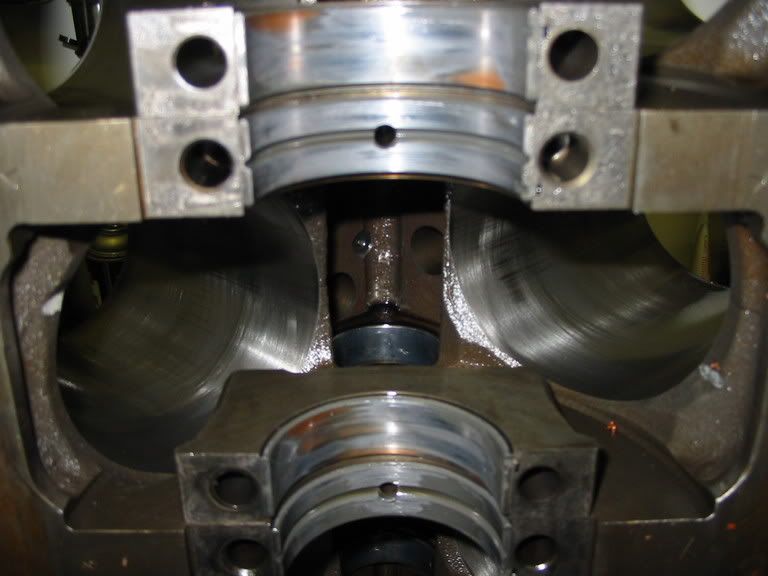
We deal with about 200 blocks a year and we do only performance work adn over a years time we get alot of calls and emails about broken caps, caps walking and bearing issues do to caps walking,
If 2 bolt blocks were as good as you say (400 HORSE) why did GM even build a 4 bolt block. When guys bring i a 2 bolt block and want a stroker engine built and want to use there 2 bolt because a magazine said it was OK I show them a bucket of broken 2 and 4 bolt caps and other 2 bolt caps that look like the bottoms were welded on, After they see that they want the proper caps installed.
Here is a good link to look over.
http://www.chevelles.com/forums/showthread.php?t=38173
Pro
Joined: Dec 2008
Posts: 531
Likes: 0
From: Frisco TX
I think the difference of opinion here is based more on application than anything else.
Race motors spend the vast majority of their time at high rpm's and in this application a 4 bolt block seems mandatory for all the reasons validated by Blockman above.
Street motors - moderately built - spend the vast majority of their time off idle and below 4000 rpm's and in this application a 2 bolt block seems to work just fine.
Before I wrote my first check on my 360ci build I had this discussion with my engine guy. My '73 2 bolt block was in really nice shape and he recommended it fine for my application. My entire assembly was balanced and ARP hardware was used. Its gonna live off idle and will spend most of its time below 4500rpm. Lets face it - there are tons of 400hp 2 bolt 350 Chevy's runnin around on the street just fine. If they had been grenading left and right for the past 30 yrs there would be no supply of used pre '86 cores left by now.
I do think 560hp out of a 355ci small block - either 2 or 4 bolt - is extreme and does not fall into the normal street motor catagory. In this case it seems foolish not to use a 4 bolt block as the foundation. As they say - the candle that burns twice as bright burns half as long.
Race motors spend the vast majority of their time at high rpm's and in this application a 4 bolt block seems mandatory for all the reasons validated by Blockman above.
Street motors - moderately built - spend the vast majority of their time off idle and below 4000 rpm's and in this application a 2 bolt block seems to work just fine.
Before I wrote my first check on my 360ci build I had this discussion with my engine guy. My '73 2 bolt block was in really nice shape and he recommended it fine for my application. My entire assembly was balanced and ARP hardware was used. Its gonna live off idle and will spend most of its time below 4500rpm. Lets face it - there are tons of 400hp 2 bolt 350 Chevy's runnin around on the street just fine. If they had been grenading left and right for the past 30 yrs there would be no supply of used pre '86 cores left by now.
I do think 560hp out of a 355ci small block - either 2 or 4 bolt - is extreme and does not fall into the normal street motor catagory. In this case it seems foolish not to use a 4 bolt block as the foundation. As they say - the candle that burns twice as bright burns half as long.
Last edited by ED69ray; Apr 26, 2009 at 11:14 AM.
Instructor
Joined: Feb 2006
Posts: 240
Likes: 0
From: Allentown PA
IMHO, It'd be nice to see an article about ANY engine build that has say 60,000 miles and 250 plus passes down the quarter mile and is still going strong, not just a quick build and throw it the dyno for a few thrashes and then tell us what a great high horsepower build this is. I don't think any of these magazine guys actually get to test these engines for that long. The way I see it is...they're just trying to sell magazines and durability is never really tested or written about that I know of. Most of these magazine engine builds have never even been in a car or under a load, never mind racing conditions or even street raced, so how do we really know if they are durable enough for the long haul most of us are counting on. No one ever side stepped a clutch at 6 grand or missed a shift on a dyno either. I'd rather believe my local engine builder or racer and their real life experiences they've had with different combinations and durability issues. Ok, my rant is over.
Drifting
Joined: Dec 2005
Posts: 1,360
Likes: 3
From: NORTHEAST
IMHO, It'd be nice to see an article about ANY engine build that has say 60,000 miles and 250 plus passes down the quarter mile and is still going strong, not just a quick build and throw it the dyno for a few thrashes and then tell us what a great high horsepower build this is. I don't think any of these magazine guys actually get to test these engines for that long. The way I see it is...they're just trying to sell magazines and durability is never really tested or written about that I know of. Most of these magazine engine builds have never even been in a car or under a load, never mind racing conditions or even street raced, so how do we really know if they are durable enough for the long haul most of us are counting on. No one ever side stepped a clutch at 6 grand or missed a shift on a dyno either. I'd rather believe my local engine builder or racer and their real life experiences they've had with different combinations and durability issues. Ok, my rant is over.
I know some guys that have gotten sucked in on the articles LOL
Race Director
Joined: Apr 2000
Posts: 17,676
Likes: 201
From: Who says "Nothing is impossible" ? I've been doing nothing for years.
I agree you can make the dyno put out any numbers you want. HP sells motors to magazines so are they going to fudge the numbers ? I wonder, after all it's only money they are after and who would be dishonest when money is involved ?
Whenever anyone gets their motor dynoed at my friends shop they are never happy they always think the numbers are low because both their engine dyno and chassis dyno are state of the art and calibrated correctly, they are not "happy" dynos.
This is done because they have been building racing motors for 30 years and a knowledgeable racer knows how fast x amount of HP moves y amount of wieght down the track in a properly setup race car.
You should have seen all the long faces when they had Viper dyno day, everyone was complaining that their was not working properly, at their "tuners / parts changers" shop they were 10-20% higher
Whenever anyone gets their motor dynoed at my friends shop they are never happy they always think the numbers are low because both their engine dyno and chassis dyno are state of the art and calibrated correctly, they are not "happy" dynos.
This is done because they have been building racing motors for 30 years and a knowledgeable racer knows how fast x amount of HP moves y amount of wieght down the track in a properly setup race car.
You should have seen all the long faces when they had Viper dyno day, everyone was complaining that their was not working properly, at their "tuners / parts changers" shop they were 10-20% higher
Le Mans Master

Joined: Oct 2002
Posts: 7,098
Likes: 378
From: Las Vegas - Just stop perpetuating myths please.
Too many varibles so say what caused any damage in any block.
The 65 396 CID 425HP early blocks used 2 bolt mains. The 327 CID 375 HP blocks also used 2 bolt mains. I belive both of these setups back in their day survived the 24 hrs of Lemans and also at Daytona under racing conditions. There are a multitude of factors involved with the reason why a set of bottom end mains walk. As Solid LT1 pointed out deteonation is a very serious problem at even moderate RPMs. Did these 2 bolt motors have timing gears installed on them to keep the timing accurate? Is the distributor curved right with the right spring rate? Was the motor balance work done correctly? Remember the Devil is in the Details, especially at high RPMs. The Hot Rod article explains to you that a 2 bolt 500 HP motor can work if built right and maintained correctly, houstonvett
 Too much timing, or too much compression or even too much mixture can cause preignition or detonation or even just max cyl press before TDC - and then something is gonna' give.
It won't matter what hp that motor makes something is gonna' give.
Other variables like reused main bolts that begin to deform or even studs used but torqued with out of calibration torque wrenches can cause failure of the mains.
Too many bad tuners out there. Having recently seen a rebuilt performance small block in blazer with a hole in the cyl wall while the piston tops where still shiny new. Hey, who is bother to take the main caps off to look when there's a hole in #8 cyl?
What im saying is that u can build a 250hp 4 bolt block and still destroy it with too much timing.
Al, everyone needs to limit their timing, build with modest compression and know what mixture to use. Before u remove any engine bolt at all learn how to tune your ignition and carb first. If u can't tune it don't bother to build it!

Good luck,
cardo0
