When you click on links to various merchants on this site and make a purchase, this can result in this site earning a commission. Affiliate programs and affiliations include, but are not limited to, the eBay Partner Network.
If that PCV valve doesn't cure your oil leaks, you could try something along this before jumping all the way to a EVAC system. I was having some crankcase pressure issues and I was able to greatly reduce the leaks at high RPM by installing an external vent tube from the oil pan to the valve cover. This worked for me ... got the idea from a circle track race car. Yes it cost a few $$'s too, but unlike someone I'm not broke.
If that PCV valve doesn't cure your oil leaks, you could try something along this before jumping all the way to a EVAC system. I was having some crankcase pressure issues and I was able to greatly reduce the leaks at high RPM by installing an external vent tube from the oil pan to the valve cover. This worked for me ... got the idea from a circle track race car. Yes it cost a few $$'s too, but unlike someone I'm not broke.
???? Just curious...if you are connecting a hose from the oil pan to the valve cover....and that is all you did....how did that help??? Unless I did not read what you wrote correctly.
When mine started weeping oil I replaced the P.C.V valve with the check valve for a power brake booster.problem solved 8 bucks.old trick we used years ago.
That 130 dollar looks nice and I'm sure works well. In the grand scheme of things not being mass produced it's a fair deal.
???? Just curious...if you are connecting a hose from the oil pan to the valve cover....and that is all you did....how did that help??? Unless I did not read what you wrote correctly.
DUB
I was getting a really odd oil leak at the fuel pump under high RPM's when I was at the track. Thought it might have been a bad fuel pump, but after replacing it with a different design and getting the same issue, I took apart the old pump and nothing was wrong.
I'm just getting too much leakage into the crank case and it pressurizes at RPM. I know I could take the time & money to take the whole engine out to rebuild it, but this little "fix" has kept it from being a major issue for me for years now. Someday I'll rebuild the engine or maybe upgrade to something larger.
But for now, this little vent line allows the oil pan to vent directly to the valve cover and out the PCV valve. Just by installing this vent line, the oil leak at the fuel pump has almost completely went away. It's a bit odd, but hey it worked.
Last edited by Jason Staley; Nov 11, 2015 at 08:12 PM.
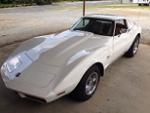
I was having some minor, but irritating oil leaks. With the performance engine in my 1974 Corvette, having a camshaft with .500" lift and 270/270 duration, RHS Performance aluminum heads (model number: 12052), 2.02"/1.6" diameter stainless steel valves; is far from a stock engine. I figured the crank case was not being under enough vacuum, and worse possible pressurizing.
I did a search for a "performance PCV valve", and found this company M/E Wagner Performance. They make a Dual Flow Adjustable PCV Valve. It is manufactured in Northeast Pennsylvania.
The engineering and manufacturing that makes this PCV Valve is of the highest quality! It is very easy to setup for one's engine.
It has alleviated the minor leaks and without a doubt the crankcase is ALWAYS under vacuum!
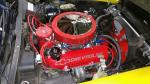
Checkout the photos of it installed on my Vette's engine, not only does it works great it looks very cool too!!!
You only buy it once. It is fully serviceable and adjustable.
Price: $129.00
Here is the link to M/E Wagner Performance's web site
I just bought one given the issues I am having with PCV valves. Contrary to beliefs they are not all the same I tried 3 today and all of them had different results. $130 for a PCV valve is crazy but if it works I dont care. This sucker better come with an oompa loompa that jumps out to fill my car with gas and tunes the carb.
on a only slightly related topic, I was playing around with different pcv valves this summer, and there are lots of different styles and flow rates I noticed (as well as questionable quality).
the reason why is my daughters vw jetta had a bad pcv setup, and I was replumbing it without spending crazy money on dealer only parts (VW uses plastic tubes with a valve inside, they break and this was taped up pretty shoddily).
anyway, why it may or may not be relevant is: vw's use an electric fan to draw vapor out of the crankcase as part of the emissions. it continues to run for 8 minutes after the engine is shut down.
I paid $30 for a complete setup at a JY, and it's pretty compact...seems like an economical way to add an evacuation system for someone maybe?
just a thought if anyone is contemplating something like that on the cheap...
I agree , street cars are not driven full power all the time.. But theres not much pressure in the crankcase at idle either .. Every driver has to use whats best for his application..one size does not fit all. with my big Roller cam, , since I only have about 4-5 inches of vacuum at idle, a PCV is near useless . An Exhaust evac system increases pull as rpm increases , the most effective way in my case.
I went down this road a while back,,, still not happy with my pcv setup. But with 6 inches vacuum at idle I decided to try just putting breathers in the valve covers and no pcv. Worked until I tipped 7000 rpms one fine day and blew the seal on the china wall. Soaked the whole engine compartment with oil. As it turned out the breathers I had tried had fairly small openings to allow air in/out, and so created a bottle neck when under high rpms. I went back to a pcv setup and enlarged the breather openings, and so far it has worked OK, but I don't often hit 7000 rpms on the street.
I am curious about an evac setup, and the exhaust type seems OK except when using mufflers....Where does all that oil vapor collect?, and how does your car smell when the mufflers get soaked with oil?
Also curious about the vacuum pump setup. Where does that vapor exit? Under the hood, or somewhere under the car?
Last edited by The Money Pit; Nov 12, 2015 at 11:46 AM.
I went down this road a while back,,, still not happy with my pcv setup. But with 6 inches vacuum at idle I decided to try just putting breathers in the valve covers and no pcv. Worked until I tipped 7000 rpms one fine day and blew the seal on the china wall. Soaked the whole engine compartment with oil. As it turned out the breathers I had tried had fairly small openings to allow air in/out, and so created a bottle neck when under high rpms. I went back to a pcv setup and enlarged the breather openings, and so far it has worked OK, but I don't often hit 7000 rpms on the street.
I am curious about an evac setup, and the exhaust type seems OK except when using mufflers....Where does all that oil vapor collect?, and how does your car smell when the mufflers get soaked with oil?
Also curious about the vacuum pump setup. Where does that vapor exit? Under the hood, or somewhere under the car?
You really will not smell it .
I never knew how much moisture a crank case collects , yes it burns off as the oil heats up in all cars and should be drawn out by the PCV system , but the vac pump pulls it all out. I drain the catch tank once a week or two and I can not be happier with it.
Look up a vacuum pump kit sbc you will see all the hardware and the catch tank
I went down this road a while back,,, still not happy with my pcv setup. But with 6 inches vacuum at idle I decided to try just putting breathers in the valve covers and no pcv. Worked until I tipped 7000 rpms one fine day and blew the seal on the china wall. Soaked the whole engine compartment with oil. As it turned out the breathers I had tried had fairly small openings to allow air in/out, and so created a bottle neck when under high rpms. I went back to a pcv setup and enlarged the breather openings, and so far it has worked OK, but I don't often hit 7000 rpms on the street.
I am curious about an evac setup, and the exhaust type seems OK except when using mufflers....Where does all that oil vapor collect?, and how does your car smell when the mufflers get soaked with oil?
Also curious about the vacuum pump setup. Where does that vapor exit? Under the hood, or somewhere under the car?
It does work with Hi-Flow Mufflers . You are only relieving pressure and removing some vapor, depending on RPM only, not large volumes of oil. It mixes with the extremely hot exhaust at the headers { I have one to each side } and I assume burns off because Theres no smell, no oil soak in my mufflers and , my pipes are perfectly clean .. Like I said ,it is not for every car. I need no emission tests here, and have a pathetic amount of vacuum from engine because of the big Roller Cam, and turn up a WHOLE LOT of RPM... . A PCV is useless in my case.. I m not recommending it for anyone, just telling you what worked best for me .
I have several drives with my Vette since I installed this PCV. The PCV valve works flawlessly. For me this is money well spent. Unlike a stock PCV valve this one can be tested, and calibrated very easily.
I highly recommend this PCV.
Last edited by 1974CorvetteJimCr; Nov 15, 2015 at 06:12 PM.