When you click on links to various merchants on this site and make a purchase, this can result in this site earning a commission. Affiliate programs and affiliations include, but are not limited to, the eBay Partner Network.
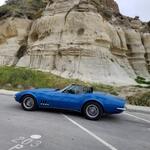
Took my 75 vert out tonight for the first night run since my ownership.
Almost everything worked perfectly. Need to make a few additional minor adjustments to my low beams.
Problem - Although I never run the lights at max, I twisted my instrument panel lights to maximum brightness to get an idea how bright they are.
While they were maxed, I had to shift a couple of times. The lights were maxed out for about 2-3 minutes then everything went black.
All other lights and blinkers work fine.
When I got home, I found the short 5A glass fuse for the Instrument Panel blown.
Before I simply replace it, I am going to get an amperage reading on that circuit at various intensity levels.
Has anyone actually measured the normal amperage draw of the Instrument Panel Lights circuit at max intensity? I would expect it to be near 3 amps since the fuse is designated for 5A.
I wired in my DC amp gauge into the circuit and determined the amperage for the instrument lights is as follows:
Completely of all the way to the right = 0.0
Initial, lowest lit setting = 1.8
Max, highest intensity = 3.3
Note, all my lights are the standard bulbs and all are working.
The fuse block calls for a 5 amp fuse, so this reading is what I expected.
I tested the circuit numerous times and it never pulled greater than 3.3. This highest reading is at the limit before it activates the Courtesy Lights (which have their own circuit).
All the wiring harnesses in my car are brand new Lectric Limited.
I guess my next step is make sure I don’t have a cluster wire pinched that is making intermittent contact while driving and bumping from my Vintage Air duct job.
I will make another post for those who are interested.
The dimmer switch is mechanical; slider moving across a wire coil. If not used often the wire coil gets corroded. When you finally use it the slider will be sitting on a corroded part of the coil and make a high resistance connection. There is another post somewhere on this forum with a photo showing this part of the dimmer switch with that problem. To avoid that, if using the dimmer switch, work it back and forth a little more aggressively to clean up the contact on the coil.
Charlie
The dimmer switch is mechanical; slider moving across a wire coil. If not used often the wire coil gets corroded. When you finally use it the slider will be sitting on a corroded part of the coil and make a high resistance connection. There is another post somewhere on this forum with a photo showing this part of the dimmer switch with that problem. To avoid that, if using the dimmer switch, work it back and forth a little more aggressively to clean up the contact on the coil.
Charlie
Thanks for the tip. The light switch sat untouched (with the car) for three years before I got it. I have been putting this car together for a year, but have not used the lights. Very likely corroded as you mention.
Do you think the extra resistance could add two amps to the overall pull?
Thanks for the tip. The light switch sat untouched (with the car) for three years before I got it. I have been putting this car together for a year, but have not used the lights. Very likely corroded as you mention.
Do you think the extra resistance could add two amps to the overall pull?
I don’t know enough about this circuit to answer your question accurately. Ohm’s law dictates extra resistance should lower the amperage. A sudden decrease in resistance will increase amperage, but only temporarily. There is also some interplay between the dimmer switch and the headlight switch as the dash lights come on along with the headlights. Getting both working by replacing switches was good enough for me without completely understanding.
Ohm’s law dictates extra resistance should lower the amperage. A sudden decrease in resistance will increase amperage, but only temporarily.
Wut?
Never mind ohm's law. No need to re-engineer a circuit.
If there is corrosion somewhere in the circuit, this will incease drawn current. But before chasing your tail, swap the fuse and see if it pops. Easy peasy.
Never mind ohm's law. No need to re-engineer a circuit.
If there is corrosion somewhere in the circuit, this will incease drawn current. But before chasing your tail, swap the fuse and see if it pops. Easy peasy.
Like I said; getting it all to work was good enough for me!
After doing residential AC work for many years in my younger days, I learned fuses don’t blow and breakers don’t trip for no reason. While this blown fuse mystery may seem minor, there was, even if for an instant, too much power being drawn in that circuit. That is what concerns me. I would not have bothered this group with something so petty if I knew the cause and had resolved it. Thank you for the responses and ideas.
One of my biggest concerns is a vehicle fire from a shorted wire. As such, I was very meticulous in my wiring job with the new harnesses, electric fans, and VA system. Everything is fused and carefully routed. I could have pinched a wire, but unlikely. The fuse could have been weak or defective, but unlikely.
I test ran the car last night for a long ride. I set the lights on medium intensity. I was testing for an intermittent short caused by vibration or bouncing around. I took some bumpy roads. No issues. All the lights still worked when done.
So normal operation max amp draw is 3.3. There is no sign of a vibration related short when the lights are on.
I am due to replace my headlight switch for an audible vacuum leak anyway. So my next step is to chase all my gray wires down for a pinch.
Anyone else got any ideas on anything that could have caused that excessive amp draw other than possible corrosion on the rheostat in the light switch?








 Instrument Lights Amperage