



Valve cover-pvc- question

Burning Brakes


Joined: Aug 2002
Posts: 1,146
Likes: 10
From: Scottsboro Alabama
 Re: Valve cover-pvc- question (Summerfun)
I honestly have never heard of that. BTW, I owned a 65 Wildcat 401 many years ago but can't remember where the pcv valve was located. Hell I don't know if it even had one!

Race Director

Joined: May 2004
Posts: 11,920
Likes: 2
Re: Valve cover-pvc- question (Older Than Dirt)
No big deal :thumbs:
I just wanted to have the engine look a bit prettier, so I installed the PCV
valve on the intake manifold to try and hide another hose.
The moral of the whole story is that it did not work for whatever reason (no baffle) so I had to therefore cut a hole in my brand new Aluminium Dart valve cover......both actually, because the one cover has the PCV valve and the other cover the breather cap.
I just wanted to have the engine look a bit prettier, so I installed the PCV
valve on the intake manifold to try and hide another hose.
The moral of the whole story is that it did not work for whatever reason (no baffle) so I had to therefore cut a hole in my brand new Aluminium Dart valve cover......both actually, because the one cover has the PCV valve and the other cover the breather cap.

Pro


Joined: Aug 2002
Posts: 705
Likes: 0
From: South Central MI
Re: Valve cover-pvc- question (cardo0)
Cardo0 said:
sorry but the spring can't push both ways, I call :bs :_dupe:
When vacuum is low while engine speed/load is high a spring forces PVC to open more to remove more of the blow-by gasses. Once the engine is stopped/no vacuum the spring forces the PVC fully shut.

Le Mans Master

Joined: Apr 2000
Posts: 5,202
Likes: 10
From: cincinnati ohio
St. Jude Donor '09
Re: Valve cover-pvc- question (Summerfun)
I put the PCV in all my manifolds, you have to fab up a sheet metal baffle and epoxy it to the bottom of the intake over the valve, plus I also use a lifter valley baffle...works good, looks good.....

[Modified by yellow 72, 3:59 PM 5/7/2004]
[Modified by yellow 72, 3:59 PM 5/7/2004]
Race Director
Joined: May 2004
Posts: 11,920
Likes: 2
Re: Valve cover-pvc- question (yellow 72)
Ah, nice to see someone that believes me.....and that has done the job of installing the PCV on the intake satisfactorily.
It certainly does look better than the hose running from the valve cover!
I guess mine would have worked if I had installed a baffle :thumbs:
It certainly does look better than the hose running from the valve cover!
I guess mine would have worked if I had installed a baffle :thumbs:

Le Mans Master
Joined: Dec 2003
Posts: 5,727
Likes: 38
From: Fremont CA
Re: Valve cover-pvc- question (Summerfun)
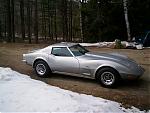
I use a PCV valve with an open baffle system going to a remote "puke tank" on my 7300RPM LT-1. I agree with with yellow 72 but, I plumbed my system using the old C2 Vette oil filler tube from the valley area to the carb. There is too much action going on in the rocker cover area to take the PCV feed from there, much more volume in the valley area. Without the PCV system, gas and water contaminate the oil quickly! Here is my system, not quite as clean as Yellow 72's but it works well for me will little fabrication required (I know the header is missing, I was welding an O2 bung on it and someone wanted to see my Accusump feed to the front oil galley so I quickly shot the photo for them.)
[IMG] [/IMG]
[Modified by Solid LT1, 3:49 PM 5/6/2004]
[IMG]
[/IMG] [Modified by Solid LT1, 3:49 PM 5/6/2004]
Racer

Joined: Feb 2004
Posts: 253
Likes: 0
From: Athol NY
Re: Valve cover-pvc- question (427V8)
The one thing I'm not a 100% on, the breather element (in aircleaner on my '73) gets oily, not dripping, but oily just the same. I very seldom have a WOT situation, so why is it dirty. I understand air moves opposite way during low manifold vacuum, but still.... :confused:
Corvette Stories
The Best of Corvette for Corvette Enthusiasts

Every 2027 Corvette Engine Explained
Joe Kucinski
Designer Imagines A Corvette That Looks More Like a Corvette Than the Corvette
Verdad Gallardo
10 Ugly Corvettes That We Still Kinda Love
Joe Kucinski
Top 10 Most Expensive Corvettes Ever Sold on Bring A Trailer
Brett Foote
10 Things Every Corvette Owner Needs (2026 Edition)
Michael S. Palmer
8 Most "Only Corvette Owners Understand" Quirks and Problems
Pouria Savadkouei
10 Reasons the C6 Z06 is Still A Performance Benchmark After 20 Years
Joe Kucinski
How Much Horsepower Every Corvette Engine "LOST" in 1972
Joe Kucinski
Top 10 DOs and DON'Ts for Protecting Your Convertible Top!
Michael S. Palmer
Race Director


Joined: Apr 2000
Posts: 17,676
Likes: 201
From: Who says "Nothing is impossible" ? I've been doing nothing for years.
Re: Valve cover-pvc- question (R 73 454)
I have never seen the PVC on the intake, I bet no one runs the PVC off the vaccum advance port on a Holley 4150 like I do though :lol:

Racer
Joined: Oct 2001
Posts: 271
Likes: 0
From: St Louis MO
Re: Valve cover-pvc- question (R 73 454)
Breather elements get oily or dirty. Some is oil, some dirty blowby gas from the crankcase. It will be REALLY oily if you have a ring problem.
My $0.02, Oil cap on one valve cover, baffled breather with hose to air cleaner on the other. Simple.
Gary
My $0.02, Oil cap on one valve cover, baffled breather with hose to air cleaner on the other. Simple.
Gary
Le Mans Master
Joined: Dec 2003
Posts: 5,727
Likes: 38
From: Fremont CA
Re: Valve cover-pvc- question (Garys '68)
Breather elements get oily or dirty. Some is oil, some dirty blowby gas from the crankcase. It will be REALLY oily if you have a ring problem.
My $0.02, Oil cap on one valve cover, baffled breather with hose to air cleaner on the other. Simple.
Gary
My $0.02, Oil cap on one valve cover, baffled breather with hose to air cleaner on the other. Simple.
Gary

Race Director


Joined: Nov 1999
Posts: 10,643
Likes: 8
From: Foxfield CO 1970 Convertible
Re: Valve cover-pvc- question (Solid LT1)
OK - I get to chime in with my experiences...
IMO:
- "Positive" in PCV means the crankcase is positive pressure due to blowby. You are venting the positive crankcase.
- The typical system installation is with one valve cover vented through a valve to the carb creating a source of low pressure to draw the air out of the crankcase. To increase efficiency there needs to be an intake provided somewhere. This is the reason for the inlet on the other valve cover. It helps if the air is filtered, so typically this intake line is through the air cleaner for convenience. So the path of the air is into one valve cover, through the crankcase via the oil drain holes, and out the other valve cover, where it enters the carb and is burned with the intake gas.
- All liquids have a vapor pressure, and at high temps, the air in the crankcase will contain oil vapor. So the air entering your engine intake will also contain oil vapor. If your PCV setup doesn't contain baffles, the oil may actually be droplets. The reason for the PCV mandate from the EPA is to keep this small amount of oil out of the atmosphere.
- I change oil often enough that there isn't a buildup of moisture or light hydrocarbons in my crankcase, however I could tell by sparkplug color that oil gets into the combustion chambers, however slight. I now run simple breathers. :)
IMO:
- "Positive" in PCV means the crankcase is positive pressure due to blowby. You are venting the positive crankcase.
- The typical system installation is with one valve cover vented through a valve to the carb creating a source of low pressure to draw the air out of the crankcase. To increase efficiency there needs to be an intake provided somewhere. This is the reason for the inlet on the other valve cover. It helps if the air is filtered, so typically this intake line is through the air cleaner for convenience. So the path of the air is into one valve cover, through the crankcase via the oil drain holes, and out the other valve cover, where it enters the carb and is burned with the intake gas.
- All liquids have a vapor pressure, and at high temps, the air in the crankcase will contain oil vapor. So the air entering your engine intake will also contain oil vapor. If your PCV setup doesn't contain baffles, the oil may actually be droplets. The reason for the PCV mandate from the EPA is to keep this small amount of oil out of the atmosphere.
- I change oil often enough that there isn't a buildup of moisture or light hydrocarbons in my crankcase, however I could tell by sparkplug color that oil gets into the combustion chambers, however slight. I now run simple breathers. :)


Thread Starter
Racer
Joined: Oct 2003
Posts: 376
Likes: 0
From: NE PA PA
Re: Valve cover-pvc- question (markdtn)
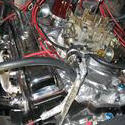
It looks like I started quite a conversation here. Thanks , great stuff. I got and installed the billet breather and billet pvc valve cover devise(cross flags) looks great. There was a port on the rear bottom of the demon. I also replaced the fuel line from pump to carb. (wrong thing to do). Mothers day, The wife takes the 78 and me in the 75. She made it only one mile and the 78 died. Wrong fuel line, I need the S-line, The one I installed closed off on the bend. :withstupid:
Le Mans Master
Joined: Oct 2002
Posts: 7,098
Likes: 378
From: Las Vegas - Just stop perpetuating myths please.
Re: Valve cover-pvc- question (Freepop)
Cardo0 said: When vacuum is low while engine speed/load is high a spring forces PVC to open more to remove more of the blow-by gasses. Once the engine is stopped/no vacuum the spring forces the PVC fully shut.
sorry but the spring can't push both ways, I call :bs :_dupe:
sorry but the spring can't push both ways, I call :bs :_dupe:
