





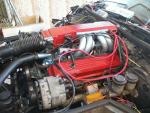







Superram or a first TPI intake

Melting Slicks


Joined: Sep 2010
Posts: 2,422
Likes: 202

the first TPI is pretty rockin... the TPIS is a modified copy... I still prefer the HSR
but you will have rails, regulator and hooking up fuel lines and vacuum on any aftermarket
and if you install these system on you will need a cam to match the new RPM range and a TUNE
PS if your state requires emissions a EGR setup is required
but you will have rails, regulator and hooking up fuel lines and vacuum on any aftermarket
and if you install these system on you will need a cam to match the new RPM range and a TUNE
PS if your state requires emissions a EGR setup is required

Race Director


Joined: Nov 2003
Posts: 12,221
Likes: 446
From: Overland Park Kansas
2020 Corvette of the Year Finalist (appearance mods)
C4 of Year Winner (appearance mods) 2019
Which would make the Superram the better choice. OTOH, the FIRST does have provisions for EGR but the hook-up would need to be fabricated.
FWIW, I wouldn't be afraid to try AFR195s with a factory cam and a FIRST. The heads would provide extra breathing with superior mid-lift numbers and the cam would still be reasonably close to the larger TPI setup. Tubes close enough to the same length.
A FIRST or SR by themselves aren't something to snub (w/o cam/heads) if the right price came along.
But the SR has to get the edge if fabrication is an issue.
As far as powerbands, they have to be pretty darn close. FIRST might have a bit more down low and visa-versa.
FWIW, I wouldn't be afraid to try AFR195s with a factory cam and a FIRST. The heads would provide extra breathing with superior mid-lift numbers and the cam would still be reasonably close to the larger TPI setup. Tubes close enough to the same length.
A FIRST or SR by themselves aren't something to snub (w/o cam/heads) if the right price came along.
But the SR has to get the edge if fabrication is an issue.
As far as powerbands, they have to be pretty darn close. FIRST might have a bit more down low and visa-versa.
Corvette Stories
The Best of Corvette for Corvette Enthusiasts

Top 10 Most Explosive Corvettes Ever Made: Power-to-Weight Ratio Ranked!
Joe Kucinski
150 hp to 1,250 hp: Every Corvette Generation Compared by the Specs That Matter
Joe Kucinski
8 Coolest Corvette Pace Cars (and Replicas) of All Time
Verdad Gallardo
Top 10 Corvette Engines RANKED by Peak Torque (70+ Years of Muscle!)
Joe Kucinski
Corvette ZR1X Will Be Pacing the Indy 500, And Could Probably Race, Too!
Verdad Gallardo
Top 10 Corvettes Coming to Mecum Indy 2026!
Brett Foote
Top 10 C9 Corvette MUST-HAVES to Fix These C8 Generation Flaws!
Michael S. Palmer
10 Revolutionary 'Corvette Firsts' Most People Don't Know
Joe Kucinski
5 Reasons to Upgrade to an LS6-Powered Corvette; 5 Reasons to Stay LT2
Michael S. Palmer


Tech Contributor
Joined: Oct 2008
Posts: 3,729
Likes: 190
From: Custer, WI
I'd like to see someone port a FIRST. Thing would flow some serious air. I have no idea about "3rd wave tuning" or any of that other stuff i've read about on TGO. Confusees the hell out of me.

Melting Slicks
Joined: Nov 2008
Posts: 2,765
Likes: 5
Tuned for an optimal RPM operating powerband.
Brian
Race Director
Joined: Nov 2003
Posts: 12,221
Likes: 446
From: Overland Park Kansas
2020 Corvette of the Year Finalist (appearance mods)
C4 of Year Winner (appearance mods) 2019
The how, when, where's of that reversion creates an extra pressurization against incoming air. It's called wave tuning. Engines operate in pulses -- which create pressure waves. Tuning for those waves (with runner length, cam events, and/or exhaust shape) will directly affect peak power production.
Also google, David Vizzard's "Exhaust Science". Great article which explains exhaust tuning. Knowing about both intake/exhaust tuning can help create a better build.
I can't wait to read about it!
Last edited by GREGGPENN; Jul 8, 2011 at 01:13 AM.
Tech Contributor
Joined: Oct 2008
Posts: 3,729
Likes: 190
From: Custer, WI
You should read about intake reversion. It's not rocket science. Since cam lobes are oval, they can't open/close like a light switch. That process is more gradual. Because of that, valves are left open BEYOND when a cylinder reaches the bottom of it's intake stroke. As it goes back up, the valve finally closes. But, not before air "reverts" back up into the intake.
The how, when, where's of that reversion creates an extra pressurization against incoming air. It's called wave tuning. Engines operate in pulses -- which create pressure waves. Tuning for those waves (with runner length, cam events, and/or exhaust shape) will directly affect peak power production.
Also google, David Vizzard's "Exhaust Science". Great article which explains exhaust tuning. Knowing about both intake/exhaust tuning can help create a better build.
I would too. I know of two people who started down that road. As with others affected by this economy, they've gotten delayed. But, they're out there and will post about it one day.
I can't wait to read about it!
The how, when, where's of that reversion creates an extra pressurization against incoming air. It's called wave tuning. Engines operate in pulses -- which create pressure waves. Tuning for those waves (with runner length, cam events, and/or exhaust shape) will directly affect peak power production.
Also google, David Vizzard's "Exhaust Science". Great article which explains exhaust tuning. Knowing about both intake/exhaust tuning can help create a better build.
I would too. I know of two people who started down that road. As with others affected by this economy, they've gotten delayed. But, they're out there and will post about it one day.
I can't wait to read about it!
As usual, someone comes through with an answer.

I'd like to read about it too. Imagine the torque.

Melting Slicks
Joined: Nov 2008
Posts: 2,765
Likes: 5
You should read about intake reversion. It's not rocket science. Since cam lobes are oval, they can't open/close like a light switch. That process is more gradual. Because of that, valves are left open BEYOND when a cylinder reaches the bottom of it's intake stroke. As it goes back up, the valve finally closes. But, not before air "reverts" back up into the intake.
The how, when, where's of that reversion creates an extra pressurization against incoming air. It's called wave tuning. Engines operate in pulses -- which create pressure waves. Tuning for those waves (with runner length, cam events, and/or exhaust shape) will directly affect peak power production.
Also google, David Vizzard's "Exhaust Science". Great article which explains exhaust tuning. Knowing about both intake/exhaust tuning can help create a better build.
I would too. I know of two people who started down that road. As with others affected by this economy, they've gotten delayed. But, they're out there and will post about it one day.
I can't wait to read about it!
The how, when, where's of that reversion creates an extra pressurization against incoming air. It's called wave tuning. Engines operate in pulses -- which create pressure waves. Tuning for those waves (with runner length, cam events, and/or exhaust shape) will directly affect peak power production.
Also google, David Vizzard's "Exhaust Science". Great article which explains exhaust tuning. Knowing about both intake/exhaust tuning can help create a better build.
I would too. I know of two people who started down that road. As with others affected by this economy, they've gotten delayed. But, they're out there and will post about it one day.
I can't wait to read about it!
But it also works in a total vacuum too.
"Particle Movement" is a better method of understanding.
BR
Race Director
Joined: Nov 2003
Posts: 12,221
Likes: 446
From: Overland Park Kansas
2020 Corvette of the Year Finalist (appearance mods)
C4 of Year Winner (appearance mods) 2019
Melting Slicks
Joined: Nov 2008
Posts: 2,765
Likes: 5
Yes,
LOL.
It won't run without Oxygen in the air.
I have brought this up before,
Too hard to explain easily on C4.
I know that a few have read on their own in the past on "Finate Amlpitude waves.
You have used them to your benefit in your 383 build in your 1989 C4 Coupe too,
Possibly without knowing so Greg.
Those invisible waves inside of a running 4- stroke engine are 10,000 times more powerful than it takes in audible sound wave pressures to blow a human ear drum out.
Done right,
It draws more air in or more importantly Oxygen to mix with gasoline or alcohol fuel.
End result is more Torque, HP. & wider operating RPM powerband.
I had a good teacher Greg on engines & all aspects of auto & truck repair.
1 on 1 for 20 some years.
Brian
LOL.
It won't run without Oxygen in the air.
I have brought this up before,
Too hard to explain easily on C4.
I know that a few have read on their own in the past on "Finate Amlpitude waves.
You have used them to your benefit in your 383 build in your 1989 C4 Coupe too,
Possibly without knowing so Greg.
Those invisible waves inside of a running 4- stroke engine are 10,000 times more powerful than it takes in audible sound wave pressures to blow a human ear drum out.
Done right,
It draws more air in or more importantly Oxygen to mix with gasoline or alcohol fuel.
End result is more Torque, HP. & wider operating RPM powerband.
I had a good teacher Greg on engines & all aspects of auto & truck repair.
1 on 1 for 20 some years.
Brian
Race Director
Joined: Nov 2003
Posts: 12,221
Likes: 446
From: Overland Park Kansas
2020 Corvette of the Year Finalist (appearance mods)
C4 of Year Winner (appearance mods) 2019

Sometimes, you ramble and avoid answers. This is one of those times.
Race Director
Joined: Nov 2003
Posts: 12,221
Likes: 446
From: Overland Park Kansas
2020 Corvette of the Year Finalist (appearance mods)
C4 of Year Winner (appearance mods) 2019
There wasn't much I did in my 383 build without understanding the consequence/result.

Racer

Joined: Oct 2007
Posts: 478
Likes: 1
"89TA whats your opnion of a worked over SR and FIRST as far as behavior/powerband? "
Hi Ron
As far as power band and the rpm range we generally use the Super Ram is geared towards the 3rd harmonic wave. The First with the longer runners is geared towards the 2nd harmonic wave.
IMHO the behavior will depend on the build of the motor such as cam choice, cubic inches, compression etc.
As you know I am currently working on a long tube runner design using the Accel Super Ram base extensively modified. I had Dr J do a preliminary flow on the base only and when he was done with his part of the work. With a small radius on the inlet it flowed 335cfm. With a larger radius on the inlet it flowed 345 cfm.
I had planned on going over to Joe Shermans today and flow the base, runners and plenum attached. However Joe was doing a dyno test and I will have re-schedule an appointment. Another thought is to get with Tony Mamo and flow the whole thing attached to an AFR 195 Competition head.
Back to the First. The base has a lot of material and can be ported quite extensively and up to a Felpro 1207 intake gasket. IMHO the restriction would be the runners once you go so big. How do you get in there and open them up all the way? I think you could go to a 1.90" diameter on the runners if one could get in there all the way. The inlet on the base will go to 2" easy enough.
On the Super Ram we have gone out to 1.8" on the runners but that includes welding and spacers in order to use longer bolts.
Hi Ron
As far as power band and the rpm range we generally use the Super Ram is geared towards the 3rd harmonic wave. The First with the longer runners is geared towards the 2nd harmonic wave.
IMHO the behavior will depend on the build of the motor such as cam choice, cubic inches, compression etc.
As you know I am currently working on a long tube runner design using the Accel Super Ram base extensively modified. I had Dr J do a preliminary flow on the base only and when he was done with his part of the work. With a small radius on the inlet it flowed 335cfm. With a larger radius on the inlet it flowed 345 cfm.
I had planned on going over to Joe Shermans today and flow the base, runners and plenum attached. However Joe was doing a dyno test and I will have re-schedule an appointment. Another thought is to get with Tony Mamo and flow the whole thing attached to an AFR 195 Competition head.
Back to the First. The base has a lot of material and can be ported quite extensively and up to a Felpro 1207 intake gasket. IMHO the restriction would be the runners once you go so big. How do you get in there and open them up all the way? I think you could go to a 1.90" diameter on the runners if one could get in there all the way. The inlet on the base will go to 2" easy enough.
On the Super Ram we have gone out to 1.8" on the runners but that includes welding and spacers in order to use longer bolts.

