When you click on links to various merchants on this site and make a purchase, this can result in this site earning a commission. Affiliate programs and affiliations include, but are not limited to, the eBay Partner Network.
I just bought an aluminum flywheel made by Fidanza for a 1991 l98 tpi. Can anyone tell how did they balance it? I went to a shop and they think match balance doesn’t work, they only accept balancing it on the crancksaft which is obviously better but in the service manual it says if you buy an oem one you only fill the required holes with weights and it should be acceptable. I have measured the volume on the stock flywheel and it’s should be about 150g. I span it on a drill with a 150g and it seems ok, without the weight it wobbles. But the fidanza has a larger weight about 200g (I can weight it later by removing it). My plan is to trim that to 150g then to fill 2 holes (which I have to drill) in the same position as on the stock flywheel (plus the weight of the holes in aluminum density). If it doesn’t work I can adjust the weight after spinning the engine otherwise I’ll just put the stock one back which looks ok and is in spec. At 130k miles it may have been previously replaced but I don’t know
thanks
PS. the measured weight for the aluminum FW weight is 186g , the bolt holes removed 3g so 189 total. I’m static balancing now with the axis on top of a ball. With the weights removed the FW only needs a few grams to stay balanced.
Update: I thought of this a bit more and I think I know why the shop refused to do a match balance. The balance tool they have is for regular flywheels that can be dynamically balance together with the clutch pressure plate to ensure a very smooth spin. But if you place two flywheels on the same axle with the counterweights at 180 deg and try to dynamically balance them the machine will ask you to counterweight the stock wheel as well because it takes into account where the weights are along the spin axis so dynamic balance doesn’t make sense for these. So my plan is to buy a motorcycle wheel balance stand and put both flywheels on it and work on the new one until they are balanced.
Update:
I have built a stand for balancing. It can be used with ball bearings or directly with the shaft on the rails but I was in a hurry and couldn’t align the stand properly so I have used ball bearings. The bearings have a bit more resistance and it’s more difficult to find fine imbalances. Hopefully it will be fine.
Last edited by Nilak; Apr 18, 2022 at 01:29 PM.
Reason: update
I’ve got the car from garage and drove it home. I like how the lightweight flywheel feels with faster rev ups. It’s a bit harder to start off from standstill, if you want to get moving quickly up to 2000rpm is enough or you can keep it around 1500 and gently engage the clutch and you will go, no problems. Anyway this depends on what type of clutch disc you have. I’ve installed an organic clutch rated stage 2 which is slightly more aggressive than a normal clutch.
Now obviously the important part is whether the flywheel which balances the shaft does it’s job well or not. Well, I’m not ver sure. Up to 3500rpm it feels well, it passes the coin test, but between 4000-5500rpm there is some vibration. Not sure if it’s from the flywheel, it could be. The fact is you have one weight on the flywheel and one on the crankshaft at 180deg but since they are not on the same rotational plane they will produce a torque that wants to bend the shaft and this can’t be canceled unless you balance the shaft internally. The vibration is noticeable in neutral (above 4000-4500rpm), while driving it’s harder to observe. When I matched balanced the FW, I took a bit from the balance weight about 16g and remove a bolt from one side. Now it has two bolts instead of 3. This reduced the weight to 158g. I also had to drill some holes at some angle (the side where I removed the bolt from) in relation the balance weight like 40 deg. But I was in a hurry because the guys from the garage had their elevator occupied with my car for much longer than they expected and I didn’t have enough time. It may need a bit of tuning of the weight. Anyway this can be done by removing the starter and oil filter then you remove the flywheel cover and have access to the FW to balance it further. After removing the cover you put the filter and the starter back and start working with trial weights. I’ll probably do this at the next oil change.
There are vibration analyzers that can be used I think but they are normally for electric motors.
I’ve done some measurements on the flywheel and here is a screenshot
the upper waveform is the reading from the accelerometer and the negative peak is where the flywheels pushes down and the lower waveform has positive pulses that indicate a reflective sticker on the flywheel which I’ve placed 180degrees relative to the factory balance weight on the flywheel.
By looking at the top waveform you can see secondary waves, maybe from the individual cylinders then a major wave with the peak close to the mark and negative peak close to the factory balance weight, but seems a bit before. It’s also possible that the waveform is a few ms behind the optical signal. I’ve tested the accelerometer and the wave gets a phase-shift depending on how you press it against the rotating assembly you want to measure. When I did the static balancing I’ve found the same imbalance, slightly offset from the factory weight like 30degrees.
At idle the major wave is not present and you can only see the secondary waves.
After 3000rpm it becomes noticeable and the waves add up.
In this snapshot we see ~3500rpm and the vibration is double compared to a perfectly ballance engine (that would be with only the secondary waves present).
Next I will place some balance weights to see how it changes. I’ll try 16grams at 180- 25=155degrees.
The problem is I have sticker weigts for wheels which may fall off and damage the case. If the FW is cold they should not fall off during testing. They can be placed on the inner rim so the centrifugal force locks them in place. Over time or at high temperature they may fall so I wouldn’t trust them as a permanent solution.
The late L98 and LT1 type SBC has a 1 piece crank seal, is internally balanced BUT that means the front balancer is zero AND rear requires a flywheel with a balance weight (or matched balanced GM flywheel which has a molded in weight). I have a Chevrolet Performance 350 ZZ4 HO Short Block Assembly and there is an specification guide for the Crankshaft - Part# 12670965 Forged 1053 Steel, Internally Balanced... so what does that mean... So much BS and conflicting information so I called up McCloud and asked also... and GM specifies what GM flywheel needs to be added (if you look at those they have a cast in weight)... further research shows that the standard balance is 23.4 oz/in.
Fidanza Billet Aluminum Flywheel 198501, zero balanced the flywheel at a balance shop (it was close to zero) and the weight kit (calculater 5.2oz @ 4.50" and I trimmed the weight to get exactly 5.2oz including hardware, minus the small screw that was installed when zero balancing at the shop)... for 23.4 oz/in balance goal (kit 337775) -- Summit sells the kit, looks similar to yours. This is what I did, and made notes to help someone else. Worked perfect.
Before installing the SMFW I installed the balance weight supplied by Fidanza. It was over 180g and I trimmed it to about 170g by cutting it and removing a bolt. Static balancing was showing I should trim it more but I didn’t have time when I did it.
Last night I added 32g on the opposite side and got this waveform:
Now the flywheel wave it looks almost flat so very little imbalance and feels smoother.
next I’ll remove the balance weight and trim it down by 32g. and chech if it’s close to 5.2oz. if it’s lighter than I’ll first try 5.2oz.
unfortunately I had to let the sticker weights on for the 2miles return home and I heard 2 bangs, probably from my car, they probably flew off and hit the bell housing 😳 , no idea if any damage idk 🤷♂️ at 3000rpm they would go about 100mph 7J energy, so it is something…
Thanks
PS
btw AZSP33D
In my op I estimated 150g on the stock flywheel which is close to the 5.2oz you mentioned
but they (center of mass of the weight) are at slightly different distance from the center that’s one of the reasons I didn’t trim it enough.
I though the counterweight flew off when I heard that sound on the window but it was something else. I drove the car today for 3km through heavy traffic, took me 20 min, then when I raised the car on jack stands and checked the flywheel, the weights were still there.
here are the plots:
this one is at 4000rpm with 32g counterweight 180deg to the factory counterweight
the second picture: no weight at 180deg, you can see a major wave in sync with the crankshaft.
third picture: 5000rpm and 32g @180deg
forth picture: 5000rpm and 40g @180deg
I see a small difference between 32 and 40g and both look good, the major wave is hard to distinguish so I think either option is acceptable, also when I hold my hand on the stick shifter at 5000rpm it feel alright. Wave patters with the clutch engaged looks similar(I didn’t take a picture of that). With the 40g it seems the major wave starts to develop in the other direction so I will try something in between - 36g. Anyway the FW should be off by less than 8g from a perfect balance which is acceptable especially on a low reving engine. Next time I’ll remove the sticking counterweights and trim down the factory (the aluminum FW) weight by 36g.
PS.
😳
Turns out the balance sticking weights were 5g not 8g so i should’ve trimmed 23-25g not 40. Which is much closer to the standard weight of 5.2oz.
Now I need to add back ~15g. I can put one bolt back which weights 8g but to add another 7g I would need to drill and tap another hole and insert another bolt or something else.
I thought of applying 7ml (7grams) of rtv silicone on the inner lip of the F/W, it’s temperature resistant and I don’t think it will ever fall off.



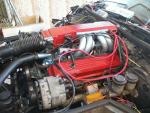







 single mass flywheel





 at 3000rpm they would go about 100mph 7J energy, so it is something…












