


Corvette Generation Question



1/4 mile/AutoX


Joined: Jun 2014
Posts: 11,440
Likes: 2,184
From: Buffalo Texas

Originally Posted by Ambalanche View Post
I could be wrong but I thought the "C" designations began with the C5 and reverted back from there.
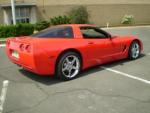
- prior to that, i remember solid axles, mid-years, and late models. when the 84's came out, 68-82's became known as "sharks", and the 84 generation were late models, then in 97, corvettes became c5's, and since then, the C-generation thing took over. i still refer to early corvettes as solid axles, mid-years, and sharks - later corvettes as C4's, C5's and C6's.
Last edited by Pounder; Dec 22, 2015 at 02:16 PM.



Safety Car

Joined: Dec 2010
Posts: 3,938
Likes: 498
From: Fords, NJ
Second Y platform (1984–present)
Chevrolet Corvette C6 Z06
Y bodies built after 1964 can be identified by the inclusion of the Y as the fourth character in the Vehicle Identification Number, or VIN. Only two Y-body cars have been produced in this second group:
2004–2009 Cadillac XLR
1984–present Chevrolet Corvette
The Y-Body has a rear-wheel drive, front-engined V8 layout, accommodating either a small block Chevrolet V8 (such as an LT4 or LS1) in the Corvette, or the 32-valve DOHC Northstar V8 in the XLR. The Y-Body also has 4-wheel independent suspension. Like a standard rear-wheel drive, front-engined chassis, the Y-Body's V8 engine is longitudinally mounted, but unlike many such cars, the Y-Body incorporates a rear-mounted transaxle (1997-present) instead of a transmission mounted directly to the engine. Power is transferred to the transaxle via a torque tube. The transaxle is offered in both 6-speed automatic and 6-speed manual versions. As of 2015 the Y platform is considered as the sole perimeter frame automobile in production (the perimeter frame has an integrated endoskeleton which serves as a safety cage).
GM's Kappa platform was inspired by the Y-body. The distinctive feature of both platforms is the backbone central-tunnel design.
Chevrolet Corvette C6 Z06
Y bodies built after 1964 can be identified by the inclusion of the Y as the fourth character in the Vehicle Identification Number, or VIN. Only two Y-body cars have been produced in this second group:
2004–2009 Cadillac XLR
1984–present Chevrolet Corvette
The Y-Body has a rear-wheel drive, front-engined V8 layout, accommodating either a small block Chevrolet V8 (such as an LT4 or LS1) in the Corvette, or the 32-valve DOHC Northstar V8 in the XLR. The Y-Body also has 4-wheel independent suspension. Like a standard rear-wheel drive, front-engined chassis, the Y-Body's V8 engine is longitudinally mounted, but unlike many such cars, the Y-Body incorporates a rear-mounted transaxle (1997-present) instead of a transmission mounted directly to the engine. Power is transferred to the transaxle via a torque tube. The transaxle is offered in both 6-speed automatic and 6-speed manual versions. As of 2015 the Y platform is considered as the sole perimeter frame automobile in production (the perimeter frame has an integrated endoskeleton which serves as a safety cage).
GM's Kappa platform was inspired by the Y-body. The distinctive feature of both platforms is the backbone central-tunnel design.
Drifting


Joined: Jun 2000
Posts: 1,340
Likes: 233
From: Placitas NM
St. Jude Contributor '03 & '04

Melting Slicks


Joined: Dec 2000
Posts: 3,280
Likes: 1,097
From: Pittsburgh PA
If i can remember right, It did start with the C5. When i first ordered my car in September of 97 I tried to get my hands on any and all information i could find. I wish i could remember where i read that the C5 designation was for the platform that the new 97 sat on.









