



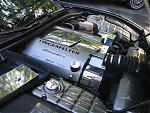





Oil catch can in 2000 Vert

Thread Starter
Drifting


Joined: Apr 2008
Posts: 1,510
Likes: 15
From: Ga
 Oil catch can in 2000 Vert
Hey all:
I installed an oil catch can in my 2000 vert today. It was pretty easy to do. Just remember, PCV into the top of the can, hose from the intake into the side of the can.


Just for kicks here is my moded engine bay:


I installed an oil catch can in my 2000 vert today. It was pretty easy to do. Just remember, PCV into the top of the can, hose from the intake into the side of the can.
Just for kicks here is my moded engine bay:
Last edited by Daddyrama31; Aug 13, 2008 at 08:54 PM.

Burning Brakes


Joined: Oct 2004
Posts: 931
Likes: 35
From: Rowlett, Texas
Daddy, let me know if you catch much oil. I installed one of the cans sold here on the Forum, and it caught almost no oil (maybe 1 ounce in 3K miles). But I don't track the car, or drive it in the high rev range all the time.
And to make it worse, the can oozed oil out the bottom o-ring. The vendor replaced it, and the new one oozed also! So, off it came.
From what I read here, I believe that most of the oil in the intakes of cars like mine that aren't tracked or driven too hard, comes thru the breather hose in front of the throttle blade, when we stomp the gas and lower the intake vacuum. This reverses the PCV flow, and the airflow thru the intake bellows pulls the oil from the valvecover area.
DG
And to make it worse, the can oozed oil out the bottom o-ring. The vendor replaced it, and the new one oozed also! So, off it came.
From what I read here, I believe that most of the oil in the intakes of cars like mine that aren't tracked or driven too hard, comes thru the breather hose in front of the throttle blade, when we stomp the gas and lower the intake vacuum. This reverses the PCV flow, and the airflow thru the intake bellows pulls the oil from the valvecover area.
DG

Le Mans Master


Joined: Mar 2002
Posts: 8,466
Likes: 51
St. Jude Donor '17
Daddy, let me know if you catch much oil. I installed one of the cans sold here on the Forum, and it caught almost no oil (maybe 1 ounce in 3K miles). But I don't track the car, or drive it in the high rev range all the time.
And to make it worse, the can oozed oil out the bottom o-ring. The vendor replaced it, and the new one oozed also! So, off it came.
From what I read here, I believe that most of the oil in the intakes of cars like mine that aren't tracked or driven too hard, comes thru the breather hose in front of the throttle blade, when we stomp the gas and lower the intake vacuum. This reverses the PCV flow, and the airflow thru the intake bellows pulls the oil from the valvecover area.
DG
And to make it worse, the can oozed oil out the bottom o-ring. The vendor replaced it, and the new one oozed also! So, off it came.
From what I read here, I believe that most of the oil in the intakes of cars like mine that aren't tracked or driven too hard, comes thru the breather hose in front of the throttle blade, when we stomp the gas and lower the intake vacuum. This reverses the PCV flow, and the airflow thru the intake bellows pulls the oil from the valvecover area.
DG
 u called him daddy

Race Director

Joined: Dec 2000
Posts: 19,304
Likes: 85
From: San Diego CA
Most catch cans act as filters to catch oil that is inherently part of blowby gases that travel past the PCV valve and into the intake. Since the main purpose of the filter and in many cases, the can itself, is to get the airborn oil to coalesce, it makes sense to keep the catch can cooler than the blowby gas temperature. Unfortunately, many catch cans are mounted very close to the engine, guaranteeing that some airborn oil will pass through and into the intake.
Oil in the intake leads to carbon buildup on the pistons which over time, can raise the compression ratio above the piston. Higher compression ratios require higher octane, without which results in pinging and intervention by the ECU to eliminate this condition - bottom line: a loss of power.
Of course, it gets even more complicated when varying throttle positions change the pressure characteristics of the blowby gases, but as a general rule, keeping oil out of the intake can only be a good thing.
Oil in the intake leads to carbon buildup on the pistons which over time, can raise the compression ratio above the piston. Higher compression ratios require higher octane, without which results in pinging and intervention by the ECU to eliminate this condition - bottom line: a loss of power.
Of course, it gets even more complicated when varying throttle positions change the pressure characteristics of the blowby gases, but as a general rule, keeping oil out of the intake can only be a good thing.

Drifting
Joined: Feb 2007
Posts: 1,993
Likes: 7
From: LaPine Oregon
Oil/air seperator
Think of the OCC ( oil catch can/tank) as an water/oil/air seperator. GM designed PVC baffles are ineffective to the volume of oil vapor that is moving thru the PVC system at high engine speed and low MAP ( absolulte manifold pressure) This was never more evident than that of LS6 valley pan baffle. The LS2 isn't much better.
Dave68 , I and others have said over and over that the effectiveness of any OCC has many variables. Not all OCC's are created equal. Most are just empty cans with an inlet and outlet, nothing to hold or seperate the moisture and oil from the air. Those that have a small amount of material to aid condensation ( SST mesh or non metallic fiber) don't trap contaminates. The designed mounting location is for convience as the location is a direct source of heat which defeats the function ( condensation ) of the can. Ifthat mounting location is going to be used , may i suggest using an insulator between the head and mounting bracket ( a heat resistant polymer plastic) and a heat shroud (SST or aluminum) to deflect direct heat from exhaust and head.
With the effects of oil blow by and crankcase gases returning to the combustion chamber thru an ineffective PVC system, I use two Mike Norris OCCs that are modified with seperator filter (Wilkerson) and coalescing filter (Binks) that are mounted low on the radiator support. Two reasons for this , cooler location and the feed and return lines offer a drain back .
The effects of oil entering the combustion chamber , carbonizing everything ; valves , pistons, rings, cylinder head, ect . The altered fuel /air mixture i.e. reduced power, ect. The probable failures of the MAFS, O2 sensors, Cats. Possibly not passing emissions tests for any numbers of the effects listed. Any thing that will optimize the reduction of oil consumption is a plus in reliability, performance.
Dave68 , I and others have said over and over that the effectiveness of any OCC has many variables. Not all OCC's are created equal. Most are just empty cans with an inlet and outlet, nothing to hold or seperate the moisture and oil from the air. Those that have a small amount of material to aid condensation ( SST mesh or non metallic fiber) don't trap contaminates. The designed mounting location is for convience as the location is a direct source of heat which defeats the function ( condensation ) of the can. Ifthat mounting location is going to be used , may i suggest using an insulator between the head and mounting bracket ( a heat resistant polymer plastic) and a heat shroud (SST or aluminum) to deflect direct heat from exhaust and head.
With the effects of oil blow by and crankcase gases returning to the combustion chamber thru an ineffective PVC system, I use two Mike Norris OCCs that are modified with seperator filter (Wilkerson) and coalescing filter (Binks) that are mounted low on the radiator support. Two reasons for this , cooler location and the feed and return lines offer a drain back .
The effects of oil entering the combustion chamber , carbonizing everything ; valves , pistons, rings, cylinder head, ect . The altered fuel /air mixture i.e. reduced power, ect. The probable failures of the MAFS, O2 sensors, Cats. Possibly not passing emissions tests for any numbers of the effects listed. Any thing that will optimize the reduction of oil consumption is a plus in reliability, performance.
Last edited by dieseldave56; Aug 17, 2008 at 07:56 AM.
Corvette Stories
The Best of Corvette for Corvette Enthusiasts

Every 2027 Corvette Engine Explained
Joe Kucinski
Designer Imagines A Corvette That Looks More Like a Corvette Than the Corvette
Verdad Gallardo
10 Ugly Corvettes That We Still Kinda Love
Joe Kucinski
Top 10 Most Expensive Corvettes Ever Sold on Bring A Trailer
Brett Foote
10 Things Every Corvette Owner Needs (2026 Edition)
Michael S. Palmer
8 Most "Only Corvette Owners Understand" Quirks and Problems
Pouria Savadkouei
10 Reasons the C6 Z06 is Still A Performance Benchmark After 20 Years
Joe Kucinski
How Much Horsepower Every Corvette Engine "LOST" in 1972
Joe Kucinski
Top 10 DOs and DON'Ts for Protecting Your Convertible Top!
Michael S. Palmer
Drifting
Joined: Feb 2007
Posts: 1,993
Likes: 7
From: LaPine Oregon
The ozze.
Daddy, let me know if you catch much oil. I installed one of the cans sold here on the Forum, and it caught almost no oil (maybe 1 ounce in 3K miles). But I don't track the car, or drive it in the high rev range all the time.
And to make it worse, the can oozed oil out the bottom o-ring. The vendor replaced it, and the new one oozed also! So, off it came.
From what I read here, I believe that most of the oil in the intakes of cars like mine that aren't tracked or driven too hard, comes thru the breather hose in front of the throttle blade, when we stomp the gas and lower the intake vacuum. This reverses the PCV flow, and the airflow thru the intake bellows pulls the oil from the valvecover area.
DG
And to make it worse, the can oozed oil out the bottom o-ring. The vendor replaced it, and the new one oozed also! So, off it came.
From what I read here, I believe that most of the oil in the intakes of cars like mine that aren't tracked or driven too hard, comes thru the breather hose in front of the throttle blade, when we stomp the gas and lower the intake vacuum. This reverses the PCV flow, and the airflow thru the intake bellows pulls the oil from the valvecover area.
DG
Burning Brakes
Joined: Oct 2004
Posts: 931
Likes: 35
From: Rowlett, Texas
Yeah, I probably need to address this issue again. Even though I don't drive my car very hard, it can't be good to have 3 ounces of oil drip out of the intake manifold while it's lying on the workbench.
Who's your Daddy??????
DG
Who's your Daddy??????
DG
