


C5 X-Pipe

Thread Starter
2nd Gear

Joined: Dec 2009
Posts: 2
Likes: 0
 C5 X-Pipe
I have a 2004 C5 LS1. I am an Old School muscle car mechanic trying to learn to work on th enew stuff. I am looking at what I can do to increase Horse Power outside the engine. I have read I can modify the Air Intake, Install Long Tube Headers, install a True X-pipe, modify the rear exhaust(Cat Back?), install a different Chip and then have it Dyno Tuned. Am I on the right path? Does an X-pipe do anything for performance? I am putting together a plan of attack. Any insight would be greatly appreciated.
thanks, john
thanks, john

Drifting


Joined: Jul 2002
Posts: 1,484
Likes: 0
From: Morgan Hill Ca.
Close, Forget the chip thing, just take it to a good dyno tuner. You need to get in there and change some stuff. Long tubes, yes! I recommend the high flow cats as well. Intake, yes! Cleanup the MAF while you are at it. Not sure which intake manifold you have on the 2004, I assume LS1. A good cheap adder is going to the LS6 intake manifold. Some small stuff is the Throttle body coolant bypass (not much there but???
I am an old schooler myself, been with the new stuff since I bought my 98 in 98. I am up to doing my own computer tunes with HP tuner software! Takes some time to learn but really neat stuff!
I am an old schooler myself, been with the new stuff since I bought my 98 in 98. I am up to doing my own computer tunes with HP tuner software! Takes some time to learn but really neat stuff!

Le Mans Master

Joined: May 2006
Posts: 5,987
Likes: 18
From: DuBois PA
St. Jude Donor '11-'12-'13-'14-'15
I was recently invovled in a new exhaust system design and we played around with the location of the "X"... the Closer to the Colelctors we put it the better the system performed over all. The theory was that it aided in scavenging as all 8 primaries were merging while the pulses were still pretty hot and flowing at close to peak velocity.
As I recall low end Torque was enhanced... I say enhanced because I don't remember any numbers!
As I recall low end Torque was enhanced... I say enhanced because I don't remember any numbers!

Safety Car


Joined: Oct 2000
Posts: 4,949
Likes: 10
From: Monticello MN
I was recently invovled in a new exhaust system design and we played around with the location of the "X"... the Closer to the Colelctors we put it the better the system performed over all. The theory was that it aided in scavenging as all 8 primaries were merging while the pulses were still pretty hot and flowing at close to peak velocity.
As I recall low end Torque was enhanced... I say enhanced because I don't remember any numbers!
As I recall low end Torque was enhanced... I say enhanced because I don't remember any numbers!
They discussed how an X-pipe works, then ran a car on a dyno, and the strip with:
1) open headers
2) mufflers & pipes w/o a crossover
3) mufflers and pipes with an H-pipe
4) mufflers and pipes with an X-pipe.
These are the results:
a) Test Vehicle / 1970 Olds 4-4-2 w/350 block and modified
b) Where first seen / NASCAR guys began using X-pipes
c) X-pipe design theory - "By running the two exhaust pipes together in this fashion, the alternating pulses in each bank can work to create the same type of scavenging action in the other."
d) Works best on a V8 engine running 300-500 hp because the volumetric efficiency is not as great as on a 700-800 hp V8 engine.
e) Dyno pulls:
1) Open header
430 hp @6850 rpm, 384 lb-ft @5600 rpm
2) 3" exhaust pipes w/Straightline mufflers and no crossover
412 hp @6650 rpm, 371 lb-ft @5600 rpm
3) Same setup as #2 except with an H-pipe
419 hp @6600 rpm, 378 lb-ft @5600 rpm
4) Same setup as #2 except with an X-pipe
428 hp @6600 rpm, 391 lb-ft @5600 rpm
Strip tests:
1) Open header
1.65 sec 60', 10.885 sec @123.89 mph
2) No run with the exhaust system w/o a crossover
3) Exhaust system w/Straightlines and full pipes and an H-pipe
1.55 sec 60', 11.007 sec @121.33 mph
4) Exhaust system w/Straightlines and full pipes and an X-pipe
1.62 sec 60', 10.897 sec @124.13 mph
This car, which used to run open headers at the strip, now runs with a dual exhaust system with an X-pipe. More details in the magazine, naturally, but very interesting, I thought.
And yes, the article discussed mounting the X-pipe far forward in the car, just after the headers, to maximize scavenging.
Ed
Drifting
Joined: Jul 2002
Posts: 1,484
Likes: 0
From: Morgan Hill Ca.
I put one of the very first sets of LG Long tubes on several years ago. (before the street versions were available) At the time I discussed them with Lou. He stated the better performance way back then by putting the X closer to the engine. I had mine right after the long tubes, but the problem is it ran the high flow cats too cold and I could not pass a sniffer test. Sooooo I moved it back.
Corvette Stories
The Best of Corvette for Corvette Enthusiasts

Every 2027 Corvette Engine Explained
Joe Kucinski
Designer Imagines A Corvette That Looks More Like a Corvette Than the Corvette
Verdad Gallardo
10 Ugly Corvettes That We Still Kinda Love
Joe Kucinski
Top 10 Most Expensive Corvettes Ever Sold on Bring A Trailer
Brett Foote
10 Things Every Corvette Owner Needs (2026 Edition)
Michael S. Palmer
8 Most "Only Corvette Owners Understand" Quirks and Problems
Pouria Savadkouei
10 Reasons the C6 Z06 is Still A Performance Benchmark After 20 Years
Joe Kucinski
How Much Horsepower Every Corvette Engine "LOST" in 1972
Joe Kucinski
Top 10 DOs and DON'Ts for Protecting Your Convertible Top!
Michael S. Palmer
Thread Starter
2nd Gear
Joined: Dec 2009
Posts: 2
Likes: 0
Thanks everyone. I am thinking of manufacturing my own x-pipe. I also will do the 3" pipe all the way and the inlinr muffler/cat. I would think do the inline would help tremendously given the location of the stock ones, having to wrap around so much to exit. Do they make inline all in one muffler/cats? Any recomendations on what brand long tubes I should get? Thanks. again.

Former Vendor
Joined: Dec 2009
Posts: 3,353
Likes: 166
From: 19804
ARH or Kooks would be two good header companies to go with. Save yourself a headache and just buy the matching x pipe for the headers you get. This will save alot of time and will be better than factory quality.
Melting Slicks

Joined: Jun 2008
Posts: 2,283
Likes: 16
From: Katy Tx
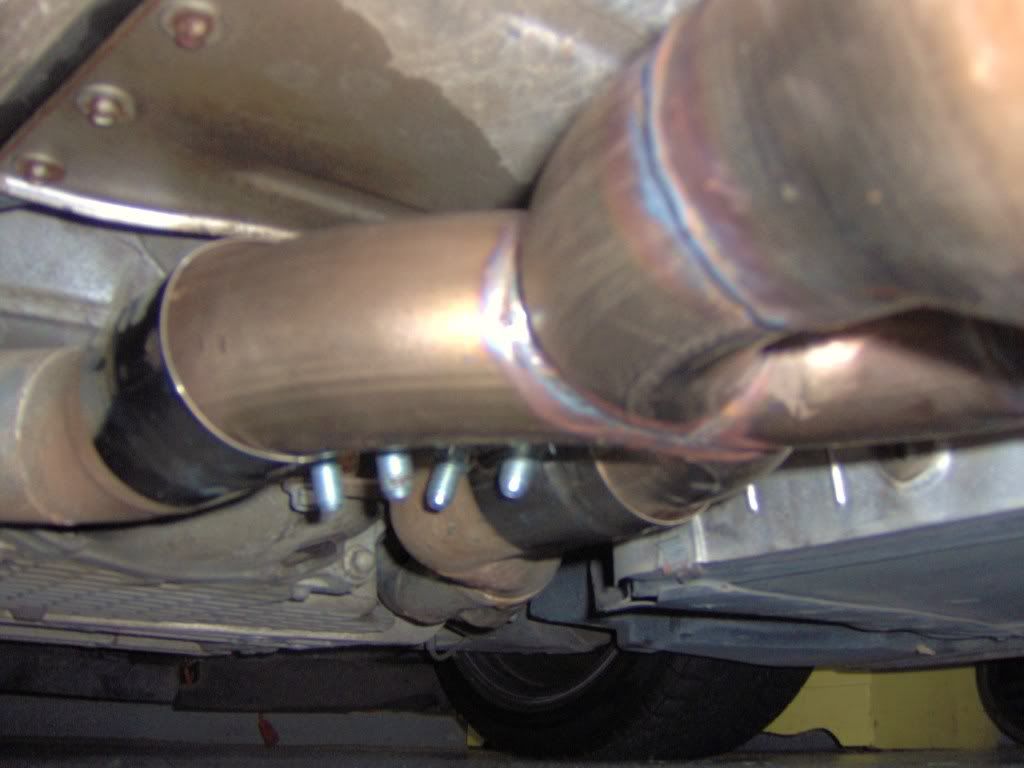
had custom x-pipe made for mine - right behind header collectors and in front of high-flow cats. I did it with the same theory stated above in mind. Definitely changed the exhaust sound - hard to tell of any power increase



Burning Brakes


Joined: Oct 2004
Posts: 931
Likes: 35
From: Rowlett, Texas
John, just my opinions after 10 years of messing with C5's.
Too cold for golf, so I'll expound a bit here:
If you're going to leave the engine internally stock (see my last paragraph), then I think you'd get just about all there was to get in the exhaust system by just going with a good 2 1/2" aftermarket full-length system, such as the LG streets, and any good catback that suits your sound requirements.
Starting up front and working back, you could:
1. Install a good cold-air intake system, the Vararam gets great power reviews, the Callaway gets the quality award. The Blackwing is beautiful, affordable, and easy to install, and works well with open foglight shrouds when moving, but does heat soak at red lights.
2. The Vararam uses the fog light openings to take in air, but if you install another intake, go ahead and open the fog light areas like the Z06 to get cool air into the engine compartment.
4. Everybody has a water temp/thermostat comment, but whatever temp you want (194/180/160), you will need to get the fans programmed to match the thermostat. Your tuner will do this when he dyno-tunes the car.
3. You have the larger MAF, no real restriction there. The Z06 has the air-straightener removed, and some guys do that on the LS1 hoping to gain a couple HP. But some guys have fits with lean codes when they do it in conjunction with a cold-air-intake.
4. You could port the throttle body - maybe only a couple of peak HP, but you should get a bit of torque in the mid-range and improved throttle resonse in that range. I just installed one, definitely jumps quicker when you hit it. No need for a big aftermarket TB on a stocker.
Someone mentioned the throttle body coolant bypass; well, why not. Buy a little hose splicer for 98 cents and do it.
5. You have the Z06 intake manifold already - it's a great piece for a stock engine. An expensive aftermarket piece might get a couple more HP, but would be prohibitively expensive for the gain seen I think.
6. Good longtube 1 3/4" headers, with high-flow cats and integrated X-pipe. And pick any aftermarket (or the Z06 ) mufflers, but watch out for resonance; some can be deafening with headers and hi-flow cats.
Don't know if 3 inch would help a stock engine; might just kill some torque rather than helping.
7. A 25% reduction harmonic balancer is a great addition; we've sen about 5HP claimed, and it makes the engine feel a bit "zingier". Reduces load on accessories also, with no downside that I have observed.
BUT, if you're gonna spend 2 days installing one, you're 70% of the way to putting in a cam. So nobody does a balancer unless they are doing a cam also (hint, hint).
8. The dyno-tune of course. The C5 has no "chip' like the old days. The computer has flash memory, and is just electronically re-programmed by your friendly tuner. There are several good hand-held units that you can purchase and plug/play a reprogram. But, I think if you are making some mods, then going to a live tuner is more rewarding, and a lot more fun. And you get the dyno sheet to prove what your new power numbers are.
9. Rearend gears and/or high-stall torque converter. I didn't notice if you had an auto or a manual. But either way, going to lower gears makes for a lot of fun and quicker acceleration. Torque converters can turn an auto-tranny Vette into a holeshot monster.
If you do all the above, you could reasonably expect maybe 40 more horses at the wheels (your numbers may vary).
Of course, all the above is assuming you will leave the internals alone - which you probably will not once you get the bug. A stock LS1 is just dying for more cam; there's 40 more HP just waiting to get out with even a mild cam, that would be totally driveable, reliable, and smooth.
DG
Too cold for golf, so I'll expound a bit here:
If you're going to leave the engine internally stock (see my last paragraph), then I think you'd get just about all there was to get in the exhaust system by just going with a good 2 1/2" aftermarket full-length system, such as the LG streets, and any good catback that suits your sound requirements.
Starting up front and working back, you could:
1. Install a good cold-air intake system, the Vararam gets great power reviews, the Callaway gets the quality award. The Blackwing is beautiful, affordable, and easy to install, and works well with open foglight shrouds when moving, but does heat soak at red lights.
2. The Vararam uses the fog light openings to take in air, but if you install another intake, go ahead and open the fog light areas like the Z06 to get cool air into the engine compartment.
4. Everybody has a water temp/thermostat comment, but whatever temp you want (194/180/160), you will need to get the fans programmed to match the thermostat. Your tuner will do this when he dyno-tunes the car.
3. You have the larger MAF, no real restriction there. The Z06 has the air-straightener removed, and some guys do that on the LS1 hoping to gain a couple HP. But some guys have fits with lean codes when they do it in conjunction with a cold-air-intake.
4. You could port the throttle body - maybe only a couple of peak HP, but you should get a bit of torque in the mid-range and improved throttle resonse in that range. I just installed one, definitely jumps quicker when you hit it. No need for a big aftermarket TB on a stocker.
Someone mentioned the throttle body coolant bypass; well, why not. Buy a little hose splicer for 98 cents and do it.
5. You have the Z06 intake manifold already - it's a great piece for a stock engine. An expensive aftermarket piece might get a couple more HP, but would be prohibitively expensive for the gain seen I think.
6. Good longtube 1 3/4" headers, with high-flow cats and integrated X-pipe. And pick any aftermarket (or the Z06 ) mufflers, but watch out for resonance; some can be deafening with headers and hi-flow cats.
Don't know if 3 inch would help a stock engine; might just kill some torque rather than helping.
7. A 25% reduction harmonic balancer is a great addition; we've sen about 5HP claimed, and it makes the engine feel a bit "zingier". Reduces load on accessories also, with no downside that I have observed.
BUT, if you're gonna spend 2 days installing one, you're 70% of the way to putting in a cam. So nobody does a balancer unless they are doing a cam also (hint, hint).
8. The dyno-tune of course. The C5 has no "chip' like the old days. The computer has flash memory, and is just electronically re-programmed by your friendly tuner. There are several good hand-held units that you can purchase and plug/play a reprogram. But, I think if you are making some mods, then going to a live tuner is more rewarding, and a lot more fun. And you get the dyno sheet to prove what your new power numbers are.
9. Rearend gears and/or high-stall torque converter. I didn't notice if you had an auto or a manual. But either way, going to lower gears makes for a lot of fun and quicker acceleration. Torque converters can turn an auto-tranny Vette into a holeshot monster.
If you do all the above, you could reasonably expect maybe 40 more horses at the wheels (your numbers may vary).
Of course, all the above is assuming you will leave the internals alone - which you probably will not once you get the bug. A stock LS1 is just dying for more cam; there's 40 more HP just waiting to get out with even a mild cam, that would be totally driveable, reliable, and smooth.
DG

Drifting
Joined: Aug 2007
Posts: 1,495
Likes: 0
From: Homer Glen IL

Very nice write up Wrench. I am working on some of those mods my self. Early LS1 users might see a curious "dip" in the dyno graph at 5500 like I did. It appears our stock valve springs are a little weak on the top end. I am replacing them this weekend.
Last edited by futuretech; Jan 15, 2010 at 11:27 AM.
Drifting
Joined: Aug 2007
Posts: 1,495
Likes: 0
From: Homer Glen IL