




C8 14 speaker audio system?

Racer


Joined: Jun 2021
Posts: 441
Likes: 382

That feature is now described specifically for the the Corvette with the 14 speaker system on the Bose website: "This system also features Active Sound Management - Engine Harmonic Cancellation and Engine Harmonic Enhancement technologies." at this link:
https://automotive.bose.com/vehicles...vette-stingray
I'm curious about your comment that it causes the muddy base. I know you reported feedback that resulted when you added the footwell sub and that it was resolved by disconnecting what is called the noise cancellation microphone in the door panel. And you get better bass sound now. But did you disconnect the microphone and evaluate the bass priror to installation of the footwell sub?
https://automotive.bose.com/vehicles...vette-stingray
I'm curious about your comment that it causes the muddy base. I know you reported feedback that resulted when you added the footwell sub and that it was resolved by disconnecting what is called the noise cancellation microphone in the door panel. And you get better bass sound now. But did you disconnect the microphone and evaluate the bass priror to installation of the footwell sub?
On the other hand with the stereo off, the engine sounds more natural to me with the mic unhooked. Again, "to me"

Race Director


Joined: Mar 2007
Posts: 11,096
Likes: 8,253
I didn't and that statment is somewhat subjective based on how the system sounded with the new sub before and after unhooking it at volume levels too low to cause feedback. There was at least one other person who did that experiment and felt it improved the sound. Again, subjective. Most people probably wont notice the change in bass response.
On the other hand with the stereo off, the engine sounds more natural to me with the mic unhooked. Again, "to me"
On the other hand with the stereo off, the engine sounds more natural to me with the mic unhooked. Again, "to me"
Race Director
Joined: Mar 2007
Posts: 11,096
Likes: 8,253
They are not selectable and cannot be disabled from the menu. To my knowledge, the only way to disable it is to disconnect one of the noise cancellation microphones. They are found in both door panels. The reason this works to disable it (again as far as I can tell) is because the diagnostics in the car detect a problem with a disconnected microphone. It will set a DTC (but apparently does not display a CEL on the DIC). One of the action taken when that DTC is set is to shut down the Active Sound Management feature. Based on galaxyjason's experience, there are no negative consequences.


Le Mans Master


Joined: Apr 2018
Posts: 5,812
Likes: 8,296
From: Dove Mountain, AZ
2023 C8 of the Year Finalist - Unmodified
Has anyone actually measured the spectral response of the 14 channel Bose system in the C8 using a RTA analyzer app with a pink noise source played to evaluate where the deficiencies are?
It would be interesting to see these results but sadly the 3 channel (base, mid, treble) EQ in the C8 would not be adequate to correct for any deficiencies found...Really wish the C8 had at least a 7~8 channel EQ rather than the tone adjust you'd find in a Cobalt...
Sound like something fun and interesting to do when I get some free time ...
It would be interesting to see these results but sadly the 3 channel (base, mid, treble) EQ in the C8 would not be adequate to correct for any deficiencies found...Really wish the C8 had at least a 7~8 channel EQ rather than the tone adjust you'd find in a Cobalt...
Sound like something fun and interesting to do when I get some free time ...
Race Director
Joined: Mar 2007
Posts: 11,096
Likes: 8,253
Has anyone actually measured the spectral response of the 14 channel Bose system in the C8 using a RTA analyzer app with a pink noise source played to evaluate where the deficiencies are?
It would be interesting to see these results but sadly the 3 channel (base, mid, treble) EQ in the C8 would not be adequate to correct for any deficiencies found...Really wish the C8 had at least a 7~8 channel EQ rather than the tone adjust you'd find in a Cobalt...
Sound like something fun and interesting to do when I get some free time ...
It would be interesting to see these results but sadly the 3 channel (base, mid, treble) EQ in the C8 would not be adequate to correct for any deficiencies found...Really wish the C8 had at least a 7~8 channel EQ rather than the tone adjust you'd find in a Cobalt...
Sound like something fun and interesting to do when I get some free time ...
"Bose AudioPilot is a proprietary technology developed by Bose Corporation that is designed to improve sound quality in a vehicle by monitoring and adjusting for changes in external noise levels. The technology works by using a series of microphones located throughout the vehicle to detect external noise levels, and then automatically adjusting the volume and equalization of the audio system to maintain consistent sound quality."
Attached is some info from the Bose site claiming 16 channels of equalization for the 14 speaker system:

Race Director
Joined: Mar 2007
Posts: 11,096
Likes: 8,253
Corvette Stories
The Best of Corvette for Corvette Enthusiasts

10 Most Common Corvette Problems of the Last 20 Years!
Joe Kucinski
5 MOST and 5 LEAST Popular Corvette Model Years in History!
Joe Kucinski
2027 Corvette Buyer's Guide: Everything You Need to Know!
Joe Kucinski
10 Things C8 Corvette Owners Hate (But Won't Tell You)
Joe Kucinski
10 Best Corvettes Coming to Barrett-Jackson Palm Beach 2026!
Brett Foote
Every Corvette Grand Sport Explained! (C2, C4, C6, C7, & C8)
Joe Kucinski
Grand Sport & Grand Sport X Launch Alongside All-New 535hp LS6 V8!
Michael S. Palmer
5 Reasons Bad Drivers Crash & 5 Ways to Avoid a Costly Mistake!
Joe Kucinski
7 Bolt-On Upgrades From Extreme Online Store to Level Up Your C6 Corvette
Pouria Savadkouei
Le Mans Master
Joined: Apr 2018
Posts: 5,812
Likes: 8,296
From: Dove Mountain, AZ
2023 C8 of the Year Finalist - Unmodified
I think someone did measure it - a long while back - I don't think it especially flat. Bose claims 16 channels of custom equalization. If it has that, we certainly don't have access to the adjusters for each channel. There is something called Audio Pilot, and that feature can be turned off in the menu. People debate what it does. Most who claim to be audiophiles say it distorts the music. While I cannot find a detailed explanation of it from a Bose source, what I think it does is monitor the ambient noise in different frequency bands and then adjust gain in those different frequency bands to compensate for the ambient noise. Sort of an adaptive volume control, but in frequency bands instead of across the full sound spectrum. I think that is a type of equalization - and may be where the reference to 16 channels of equalization comes from. I did find an explanation of it from a non-Bose source and it is this:
I wouldn't expect the output from the Bose amp to be flat (even with bass, mid, and treble set to zero) as that would not be very desirable from a listening perspective...Bose more than likely has their internal DSP EQ setup similar to a "house curve" which is programmed within the AMP but not accessible to any of us (at least not that I'm aware of)..
Why a house curve? When you have flattened out the response and corrected all the dips and nulls you probably wouldn't be very pleased with the results. You also have to compensate for other variables which include important psychoacoustic effects (i.e. Fletcher Munson equal loudness curves).. In short, a flat response will not sound so great to most people...
I think more than anything it's the very basic 3 channel EQ (bass, mid, treble) I find the most disappointing!
Last edited by tadda; May 4, 2023 at 09:15 PM.
Le Mans Master
Joined: Apr 2018
Posts: 5,812
Likes: 8,296
From: Dove Mountain, AZ
2023 C8 of the Year Finalist - Unmodified
I found that someone recently measured the response curve of the Bose 14 Speaker System ...
Source:
Recommended Equalizer Settings/Setup for C8 Bose Premium System
For those curious what the C8 Corvette infotainment system tone controls do. I made a few quick measurements a while back.
Measurement setup:
REW - Room EQ Wizard Room Acoustics Software (an audio spectrum analyzer tool).
Dayton Audio UMM-6 USB Measurement Microphone.
Mic at drivers side headrest.
30-20,000 Hz sweep
Volume a few ticks past mid-way.
Coupe
First graph is all tone controls at 0 (flat). The other graphs show the affects of the tone controls at their max and min settings.
Measurement setup:
REW - Room EQ Wizard Room Acoustics Software (an audio spectrum analyzer tool).
Dayton Audio UMM-6 USB Measurement Microphone.
Mic at drivers side headrest.
30-20,000 Hz sweep
Volume a few ticks past mid-way.
Coupe
First graph is all tone controls at 0 (flat). The other graphs show the affects of the tone controls at their max and min settings.
Normally I’m not a big Bose fan either but agree that they did a good job using the DSP to deal with reflections from 14 speakers in such a small cabin. The tone control graphs I shared have a lot of smoothing enabled to clearly show the tone control impacts.
The biggest improvement in sound quality comes when you use a "connected device" as a source (i.e. USB, Phone Cable, etc).... XM has terrible quality. Then, if using even a smartphone, you can add a "real" multiband equalizer to tune the sound to your liking.




Melting Slicks

Joined: May 2021
Posts: 2,562
Likes: 1,579
REW is a great tool, glad to see that someone used it to do a good analysis on the C8. I have used it in some large briefing and display systems in large rooms to analyze and optimize accoustics.
Amazing to see the effect of adding sound deadening panels to walls and speaker placement, and phase/echo cancellation processing in DSP's can do.
What I can see right off the bat is that with all the C8 settings for bass/mid/treble at +0 dB the curve is actually pretty damn close to the harman kardon house curve. For a vehicle, that's really good!
I find that the C8 tweeters are a bit harsh/distorted if you boost the treble too much. Would be nice to do some sweeps and look at distortion vs just SPL levels.
110dB at 30hz is a lot of boom for a stock sound system too. Whatever happened to Tigra and Bunny?
Amazing to see the effect of adding sound deadening panels to walls and speaker placement, and phase/echo cancellation processing in DSP's can do.
What I can see right off the bat is that with all the C8 settings for bass/mid/treble at +0 dB the curve is actually pretty damn close to the harman kardon house curve. For a vehicle, that's really good!
I find that the C8 tweeters are a bit harsh/distorted if you boost the treble too much. Would be nice to do some sweeps and look at distortion vs just SPL levels.
110dB at 30hz is a lot of boom for a stock sound system too. Whatever happened to Tigra and Bunny?
Le Mans Master
Joined: Apr 2018
Posts: 5,812
Likes: 8,296
From: Dove Mountain, AZ
2023 C8 of the Year Finalist - Unmodified
REW is a great tool, glad to see that someone used it to do a good analysis on the C8. I have used it in some large briefing and display systems in large rooms to analyze and optimize accoustics.
Amazing to see the effect of adding sound deadening panels to walls and speaker placement, and phase/echo cancellation processing in DSP's can do.
What I can see right off the bat is that with all the C8 settings for bass/mid/treble at +0 dB the curve is actually pretty damn close to the harman kardon house curve. For a vehicle, that's really good!
I find that the C8 tweeters are a bit harsh/distorted if you boost the treble too much. Would be nice to do some sweeps and look at distortion vs just SPL levels.
Amazing to see the effect of adding sound deadening panels to walls and speaker placement, and phase/echo cancellation processing in DSP's can do.
What I can see right off the bat is that with all the C8 settings for bass/mid/treble at +0 dB the curve is actually pretty damn close to the harman kardon house curve. For a vehicle, that's really good!
I find that the C8 tweeters are a bit harsh/distorted if you boost the treble too much. Would be nice to do some sweeps and look at distortion vs just SPL levels.
I too found that the tweeter high frequency response to be a bit too bright and harsh for me....I found reducing the treble output to 0 ~ (-1) helped somewhat to reduce this distortion...Damn I really wish we had a proper EQ!
With the limited tone controls we currently have in the C8 this is what I've found works best for me...

Race Director
Joined: Mar 2007
Posts: 11,096
Likes: 8,253
Follow up...
I found that someone recently measured the response curve of the Bose 14 Speaker System ...
Source:
Recommended Equalizer Settings/Setup for C8 Bose Premium System
I found that someone recently measured the response curve of the Bose 14 Speaker System ...
Source:
Recommended Equalizer Settings/Setup for C8 Bose Premium System
And it brings up another point. Is the goal to achieve a flat response across the spectrum? I assume these measurements are made with the car stationary - no road noise and minimal ambient noise. But what happens when ambient noise competes with the audio? Is a flat response when stationary still "ideal", whatever that means? My understanding of the AudioPilot is that it measures ambient noise in different frequency bands (I don't know how many) and then boosts the volume in frequency bands to compensate for the ambient noise in the respective bands. So its not just boosting overall volume - its creating a non-linear frequency response to compensate for ambient noise. It should have no effect when the car is stationary, because there is no ambient noise - so if it works as I suggest - measurements with it on and off should look the same. It should only affect the response curves when there is background noise. Many forum members recommend leaving it off because they say it introduces distortion. But is the concept of compensating for ambient noise by changing the frequency response a bad one - or is it just poorly executed?

Le Mans Master
Joined: Apr 2018
Posts: 5,812
Likes: 8,296
From: Dove Mountain, AZ
2023 C8 of the Year Finalist - Unmodified
.
- Personal Hearing Response
- Sound Space Environment
- Psychoacoustic Effects (Equal Loudness Perceptions)
- Personal Music and Sound Preferences
The second part of your question I believe can be answered below which I posted a while ago...
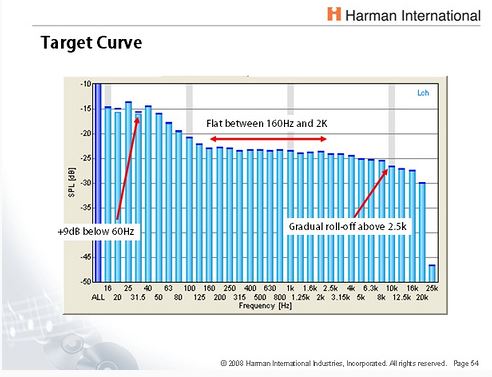
I wouldn't expect the output from the Bose amp to be flat (even with bass, mid, and treble set to zero) as that would not be very desirable from a listening perspective...Bose more than likely has their internal DSP EQ setup similar to a "house curve" which is programmed within the AMP but not accessible to any of us (at least not that I'm aware of)..
Why a house curve? When you have flattened out the response and corrected all the dips and nulls you probably wouldn't be very pleased with the results. You also have to compensate for other variables which include important psychoacoustic effects (i.e. Fletcher Munson equal loudness curves).. In short, a flat response will not sound so great to most people...
Why a house curve? When you have flattened out the response and corrected all the dips and nulls you probably wouldn't be very pleased with the results. You also have to compensate for other variables which include important psychoacoustic effects (i.e. Fletcher Munson equal loudness curves).. In short, a flat response will not sound so great to most people...
Further explanation of equal loudness / psychoacoustic effects linked below:
Psychoacoustics - How We hear
Last edited by tadda; Dec 22, 2023 at 02:53 PM.
Melting Slicks
Joined: May 2021
Posts: 2,562
Likes: 1,579
Yep, I usually go for harmon kardon house curve as a good baseline. Lot's of research already done here...
This is a measurement of overall SPL vs frequency though, and doesn't consider things like echoes, phase distortions, etc.
I believe the bose audiopilot system is also doing more advanced things than just auto-equalization based on ambient sound levels (HTC top down, higher speed, higher AC air settings, etc.)
Pretty sure it is also doing some sort of inverted/phase/cancellation along with some sort of "engine noise" insertion. Although I have also heard that it is nulling out the engine noise. Is it nulling specific aspects of the engine noise? Because it sure seems like the DI injectors are super chatty inside my cabin. Sounds like an old sewing machine.
Wonder if someone has got around to making the back window in a coupe removable, or creating a panel that can be opened?
Yeah, you would want the windows down too probably to keep hot air / CO flowing to the rear, but would be nice to hear that engine / exhaust note more although I think the noise would a lot more DI injector and valve train than people would like.
This is a measurement of overall SPL vs frequency though, and doesn't consider things like echoes, phase distortions, etc.
I believe the bose audiopilot system is also doing more advanced things than just auto-equalization based on ambient sound levels (HTC top down, higher speed, higher AC air settings, etc.)
Pretty sure it is also doing some sort of inverted/phase/cancellation along with some sort of "engine noise" insertion. Although I have also heard that it is nulling out the engine noise. Is it nulling specific aspects of the engine noise? Because it sure seems like the DI injectors are super chatty inside my cabin. Sounds like an old sewing machine.
Wonder if someone has got around to making the back window in a coupe removable, or creating a panel that can be opened?
Yeah, you would want the windows down too probably to keep hot air / CO flowing to the rear, but would be nice to hear that engine / exhaust note more although I think the noise would a lot more DI injector and valve train than people would like.
Le Mans Master
Joined: Apr 2018
Posts: 5,812
Likes: 8,296
From: Dove Mountain, AZ
2023 C8 of the Year Finalist - Unmodified
AudioPilot monitors cabin noise levels and vehicle speed and basically adjusts the audio volume accordingly...There is no real noise cancellation done with this feature...It only reacts to "sustained" noise sources, analyses the spectrum of these noise source(s), and compensates the volume accordingly...It is most effective at lower volume settings where background noise can truly affect how well the music can be heard while being played through the audio system. At mid and higher volume settings, where the music is much louder than the background noise, there may be little or no compensations made by AudioPilot.
I have a coupe and never travel with the windows down or top off, so after playing around with the AudioPilot feature I found that disabling it resulted in a cleaner / less distorted sound...YMMV
I have a coupe and never travel with the windows down or top off, so after playing around with the AudioPilot feature I found that disabling it resulted in a cleaner / less distorted sound...YMMV
Race Director
Joined: Mar 2007
Posts: 11,096
Likes: 8,253
Yep, I usually go for harmon kardon house curve as a good baseline. Lot's of research already done here...
This is a measurement of overall SPL vs frequency though, and doesn't consider things like echoes, phase distortions, etc.
I believe the bose audiopilot system is also doing more advanced things than just auto-equalization based on ambient sound levels (HTC top down, higher speed, higher AC air settings, etc.)
Pretty sure it is also doing some sort of inverted/phase/cancellation along with some sort of "engine noise" insertion. Although I have also heard that it is nulling out the engine noise. Is it nulling specific aspects of the engine noise? Because it sure seems like the DI injectors are super chatty inside my cabin. Sounds like an old sewing machine.
Wonder if someone has got around to making the back window in a coupe removable, or creating a panel that can be opened?
Yeah, you would want the windows down too probably to keep hot air / CO flowing to the rear, but would be nice to hear that engine / exhaust note more although I think the noise would a lot more DI injector and valve train than people would like.
This is a measurement of overall SPL vs frequency though, and doesn't consider things like echoes, phase distortions, etc.
I believe the bose audiopilot system is also doing more advanced things than just auto-equalization based on ambient sound levels (HTC top down, higher speed, higher AC air settings, etc.)
Pretty sure it is also doing some sort of inverted/phase/cancellation along with some sort of "engine noise" insertion. Although I have also heard that it is nulling out the engine noise. Is it nulling specific aspects of the engine noise? Because it sure seems like the DI injectors are super chatty inside my cabin. Sounds like an old sewing machine.
Wonder if someone has got around to making the back window in a coupe removable, or creating a panel that can be opened?
Yeah, you would want the windows down too probably to keep hot air / CO flowing to the rear, but would be nice to hear that engine / exhaust note more although I think the noise would a lot more DI injector and valve train than people would like.
https://automotive.bose.com/vehicles...vette-stingray
and read about the various different features claimed by Bose for the 14 speaker system in the Corvette C8.
Audio Pilot is described like this, and does not mention the measuring the ambient noise in frequency bands though I think that is how it works. "Noise from the road can often interfere with your music. AudioPilot Noise compensation technology monitors any sustained background noise and adjusts the music so you can hear it better. It happens automatically, so there’s no need to adjust the controls or turn up the volume."
Further down on website, it describes a different feature called Active Sound Management: " This system features Engine Harmonic Cancellation technology. Active Sound Management enables carmakers to make your driving experience more enjoyable. Discover the suite of Bose technologies that manufacturers use to improve vehicle sound characteristics, efficiency, and performance." You can find Active Noise Cancellation in the Owners Manual, and in the service manual you can find the schematics and the replacement procedure for what are called noise cancellation microphones, which are in the door trim toward the back of the door. The manual says you cannot disable this feature. But it can be disabled by disconnecting just one of the microphones. I do not know if the AudioPilot uses the same microphones to monitor ambient noise. I do know that a forum member that added an aftermarket speaker found it necessary to disconnect one of the microphone - and did so without causing any other obvious issues.
Adding- in a verbal statement Tadge said the purpose of the Noise Cancellation was to cancel the noise resulting when in V4 mode.

Race Director

Joined: Sep 2016
Posts: 13,180
Likes: 10,511
AudioPilot monitors cabin noise levels and vehicle speed and basically adjusts the audio volume accordingly...There is no real noise cancellation done with this feature...It only reacts to "sustained" noise sources, analyses the spectrum of these noise source(s), and compensates the volume accordingly...It is most effective at lower volume settings where background noise can truly affect how well the music can be heard while being played through the audio system. At mid and higher volume settings, where the music is much louder than the background noise, there may be little or no compensations made by AudioPilot.
I have a coupe and never travel with the windows down or top off, so after playing around with the AudioPilot feature I found that disabling it resulted in a cleaner / less distorted sound...YMMV
I have a coupe and never travel with the windows down or top off, so after playing around with the AudioPilot feature I found that disabling it resulted in a cleaner / less distorted sound...YMMV
Le Mans Master
Joined: Apr 2018
Posts: 5,812
Likes: 8,296
From: Dove Mountain, AZ
2023 C8 of the Year Finalist - Unmodified
It doesn't adjust the overall volume. It adjusts the frequency response. If it detects a lot of high frequency noise, it raises the level of the highs in the music. If it detects a lot of low frequency tire rumble, it raises the low frequencies. Etc. It also ads a ton of distortion to the sound, so I suspect dohabandit is right that it's playing psycho acoustic games with phase and other things. Those are Bose's favorite tricks. You might not be able to hear it on rock music, but it's very audible on some types of music. It's not just an AVC (automatic volume control).
I thought I was clear (highlighted below) but apparently not clear enough though...I should have clarified my earlier comments made regarding compensation of volume accordingly within the frequency ranges of a sustained noise source... I did not intend to imply AudioPilot simply increases the overall volume.

AudioPilot monitors cabin noise levels and vehicle speed and "basically" adjusts the audio volume accordingly...There is no real noise cancellation done with this feature...It only reacts to "sustained" noise sources, analyses the spectrum of these noise source(s), and compensates the volume accordingly...It is most effective at lower volume settings where background noise can truly affect how well the music can be heard while being played through the audio system. At mid and higher volume settings, where the music is much louder than the background noise, there may be little or no compensations made by AudioPilot.
I have a coupe and never travel with the windows down or top off, so after playing around with the AudioPilot feature I found that disabling it resulted in a cleaner / less distorted sound...YMMV
I have a coupe and never travel with the windows down or top off, so after playing around with the AudioPilot feature I found that disabling it resulted in a cleaner / less distorted sound...YMMV
That said, AudioPilot is really not that complex and is a fairly basic compensation system...What I don't like about the AudioPilot volume compensations is that when it's active it also changes the EQ curve settings (As Andybump was alluding to in an earlier post) relative to the frequencies of noise it's attempting to mask...
On the other hand, the Bose Advanced Staging, Centerpoint, and Active Sound Management Technologies are far more complex and do introduce quite a bit of phase and signal distortions back into the system...
Along with AudioPliot, which I currently have disabled, I also plan on disabling the Active Sound Management (Engine Harmonic and Noise Cancellation) system soon....
Last edited by tadda; Dec 22, 2023 at 09:06 PM.