To PCV or not to PCV

Race Director


Joined: Nov 1999
Posts: 10,643
Likes: 8
From: Foxfield CO 1970 Convertible

1) You say: "My arguments are that PCV setups are for emissions reasons".
Don't know how many more times I can contend that PCV wasn't designed for emission purposes. Go back and read the difference between closed and open PCV systems. An open PCV system simply spewed vapors into the atmosphere; obvioulsy not an effort to reduce emissions. The closed system addressed that (the emission part) AND improved crankcase ventilation.
You're incorrect - An open PCV system doesn't simply spew vapors into the atmosphere - it tries to route them into the intake manifold, which is the intial part of emissions reduction. Don't you read your own links?
2) If the thought of blowby vapors being sucked into the intake bothers you that much, then fine, run a catch can. But the ongoing arguement to this point, has been Breathers vs. PCV, so your catch-can solution would need PCV system (or a vacuum pump) to function; right?
With breathers only, please explain how blowby wastes are not left to 'sit in the crankcase'? What are the blowby wastes replaced with?
2) The oil is changed frequently enough that blowby particulates in the oil are removed before they can form sludge.
For an engine that is properly maintained, blowby wastes just aren't a concern.
5) Oil leaks. Do you not believe vacuum in the crankcase helps reduce oil leaks?
7) You say: "Noonie's test is interesting but it doesn't show any flow. It is showing pressure.".
No, it's showing vacuum, the key ingrediant to the PCV recipe.
No, it's showing vacuum, the key ingrediant to the PCV recipe.
8) You ask: "Do you not understand that a hole in the wall of a container equalizes the pressure between the two sides".
Incorrect. You forget that pressure is continually added to one of the two sides of the container (the crankcase).
Incorrect. You forget that pressure is continually added to one of the two sides of the container (the crankcase).
As the liquid cola is sucked through the straw, what replaces the LC in the can? Fresh air, right? What pulls the fresh air into the coke can as the liquid cola is sucked out?
I'll give you a clue. It starts with a "V".
I'll give you a clue. It starts with a "V".
Back to your engine. With the same coke can and straw, blow through the straw (the air forced through the straw represents blowby). The opening in the can that surrounds the straw are your breathers. Your can will always be full of blowby wastes as long as you blow (engine is running); fresh air can't get into the can (crankcase) to displace the blowby vapors.
Bottom line: If your engine has a PCV system that's OK. It will emit fewer emissions into the air. But it doesn't improve the HP over a breather equipped engine, and is more than likely burning oil vapor in the cylinders, which reduces its power.

Race Director

Joined: Mar 2006
Posts: 14,112
Likes: 28
From: Florida
Do you mean low pressure? Low pressure will help contain oil from dripping out of a leak...until the engine is turned off. The leak was always there.
It's showing reduced pressure.
And the hole is continually open...
Absolutely true.
Absolutely false. Atmospheric pressure fills the can. Vacuum doesn't "suck" air into it! A vacuum doesn't have properties and doesn't exist, even though people speak as though it does.
And when you stop blowing, fresh air will gradually fill the can. But it's still a moot point. You're too fixated on a crankcase of fresh air. I explained above why blowby wastes are not a concern.
Bottom line: If your engine has a PCV system that's OK. It will emit fewer emissions into the air. But it doesn't improve the HP over a breather equipped engine, and is more than likely burning oil vapor in the cylinders, which reduces its power.
Have you some strange fixation with weather??? Desire to be a weatherman/girl.
All this evaporation, sidewalks, high and low pressure fronts, straws ....
Here is a pic of a quote out of the GM Rochester QJet Service Manual

As I said in a previous post, maybe you missed it..
This can go on for ever if you start dissecting the meaning of words. 
The accepted definition of vacuum is 'any space with less than atmospheric pressure', not to be confused with 'absolute vacuum which is a theory on earth only' and cannot be produced on earth.
I have never heard anyone say "I cleaned the house today with my low atmospheric pressure cleaning device'.
I don't see the analogy between the vented coke can and the vented crankcase. You can't get coke thru sucking a straw in the can if the straw isn't immersed into the coke. After all the pcv valve isn't immersed into the crankcase.
The pcv valve is designed to close instantly upon backfire, to prevent 'what' and 'where'?
BTW, I found I have been spelling vacuum wrong most of the time.
The accepted definition of vacuum is 'any space with less than atmospheric pressure', not to be confused with 'absolute vacuum which is a theory on earth only' and cannot be produced on earth.
I have never heard anyone say "I cleaned the house today with my low atmospheric pressure cleaning device'.
I don't see the analogy between the vented coke can and the vented crankcase. You can't get coke thru sucking a straw in the can if the straw isn't immersed into the coke. After all the pcv valve isn't immersed into the crankcase.
The pcv valve is designed to close instantly upon backfire, to prevent 'what' and 'where'?
BTW, I found I have been spelling vacuum wrong most of the time.
The reference to "vacuum" is listed countless times in that and many other GM service manuals.
Maybe you feel GM is wrong and should have used weathermen and women to develop the pcv system etc. instead of engineers.


Melting Slicks


Joined: Mar 2005
Posts: 2,838
Likes: 10
From: Austin TX
Z-Man, you've made a lot of incorrect statements in one post. I beg of you, please go back and read from any one of the 30-35 links previously posted.
The arguement to this point is what's better for removing harmful blowby vapors: A pair of breathers? Or a PCV system? If you're ok running your crankcase with a concentration of blowby vapors, go boy go!
Please don't say it's better and/or, if you do, come up with some documentation that supports your opinion. So far, on the supporting document count, the score is about 35 to 0; the "pair of breathers" crowd is well behind. If you wish, we could probably present another 500 docs to support our statements.
To correct your statements,..
1) You say: "That jar IS on a PCV system. It would also work on a breather system, which many race cars require to prevent drips on the track. I'll probably put a catch can on my breather system too."
99% of the PCV systems don't have catch cans. They're not needed. If you're 'catching' a lot of liquid oil, you either have inadequate or missing baffles. Also with breathers only, exactly how will you rig a catch can?
2) You say:
"1) The car is started frequently and heated up enough to evaporate any volatile liquid blowby.
2) The oil is changed frequently enough that blowby particulates in the oil are removed before they can form sludge.
For an engine that is properly maintained, blowby wastes just aren't a concern."
I agree, if the oil's temp is over 212~ degrees, the liquid water will evaporate from the oil. But it's the job of the PCV system to evacuate the vaporized water (steam) and other harmful compounds; CO2, unspent fuel, acids, etc. With breathers only, the crankcase will always have a concentration of these harmful vapors. There's no flow of fresh air to replace the blowby gasses. With breathers only, harmful vapors are replaced by,..more harmful blowby vapors.
But if you believe "blowby wastes just aren't a concern" then run a pair of breathers. Also, I'd LOVE to see some supporting evidence that blowby vapors "are not a concern" to counter the 35 or so docs presented to this point.
3) To my question regarding oil leaks: "Do you not believe vacuum in the crankcase helps reduce oil leaks?"
...you say: "Do you mean low pressure? Low pressure will help contain oil from dripping out of a leak...until the engine is turned off. The leak was always there."
First, you obviously have a hard time understanding vacuum as it relates to atmospheric pressure. Second, pressure in the crankcase can and will create oil leaks. If you want to argue otherwise, please support your notion with something other than opinion.
4) On the topic of two adjacent chambers with a "hole" between them,..
You ask: "Do you not understand that a hole in the wall of a container equalizes the pressure between the two sides".
I said: "Incorrect. You forget that pressure is continually added to one of the two sides of the container (the crankcase)."
You stated: "And the hole is continually open..."
Do you own an air compressor with guages? Leave the drain plug open and turn on the compressor. You'll see pressure rise (as it relates to atmospheric pressure) in the AC though there's a hole (the open drain plug). Pressure will be higher in the AC as long as the motor is running.
That's what's happening the crankcase. Pressure is being pumped in in the form of blowby. Your pair of breathers relieve some of this pressure but certainly not entirely. Just like the open drank **** on the air compressor relieves pressure, but not entirely.
Therefore with a pair of breathers, your crankcase (when the engine is running) will always have higher pressure than atmospheric.
With a PCV system that pressure is countered with vacuum (see exhibit "A"; Noonie's photos).
5) Regarding the straw in the coke can,..
You say: "Atmospheric pressure is forcing liquid into your mouth?" .
Not without vacuum or sucking (again, as it relates to atmosphiric pressure) pulling the liquid soda up the straw
6) I said: "As the liquid cola is sucked through the straw, what replaces the LC in the can? Fresh air, right? What pulls the fresh air into the coke can as the liquid cola is sucked out? I'll give you a clue. It starts with a "V"."
Again, you want to believe vacuum doesn't exist.
7) You say: "But it (PCV) doesn't improve the HP over a breather equipped engine, and is more than likely burning oil vapor in the cylinders, which reduces its power."
The breathers-only crowd had trotted out the notion that breathers increase HP and/or a PCV system decreases HP. Of the 35~ links presented to this point, there's not one statement that supports this opinion. In fact there are a dozen statements that say there's is no performance difference, with or without.
If you can find something to support your notion, please share. Here's a good place to start: www.google.com
Oil vapor reducing HP? I'd love to see data. First, at what temp, does oil vaporize? Second, oil changes on my cars show almost zero oil usage (3000 mile intervals). Third, again, if oil is being sucked into the intake, you have inadequate or missing baffling.
The PCV crowd has presented several docs that stated that vacuum in the crankcase is better for HP than pressure. Go back and read from the links. Not that any of us are running a PCV system for HP gains (Again, vacuum and pressure as it relates to atmospheric pressure, so you don't get confused).
We know your opinion. We're clear. If you want to present useable facts and evidence that show us breathers are better than a PCV system, please, present them.
Until then, my PCV's are intact and fresh air is displacing harmful blowby vapors (at least the automotive engineers from the last 50 years believe they're harmful).
The arguement to this point is what's better for removing harmful blowby vapors: A pair of breathers? Or a PCV system? If you're ok running your crankcase with a concentration of blowby vapors, go boy go!
Please don't say it's better and/or, if you do, come up with some documentation that supports your opinion. So far, on the supporting document count, the score is about 35 to 0; the "pair of breathers" crowd is well behind. If you wish, we could probably present another 500 docs to support our statements.
To correct your statements,..
1) You say: "That jar IS on a PCV system. It would also work on a breather system, which many race cars require to prevent drips on the track. I'll probably put a catch can on my breather system too."
99% of the PCV systems don't have catch cans. They're not needed. If you're 'catching' a lot of liquid oil, you either have inadequate or missing baffles. Also with breathers only, exactly how will you rig a catch can?
2) You say:
"1) The car is started frequently and heated up enough to evaporate any volatile liquid blowby.
2) The oil is changed frequently enough that blowby particulates in the oil are removed before they can form sludge.
For an engine that is properly maintained, blowby wastes just aren't a concern."
I agree, if the oil's temp is over 212~ degrees, the liquid water will evaporate from the oil. But it's the job of the PCV system to evacuate the vaporized water (steam) and other harmful compounds; CO2, unspent fuel, acids, etc. With breathers only, the crankcase will always have a concentration of these harmful vapors. There's no flow of fresh air to replace the blowby gasses. With breathers only, harmful vapors are replaced by,..more harmful blowby vapors.
But if you believe "blowby wastes just aren't a concern" then run a pair of breathers. Also, I'd LOVE to see some supporting evidence that blowby vapors "are not a concern" to counter the 35 or so docs presented to this point.
3) To my question regarding oil leaks: "Do you not believe vacuum in the crankcase helps reduce oil leaks?"
...you say: "Do you mean low pressure? Low pressure will help contain oil from dripping out of a leak...until the engine is turned off. The leak was always there."
First, you obviously have a hard time understanding vacuum as it relates to atmospheric pressure. Second, pressure in the crankcase can and will create oil leaks. If you want to argue otherwise, please support your notion with something other than opinion.
4) On the topic of two adjacent chambers with a "hole" between them,..
You ask: "Do you not understand that a hole in the wall of a container equalizes the pressure between the two sides".
I said: "Incorrect. You forget that pressure is continually added to one of the two sides of the container (the crankcase)."
You stated: "And the hole is continually open..."
Do you own an air compressor with guages? Leave the drain plug open and turn on the compressor. You'll see pressure rise (as it relates to atmospheric pressure) in the AC though there's a hole (the open drain plug). Pressure will be higher in the AC as long as the motor is running.
That's what's happening the crankcase. Pressure is being pumped in in the form of blowby. Your pair of breathers relieve some of this pressure but certainly not entirely. Just like the open drank **** on the air compressor relieves pressure, but not entirely.
Therefore with a pair of breathers, your crankcase (when the engine is running) will always have higher pressure than atmospheric.
With a PCV system that pressure is countered with vacuum (see exhibit "A"; Noonie's photos).
5) Regarding the straw in the coke can,..
You say: "Atmospheric pressure is forcing liquid into your mouth?" .
Not without vacuum or sucking (again, as it relates to atmosphiric pressure) pulling the liquid soda up the straw
6) I said: "As the liquid cola is sucked through the straw, what replaces the LC in the can? Fresh air, right? What pulls the fresh air into the coke can as the liquid cola is sucked out? I'll give you a clue. It starts with a "V"."
Again, you want to believe vacuum doesn't exist.
7) You say: "But it (PCV) doesn't improve the HP over a breather equipped engine, and is more than likely burning oil vapor in the cylinders, which reduces its power."
The breathers-only crowd had trotted out the notion that breathers increase HP and/or a PCV system decreases HP. Of the 35~ links presented to this point, there's not one statement that supports this opinion. In fact there are a dozen statements that say there's is no performance difference, with or without.
If you can find something to support your notion, please share. Here's a good place to start: www.google.com
Oil vapor reducing HP? I'd love to see data. First, at what temp, does oil vaporize? Second, oil changes on my cars show almost zero oil usage (3000 mile intervals). Third, again, if oil is being sucked into the intake, you have inadequate or missing baffling.
The PCV crowd has presented several docs that stated that vacuum in the crankcase is better for HP than pressure. Go back and read from the links. Not that any of us are running a PCV system for HP gains (Again, vacuum and pressure as it relates to atmospheric pressure, so you don't get confused).
We know your opinion. We're clear. If you want to present useable facts and evidence that show us breathers are better than a PCV system, please, present them.
Until then, my PCV's are intact and fresh air is displacing harmful blowby vapors (at least the automotive engineers from the last 50 years believe they're harmful).
Last edited by 73, Dark Blue 454; Apr 30, 2009 at 01:45 PM.

Burning Brakes

Joined: Dec 2007
Posts: 952
Likes: 0
It is apparent that Dark Blue still has not looked up open u-tube manometers, or studied Blaise Pascal's theory, and still does not understand that the term "vacuum" is a slang term for low pressure.
Unless he understands physics, he will never understand the rest of what Z-man and I are trying to convey to the ignorant masses. So be it.
The distortion of facts by the OP renders this thread moot.
Unless he understands physics, he will never understand the rest of what Z-man and I are trying to convey to the ignorant masses. So be it.
The distortion of facts by the OP renders this thread moot.
Melting Slicks
Joined: Mar 2005
Posts: 2,838
Likes: 10
From: Austin TX
FB007, I've no idea how your post above furthers the opinion that breathers-only are superior to a PCV system.
You could stack to the moon, all the things I don't know. That's why I research. It's why there are dozens of supporting docs on this thread to support the statements I've made.
If your toolbox has in it, a U-Tube Manometer, and it somehow supports your theory that breathers are better and/or a PCV system inferior, please enlighten us.
My toolbox has in it, a "vacuum" gauge. It measures "vacuum" as it exists on earth, in inches of mercury (hg). It's a very useful tool used in the automtive community for a hundred years now. For instance, go back and study Noonie's photos. The "vacuum" guage is registering between 5-6hg, which showed us, that indeed, the PCV system is working fine.
If I've made an incorrect statement or have drawn the wrong conclusions in any of my posts, then make your case. Again, supporting docs would augment your cause. Here's a good place to start: www.google.com
But if you want to argue that we should no longer use the "slang term, vacuum", good luck.
You could stack to the moon, all the things I don't know. That's why I research. It's why there are dozens of supporting docs on this thread to support the statements I've made.
If your toolbox has in it, a U-Tube Manometer, and it somehow supports your theory that breathers are better and/or a PCV system inferior, please enlighten us.
My toolbox has in it, a "vacuum" gauge. It measures "vacuum" as it exists on earth, in inches of mercury (hg). It's a very useful tool used in the automtive community for a hundred years now. For instance, go back and study Noonie's photos. The "vacuum" guage is registering between 5-6hg, which showed us, that indeed, the PCV system is working fine.
If I've made an incorrect statement or have drawn the wrong conclusions in any of my posts, then make your case. Again, supporting docs would augment your cause. Here's a good place to start: www.google.com
But if you want to argue that we should no longer use the "slang term, vacuum", good luck.

8th Gear

Joined: Nov 2005
Posts: 8
Likes: 0
From: AUSTIN TX
Positive Crankcase Ventilation
My 56 Chevy through my 67 Camaro had a crankcase vent at the rear of the block. My 68 Vette had a PCV. I am pretty sure it started in 68 and the smog pumps started in 69. My brother's 69 Chevelle had one.
Corvette Stories
The Best of Corvette for Corvette Enthusiasts

10 Reasons the C6 Z06 is Still A Performance Benchmark After 20 Years
Joe Kucinski
How Much Horsepower Every Corvette Engine "LOST" in 1972
Joe Kucinski
Top 10 DOs and DON'Ts for Protecting Your Convertible Top!
Michael S. Palmer
Top 10 Most Explosive Corvettes Ever Made: Power-to-Weight Ratio Ranked!
Joe Kucinski
150 hp to 1,250 hp: Every Corvette Generation Compared by the Specs That Matter
Joe Kucinski
8 Coolest Corvette Pace Cars (and Replicas) of All Time
Verdad Gallardo
Top 10 Corvette Engines RANKED by Peak Torque (70+ Years of Muscle!)
Joe Kucinski
Corvette ZR1X Will Be Pacing the Indy 500, And Could Probably Race, Too!
Verdad Gallardo
Top 10 Corvettes Coming to Mecum Indy 2026!
Brett Foote


Race Director
Joined: Mar 2006
Posts: 14,112
Likes: 28
From: Florida
Here’s some more info to mull over.
Had a little time to get some reading on the road today. Traffic was pretty heavy, so I didn’t get a lot.
I connected my “lower than atmospheric pressure gauge” (because Z-man and FB007 contend vacuum does not exist) the same as before, to the oem passenger valve cover breather tube.
I taped the gauge over the shadowband, so it’s not as clear as should be with the bright Florida sun behind it.
At startup and idle I got the same reading of 6”
After the engine got to full temp (180°) it went up to 7”

At 2000 rpm steady cruise it went back to 5”
At 2500 rpm steady cruise it stayed at 5”
At 3000 rpm steady cruise it stayed at 5”

At 3500 rpm steady cruise it dropped to 4.5”

At 4000 rpm steady cruise it stayed at 4”
Traffic wouldn’t let me cruise at any higher rpm
Half throttle acceleration thru 1st, 2nd and into 3rd stayed at 4”
Full throttle acceleration brought it to .5# pressure.

Thru all of the cruising rpm’s the needle stayed pretty steady.
At WOT acceleration, thru the gears, there was a lag of 3 or 4 seconds to reach pressure.
Had a little time to get some reading on the road today. Traffic was pretty heavy, so I didn’t get a lot.
I connected my “lower than atmospheric pressure gauge” (because Z-man and FB007 contend vacuum does not exist) the same as before, to the oem passenger valve cover breather tube.
I taped the gauge over the shadowband, so it’s not as clear as should be with the bright Florida sun behind it.
At startup and idle I got the same reading of 6”
After the engine got to full temp (180°) it went up to 7”
At 2000 rpm steady cruise it went back to 5”
At 2500 rpm steady cruise it stayed at 5”
At 3000 rpm steady cruise it stayed at 5”
At 3500 rpm steady cruise it dropped to 4.5”
At 4000 rpm steady cruise it stayed at 4”
Traffic wouldn’t let me cruise at any higher rpm
Half throttle acceleration thru 1st, 2nd and into 3rd stayed at 4”
Full throttle acceleration brought it to .5# pressure.
Thru all of the cruising rpm’s the needle stayed pretty steady.
At WOT acceleration, thru the gears, there was a lag of 3 or 4 seconds to reach pressure.
Burning Brakes
Joined: Dec 2007
Posts: 952
Likes: 0
Noonie,
When you say you connected the gauge to the fresh air tube, you used an adapter that closed off the intake, correct?
I wished you would have used the dipstick tube instead, and maintained the fresh air intake open.
When you say you connected the gauge to the fresh air tube, you used an adapter that closed off the intake, correct?
I wished you would have used the dipstick tube instead, and maintained the fresh air intake open.
Race Director
Joined: Mar 2006
Posts: 14,112
Likes: 28
From: Florida
First things first

Really didn't want to confuse the issue yet. It's easy for people to get on tangeants with too much info.

I did that also, (knew what the results would be anyway) and that's the way I usually test for a bad pcv system or even a very quick test for excessive blowby before a compression and/or leakdown test.

Was out of hose long enough to go inside the cabin, so I'll do both tests again, also when the traffic is lighter.
I always run with a gauge on a DD, great tool.
Really, to be a little more informative, another gauge should be hooked up to the intake at the same time.
This test, as is, does give some usefull info.
I think here you must at least look at pcv valve operation vs blowby.

Le Mans Master


Joined: Apr 2007
Posts: 7,353
Likes: 72
From: Graceland in a Not Correctly Restored Stingray

Much appreciated as your scientific approach is (
), having used the fresh air tube IMHO does likely skew results from what they would in practice be. Any chance for a re-test using another crankcase "port" as FB007 suggests?

Instructor
Joined: Oct 2008
Posts: 187
Likes: 12
I really don,t like the idea of pulling oil mist back into the intake on my toy,s .So i fab.
catch tanks .1 1/2 hose off each valve cover into alum. tank with petcock .To see how much water condenses into this tank is amazing .I use this system on my truck-454
and in my boat ,twin TD 496 strokers .keeps engine bays cleen and moisture out of your oil.
catch tanks .1 1/2 hose off each valve cover into alum. tank with petcock .To see how much water condenses into this tank is amazing .I use this system on my truck-454
and in my boat ,twin TD 496 strokers .keeps engine bays cleen and moisture out of your oil.
Race Director
Joined: Nov 1999
Posts: 10,643
Likes: 8
From: Foxfield CO 1970 Convertible
To correct your statements,..
1)
You’re partially correct when you say they’re not needed. They’re not needed if you don’t mind the oil vapors entering your intake (see below for references). 99% of the cars out there are not performance oriented.
I plan on putting tubes from my breathers that run to a common point (probably on the firewall) and into a combination breather / oil catch bottle. Tons of folks do this and there are many solutions. The breather bottle isn’t very big and it’s way better looking than the glass one I posted above. Here’s a picture of one:
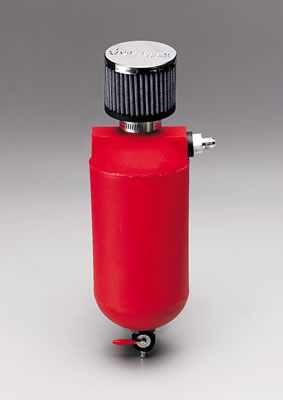
Here’s a full blown article on putting together a fairly high end breather system.
http://www.popularhotrodding.com/tec...ion/index.html
2)
2a. You only need to get the oil hot to evaporate it – it doesn’t have to get to the boiling point of water to drive off any HC liquids or water. Most of the hydrocarbons evaporate at much lower temps than water, and the HCs in gasoline are the ones we’re talking about.
2b. With either system, fresh air starts to enter the crankcase as soon as the engine is shut off. Here’s an example of this behavior: I run EFI, and have an O2 sensor located a few inches downstream of my shorty headers. The rest of my exhaust system is about 10-13 feet long if you count the path through spiral baffles out to the tip. Keep in mind, “blowby” is called “exhaust” if it comes out the exhaust system, so it’s the same stuff. Anyway, to calibrate the O2 sensor, it needs to be in air. If I shut off the engine and take a reading, the O2 sensor shows no oxygen present. If I wait until the next morning, the O2 sensor reads 21%. How can that be? Again, read about Brownian motion and diffusion…. The gas in the crankcase just diffuses into the air, and air moves into the crankcase.
Well, most of you references don’t support the idea that they are harmful to the engine – most of them talk about the environment. Let’s look at them…
http://www.valvoline.com/carcare/art...cid=2&scccid=3 (doesn’t mention that blowby is harmful to the engine)
http://books.google.com/books?id=U4T...esult&resnum=3 (says blowby harmful if not removed)
http://www.filtercouncil.org/techdata/tsbs/94-2R1.pdf (only says that blowby gases are harmful if released to the environment)
http://www.106rallye.co.uk/members/d...hersystems.pdf (says only that blowby gases are harmful if released to the environment. It also states that oil separation is required in the breather system to remove carry over oil and prevent it from re-entering the engine – something most PCV systems don’t have.)
http://www.absoluteastronomy.com/topics/PCV_valve (States only that blowby is harmful to the environment. Also states that PCV systems are harmful to intake systems due to residue buildup from oil vapors. “However, due to the constant circulation of the oil within the engine, along with the high speed movement of the crankshaft, an oil mist is also passed through the PCV system and into the intake. The oil is then either burnt during combustion or settles along the intake tract, causing a gradual build-up of residue inside the inlet path. For this reason many engine tuners choose to replace the PCV system with an oil catch can and breather filter which vents the blow-by gases directly to atmosphere and retains the oil in a small tank…”)
http://books.google.com/books?id=jco...um=9#PPA535,M1 (only says that blowby gases are harmful if released to the environment)
http://www.underhoodservice.com/Arti...ts_breath.aspx (talks about how a PCV system can harm an engine if it is not maintained)
http://www.secondchancegarage.com/public/239.cfm (only says that blowby gases are harmful if released to the environment)
http://www.aa1car.com/library/pcv.htm (only says that blowby gases are harmful if released to the environment)
http://autonettv.com/category/auto-tips/pcv-valve (says blowby harmful to the environment and the engine if not removed)
http://books.google.com/books?id=QLY...esult&resnum=6 (says blowby harmful to environment and possibly the engine)
I understand vacuum perfectly, you don’t. To continue the discussion, I will drop my use of the engineering term of vacuum, and understand that in your layman’s terminology, your are using “vacuum” to refer to a positive pressure lower than atmospheric. Any documentation from automotive engineers contains this dumbed-down definition too, since they obviously already discovered that the average person can’t comprehend the strict definition of a vacuum.
Yes – SUFFICIENT pressure in a crankcase will cause oil leaks by forcing oil through weak spots in gaskets, etc. The pressure in a properly set up breather system is no where high enough to cause oil leaks. Conversely, if a PCV system stops oil from leaking out of a crankcase, the breather inlet must be clogged or insufficiently sized.
OK – I see where you are not understanding a breather system correctly. A correctly installed breather system typically has two 1 inch holes to relieve the internal pressure – way more than is necessary to virtually equalize the pressure. Any pressure in the crankcase would only be academic.
Your example of a drain **** is like having a pin hole in the crankcase – apples and oranges.
And yes, yet again – this shows you don’t know what reduced pressure is (and certainly not a vacuum) – the atmosphere is PUSHING the Coke up the straw. The reduced pressure does not “suck” the liquid up into the straw. The fresh air is not pulled into the can – it FLOWS INTO THE CAN since it is at a higher pressure. If the can was sealed and strong enough to keep it from collapsing, you couldn’t suck the Coke into the straw.
Except in laboratories and outer space, vacuums don’t exist.
Here’s a children’s school assignment for you which covers this subject:
“Suction, which is usually thought of as a pulling force, does not exist.”
“When you “suck” on a straw, you actually expand the volume of gas on one side of the liquid (the side connected to your mouth). By expanding the volume of the gas inside the straw, you spread the atoms out, resulting in a lowering of pressure inside the straw. It is the outside air pressure that is also pushing on the liquid in the straw which pushes the liquid up the straw. You don’t pull the liquid into your mouth, you lower the internal pressure to allow the outside pressure to push the liquid up the straw.”
http://www.concord.org/~btinker/work...15Suction.html
7) You say: "But it (PCV) doesn't improve the HP over a breather equipped engine, and is more than likely burning oil vapor in the cylinders, which reduces its power."
Baffles will reduce oil droplets that are flung around by the rockers, but they won’t stop the oil vapor itself because that’s a gas. Oil is continuously vaporizing at regular running engine temperatures. The vapors are being continuously sent to your intake. “Almost” zero oil usage – the almost amount is being burned in your cylinders.
OK – here you go…
Here’s a racing site
http://www.rivayamaha.com/RivaStore/...ather%20System
“Easy to install catch can/oil breather eliminates power-robbing crankcase fumes and oil vapor from your engine's air intake. Increases horsepower by removing the engine's requirement to burn relaitvely non-combustable oil.” (They spell about like you do…)
Here’s a group that says “routing blow by back in to combustion chamber while boosting effects the octane rating of fuel thereby increasing chance of detonation. and decrease in performance.” Granted, they’re boosting their engines, but it still is an example of decreased performance.
http://www.team-bhp.com/forum/modifi...s-added-7.html
“Cars and trucks like the 03, 04 Cobras and the Lightnings are prone to major amounts of oil being re-circulated back into the intake track through the PCV system. This can cause sticky throttle, clogged intercooler fins, gummed up intake runners, carbon deposits and can even lower the octane rating of your fuel.”
http://jlttruecoldair.com/zencart/in...products_id=23
“What's bad about burning a little oil? As oil gets sucked in, the throttle body, intake manifold, cold start fuel injector, and T-VIS butterflies develop a thick oily residue which coats everything it touches. When the tiny particles of dust and dirt that make it past the air filter come in contact with that oil, they bond together making a thick sludge. In the most severe cases, this can lead to the complete failure of the T-VIS system when the butterflies get so gunked up they can no longer open and close properly. The bad part about getting the throttle body dirty in particular is that it has sensors within it that contribute to the info the ECU needs to properly run the engine. Those sensors can't operate properly if they're covered in an oily residue.”
http://www.gassavers.org/archive/ind...run/t-290.html
From the latest tech letters to Popular Hotrodding:
“The downside to using a PCV valve is that along with the fuel-rich blow-by gases, oil vapors are trapped in the same spaces. This means that they both get sent back into the engine to be consumed with the regular air and fuel mixture. The oil can leave residue on the back of the valves and in the combustion chamber, inhibiting flow, and generally being dirty.”
This next one comes straight from Purolator. I added the emphasis. Note that they seem to think that FRESH AIR contains the HARMFUL CONTAMINANTS!!
Breathers
Breathers are used in conjunction with the Positive Crankcase Ventilation (PCV) valve. Typically located in the air filter housing, the breather element serves to filter the fresh air being drawn into the crankcase. Breathers from Purolator prevent unfiltered air, with all its harmful contaminants, from entering the engine crankcase.
PCV Valves
Positive Crankcase Ventilation (PCV) valves were the very first, automotive pollution control devices, and continue to be part of the vehicle's far more sophisticated emission control systems seen on vehicles today. Replacing a worn out PCV valve with a fresh Purolator PCV valve can prevent a multitude of problems - rough engine idle, blown oil seals, fumes in the passenger compartment, excessive engine part wear and shorter oil life.
http://articles.directorym.net/Autom...akland_CA.html
I could go on and on, but you get the idea…well, maybe not.
noonie: While your experimental gauge setup is interesting, it only shows that the pressure in the intake is reduced when the crankcase is sealed shut. To show PCV flow, you would need a flowmeter in that section of tubing. Or at least, to measure some sort of pressure drop, you would need to hook up the gauge like SkunkWorks and FB007 suggest - off of the oil dipstick tube or even the valve cover - WITH THE PCV INLET STILL ATTACHED and open.
1)
99% of the PCV systems don't have catch cans. They're not needed. If you're 'catching' a lot of liquid oil, you either have inadequate or missing baffles. Also with breathers only, exactly how will you rig a catch can?
I plan on putting tubes from my breathers that run to a common point (probably on the firewall) and into a combination breather / oil catch bottle. Tons of folks do this and there are many solutions. The breather bottle isn’t very big and it’s way better looking than the glass one I posted above. Here’s a picture of one:
Here’s a full blown article on putting together a fairly high end breather system.
http://www.popularhotrodding.com/tec...ion/index.html
2)
I agree, if the oil's temp is over 212~ degrees, the liquid water will evaporate from the oil. But it's the job of the PCV system to evacuate the vaporized water (steam) and other harmful compounds; CO2, unspent fuel, acids, etc. With breathers only, the crankcase will always have a concentration of these harmful vapors. There's no flow of fresh air to replace the blowby gasses. With breathers only, harmful vapors are replaced by,..more harmful blowby vapors.
2b. With either system, fresh air starts to enter the crankcase as soon as the engine is shut off. Here’s an example of this behavior: I run EFI, and have an O2 sensor located a few inches downstream of my shorty headers. The rest of my exhaust system is about 10-13 feet long if you count the path through spiral baffles out to the tip. Keep in mind, “blowby” is called “exhaust” if it comes out the exhaust system, so it’s the same stuff. Anyway, to calibrate the O2 sensor, it needs to be in air. If I shut off the engine and take a reading, the O2 sensor shows no oxygen present. If I wait until the next morning, the O2 sensor reads 21%. How can that be? Again, read about Brownian motion and diffusion…. The gas in the crankcase just diffuses into the air, and air moves into the crankcase.
But if you believe "blowby wastes just aren't a concern" then run a pair of breathers. Also, I'd LOVE to see some supporting evidence that blowby vapors "are not a concern" to counter the 35 or so docs presented to this point.
http://www.valvoline.com/carcare/art...cid=2&scccid=3 (doesn’t mention that blowby is harmful to the engine)
http://books.google.com/books?id=U4T...esult&resnum=3 (says blowby harmful if not removed)
http://www.filtercouncil.org/techdata/tsbs/94-2R1.pdf (only says that blowby gases are harmful if released to the environment)
http://www.106rallye.co.uk/members/d...hersystems.pdf (says only that blowby gases are harmful if released to the environment. It also states that oil separation is required in the breather system to remove carry over oil and prevent it from re-entering the engine – something most PCV systems don’t have.)
http://www.absoluteastronomy.com/topics/PCV_valve (States only that blowby is harmful to the environment. Also states that PCV systems are harmful to intake systems due to residue buildup from oil vapors. “However, due to the constant circulation of the oil within the engine, along with the high speed movement of the crankshaft, an oil mist is also passed through the PCV system and into the intake. The oil is then either burnt during combustion or settles along the intake tract, causing a gradual build-up of residue inside the inlet path. For this reason many engine tuners choose to replace the PCV system with an oil catch can and breather filter which vents the blow-by gases directly to atmosphere and retains the oil in a small tank…”)
http://books.google.com/books?id=jco...um=9#PPA535,M1 (only says that blowby gases are harmful if released to the environment)
http://www.underhoodservice.com/Arti...ts_breath.aspx (talks about how a PCV system can harm an engine if it is not maintained)
http://www.secondchancegarage.com/public/239.cfm (only says that blowby gases are harmful if released to the environment)
http://www.aa1car.com/library/pcv.htm (only says that blowby gases are harmful if released to the environment)
http://autonettv.com/category/auto-tips/pcv-valve (says blowby harmful to the environment and the engine if not removed)
http://books.google.com/books?id=QLY...esult&resnum=6 (says blowby harmful to environment and possibly the engine)
First, you obviously have a hard time understanding vacuum as it relates to atmospheric pressure. Second, pressure in the crankcase can and will create oil leaks. If you want to argue otherwise, please support your notion with something other than opinion.
Yes – SUFFICIENT pressure in a crankcase will cause oil leaks by forcing oil through weak spots in gaskets, etc. The pressure in a properly set up breather system is no where high enough to cause oil leaks. Conversely, if a PCV system stops oil from leaking out of a crankcase, the breather inlet must be clogged or insufficiently sized.
That's what's happening the crankcase. Pressure is being pumped in in the form of blowby. Your pair of breathers relieve some of this pressure but certainly not entirely. Just like the open drank **** on the air compressor relieves pressure, but not entirely.
Therefore with a pair of breathers, your crankcase (when the engine is running) will always have higher pressure than atmospheric.
Therefore with a pair of breathers, your crankcase (when the engine is running) will always have higher pressure than atmospheric.
Your example of a drain **** is like having a pin hole in the crankcase – apples and oranges.
5) Regarding the straw in the coke can,..
You say: "Atmospheric pressure is forcing liquid into your mouth?" .
Not without vacuum or sucking (again, as it relates to atmosphiric pressure) pulling the liquid soda up the straw
6) I said: "As the liquid cola is sucked through the straw, what replaces the LC in the can? Fresh air, right? What pulls the fresh air into the coke can as the liquid cola is sucked out? I'll give you a clue. It starts with a "V"."
Again, you want to believe vacuum doesn't exist.
You say: "Atmospheric pressure is forcing liquid into your mouth?" .
Not without vacuum or sucking (again, as it relates to atmosphiric pressure) pulling the liquid soda up the straw
6) I said: "As the liquid cola is sucked through the straw, what replaces the LC in the can? Fresh air, right? What pulls the fresh air into the coke can as the liquid cola is sucked out? I'll give you a clue. It starts with a "V"."
Again, you want to believe vacuum doesn't exist.
Except in laboratories and outer space, vacuums don’t exist.
Here’s a children’s school assignment for you which covers this subject:
“Suction, which is usually thought of as a pulling force, does not exist.”
“When you “suck” on a straw, you actually expand the volume of gas on one side of the liquid (the side connected to your mouth). By expanding the volume of the gas inside the straw, you spread the atoms out, resulting in a lowering of pressure inside the straw. It is the outside air pressure that is also pushing on the liquid in the straw which pushes the liquid up the straw. You don’t pull the liquid into your mouth, you lower the internal pressure to allow the outside pressure to push the liquid up the straw.”
http://www.concord.org/~btinker/work...15Suction.html
7) You say: "But it (PCV) doesn't improve the HP over a breather equipped engine, and is more than likely burning oil vapor in the cylinders, which reduces its power."
The breathers-only crowd had trotted out the notion that breathers increase HP and/or a PCV system decreases HP. Of the 35~ links presented to this point, there's not one statement that supports this opinion. In fact there are a dozen statements that say there's is no performance difference, with or without.
If you can find something to support your notion, please share. Here's a good place to start: www.google.com
Oil vapor reducing HP? I'd love to see data. First, at what temp, does oil vaporize? Second, oil changes on my cars show almost zero oil usage (3000 mile intervals). Third, again, if oil is being sucked into the intake, you have inadequate or missing baffling.
If you can find something to support your notion, please share. Here's a good place to start: www.google.com
Oil vapor reducing HP? I'd love to see data. First, at what temp, does oil vaporize? Second, oil changes on my cars show almost zero oil usage (3000 mile intervals). Third, again, if oil is being sucked into the intake, you have inadequate or missing baffling.
OK – here you go…
Here’s a racing site
http://www.rivayamaha.com/RivaStore/...ather%20System
“Easy to install catch can/oil breather eliminates power-robbing crankcase fumes and oil vapor from your engine's air intake. Increases horsepower by removing the engine's requirement to burn relaitvely non-combustable oil.” (They spell about like you do…)
Here’s a group that says “routing blow by back in to combustion chamber while boosting effects the octane rating of fuel thereby increasing chance of detonation. and decrease in performance.” Granted, they’re boosting their engines, but it still is an example of decreased performance.
http://www.team-bhp.com/forum/modifi...s-added-7.html
“Cars and trucks like the 03, 04 Cobras and the Lightnings are prone to major amounts of oil being re-circulated back into the intake track through the PCV system. This can cause sticky throttle, clogged intercooler fins, gummed up intake runners, carbon deposits and can even lower the octane rating of your fuel.”
http://jlttruecoldair.com/zencart/in...products_id=23
“What's bad about burning a little oil? As oil gets sucked in, the throttle body, intake manifold, cold start fuel injector, and T-VIS butterflies develop a thick oily residue which coats everything it touches. When the tiny particles of dust and dirt that make it past the air filter come in contact with that oil, they bond together making a thick sludge. In the most severe cases, this can lead to the complete failure of the T-VIS system when the butterflies get so gunked up they can no longer open and close properly. The bad part about getting the throttle body dirty in particular is that it has sensors within it that contribute to the info the ECU needs to properly run the engine. Those sensors can't operate properly if they're covered in an oily residue.”
http://www.gassavers.org/archive/ind...run/t-290.html
From the latest tech letters to Popular Hotrodding:
“The downside to using a PCV valve is that along with the fuel-rich blow-by gases, oil vapors are trapped in the same spaces. This means that they both get sent back into the engine to be consumed with the regular air and fuel mixture. The oil can leave residue on the back of the valves and in the combustion chamber, inhibiting flow, and generally being dirty.”
This next one comes straight from Purolator. I added the emphasis. Note that they seem to think that FRESH AIR contains the HARMFUL CONTAMINANTS!!
Breathers
Breathers are used in conjunction with the Positive Crankcase Ventilation (PCV) valve. Typically located in the air filter housing, the breather element serves to filter the fresh air being drawn into the crankcase. Breathers from Purolator prevent unfiltered air, with all its harmful contaminants, from entering the engine crankcase.
PCV Valves
Positive Crankcase Ventilation (PCV) valves were the very first, automotive pollution control devices, and continue to be part of the vehicle's far more sophisticated emission control systems seen on vehicles today. Replacing a worn out PCV valve with a fresh Purolator PCV valve can prevent a multitude of problems - rough engine idle, blown oil seals, fumes in the passenger compartment, excessive engine part wear and shorter oil life.
http://articles.directorym.net/Autom...akland_CA.html
I could go on and on, but you get the idea…well, maybe not.
noonie: While your experimental gauge setup is interesting, it only shows that the pressure in the intake is reduced when the crankcase is sealed shut. To show PCV flow, you would need a flowmeter in that section of tubing. Or at least, to measure some sort of pressure drop, you would need to hook up the gauge like SkunkWorks and FB007 suggest - off of the oil dipstick tube or even the valve cover - WITH THE PCV INLET STILL ATTACHED and open.