When you click on links to various merchants on this site and make a purchase, this can result in this site earning a commission. Affiliate programs and affiliations include, but are not limited to, the eBay Partner Network.
In case anyone is interested, I found this valve spring compressor tool on the Summit Racing website for about $40. Looks like it will do the trick nicely:
See here: https://www.summitracing.com/parts/sum-906784
The tool looks to be the way to go. If you don't have an air compressor, you can push rope into the cylinder and then bring it to TDC to compress the rope against the valves to hold them up. I have done it this way, but it is pretty much a PIA compared to using 100 psi of air. But, the advantage of the rope is you will likely not have a problem with pushing the piston down and moving the car. Use a good grade nylon rope or something and tie a loop on the end so you can retrieve it.
Of course I don't know how anyone lives without a air compressor. I have had my 2 stage compressor since the 80s and use it several times a week. I am really surprised it had not lost a rod or start to use oil.
In case anyone is interested, I found this valve spring compressor tool on the Summit Racing website for about $40. Looks like it will do the trick nicely:
See here: https://www.summitracing.com/parts/sum-906784
That's the tool I use. Works great. I did make a couple of minor modifications to the tool. First, I bent the forked lever to straighten it a bit. That worked better for me. Second, I took off the top bolt and replaced it with a quick release pin. That makes it quicker to change between rocker studs. Picture below.
I've said this before and I'll say it again, O-Ring valve seals do absolutely NOTHING while the engine is not running to keep oil from running down the valve stem. I mean do you think hot oil is going to stop when it gets to the o-ring and not jut flow right over the top of it? Their purpose is to sling excess oil off while the engine is RUNNING.
Umbrella seals [PC = [perfect circle] will keep oil from running down the valves while the engine sits overnight [hence blue smoke on COLD start up]
In the very olden days we would use ford umbrella on small blocks, and again in the old days you had to machine the outside of the valve guide boss to make clearance for the umbrella seals. I'm guessing today they have developed an umbrella that fits stock heads.
Putting new o-rings on will do nothing to help in my opinion.
Use synthetic oil to lessen the appearance of blue smoke in the morning. I'm not so sure this is oil is going by the guide, I'd bet the rings are the issue.
From: Middle TN by way of KY, OH, VA, IL, CA, FL, NY, SC, HI
Originally Posted by Mr Fufu
Hi R66 - Thanks for the link to the video. I watched all 18 minutes of it. It really helped to illustrate the process. It doesn't look that hard to do, except I'd be doing it with the engine in the car vs. on a stand.
I don't have an air compressor, which looks essential to doing this job. Maybe this gives me a good excuse to buy one
A definite yes on buying an air compressor if doing this yourself. The rope method will be a PITA with the engine in the car. Besides, you're saving enough to pay for several air compressors.
Originally Posted by R66
Found a U-tube for you: https://www.youtube.com/watch?v=OsGqmOQus6Y
Disclaimer: I didn't watch the whole video, if you decide to tackle this, let me know and I will watch it and add some comments that may or may not be helpful.
.
I watched the whole thing too (truth: I fast forwarded lots of it). I'm pretty OCD, but I was not crazy about his swapping/mismatching the valve train components, as he admittedly swapped the pushrods from cylinder to cylinder and did not appear to keep track of returning the rockers and rocker ***** to their original positions. Also, I thought his cleanliness practices could be improved for benefit of the engine. Of course, in both cases, the difference may only matter if you're trying to make the engine go another 100,000 miles, as we've all done worse with engines that ran fine afterwords. However, the amount of time to keep things clean and keep track of the valve train components is mere moments, and can save some avoidable wear on the engine.
$3000-$4000 for valve seals (if that's really what you need) seems to be up there with $25,000+ paint jobs.
Last edited by Easy Rhino; Oct 7, 2020 at 01:08 PM.
I don't know what the price of things are in BC but the price for replacing the seals is unbelievable. A good single stage 80 gal compressor can be bought new for $600 and a 2 stage for $1,000 down here. I bought the 2 stage as I was painting cars and using the air tools a lot. Now it is used just a couple of times a week.
I agree that umbrella seals are better than just the o-rings. While you have it apart, why not add them.
Here is an article I wrote on how to change valves seals without removing the heads. It has a lot of pictures and descriptions. You will need an air compressor or as the old timers used to do is insert rope into the spark plug hole and rotate the engine till it stopped against the valves.
Joe
From: Middle TN by way of KY, OH, VA, IL, CA, FL, NY, SC, HI
Originally Posted by plaidside
Here is an article I wrote on how to change valves seals without removing the heads. It has a lot of pictures and descriptions. You will need an air compressor or as the old timers used to do is insert rope into the spark plug hole and rotate the engine till it stopped against the valves.
Joe
Joe;
That is a really nicely documented and photographed procedure. Thanks for posting it. You make several good points for the benefit of those that may not have done this before.
I used the rope method before I could afford a good compressor: The PRO is you don't have the air pressure pushing the piston down and moving the car forward or back if you don't have the wheels blocked. No need to ask me how I know. The CON is the pain of feeding a couple of feet of rope in thru the sparkplug hole.
The air method takes a fairly good compressor with some health CFM if there is leak by past the rings or valves. Also, be prepared to keep the wrench on the bolt in the end of the crank to help keep it spinning the crank. Don't forget to put it in high get every time you get a piston to TDC. Wheel chocks are a must.
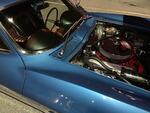
My '67 coupe blows blue smoke upon start up. The engine uses about a quart of oil every 6-700 miles. The #2 spark plug gets fouled leading to loss of power and unstable idle. Replacing this spark plug restores the performance and idle quality. But this fix is temporary, as the source of the plug fouling remains.
This car has its born-with stock base engine (300hp/327 cu in).
The engine has 91,400 miles on it now. It was completely rebuilt in 1990, including multi-angle valve grind and new valve guides. When rebuilt, the engine had 74,000 miles on it. So, it has traveled about 18,000 miles since being rebuilt.
Now, 30 years later, the engine runs very strong, with no issues other than the smoking upon start up.
From reading posts here it would appear the smoke on start up is due to deteriorated valve seals (and/or valve guides).
To my questions:
Is the smoke on start up most likely caused by bad valve guide seals? Would an engine with only 18k on it since rebuild have bad guides also?
Can the valve seals be replaced without removing the cylinder heads from the car?
What type of replacement valve seals should I use? Are there different kinds? Which are best?
Is valve seal replacement within the scope of a backyard mechanic like me? Cursory reading indicates the procedure isn't too complicated. Or is this best done by an experienced shop?
I took my car to a mechanic who works on vintage Corvettes. He said the heads would have to come off to replace the valve guides and the valve seals. He estimated this job at $3,000 to $4,000. I'm thinking a lower cost place to start would be to replace the valve seals without removing the heads to see if this fixes the problem.
Thanks for sharing your thoughts and advice.
I want to add some info about the two basic types of valve seal systems. The purpose of the valve seals is to prevent excessive oil from running down the valve guide into the cylinder. Intake valves are more of a problem than exhaust valves, because when the intake valve opens there is a slight vacuum in the cylinder. This can suck oil down the valve stem.
The challenge for valve seals is that they need to allow SOME oil to run down the valve stem so that the valve stem is lubricated in the valve guide. However, too much oil will make smoke and excessive oil consumption. So, a careful balance in oil leakage is required.
As originally designed, the Chevy small block oil control system works very well, but it is important to understand how it works. The first line of defense against excessive oil going down the valve stem is the stamped steel "umbrella" on top of the valve spring. The purpose of this umbrella is to limit the amount of oil splash onto the valve stem. The second part of the system is the O-ring under the spring retainer keepers. The purpose of the O-ring is to prevent oil that puddles on top of the spring retainer from running down the through the retainer, past the keepers, into the valve guide. This leakage path is what causes smoke on start-up.
Together, the umbrella splash shields and the O-rings do a perfectly adequate job of controlling oil consumption while also providing adequate oil lubrication for the valve guides.
Over time, the O-ring seals get brittle and crack, leading to leakage. It is a simple task to replace these O-rings with the heads on the car. For engines that smoke on start-up, new O-ring seals will usually fix the problem.
Modern heads typically use what is called a "positive oil seal" that is mounted on the valve guide boss of the cylinder head casting. This type of seal does not require the stamped steel "umbrellla" on top of the valve spring. Most machinists will insist on converting to this style of valve seal when they rebuild vintage small block heads. However, this requires machining the valve guide boss and is not really necessary for adequate oil control. The original GM design that combines the stamped steel umbrella splash shield with the keeper O-ring works just fine.
Thousands of Chevy small block owners have been persuaded to have their heads removed and completely rebuilt when all that was really needed was to replace the old, cracked O-rings under the keepers. This replacement is an easy task that can be performed by a skilled mechanic in about an hour, and can be performed by a careful and patient amateur in an afternoon.
Last edited by GearheadJoe; Oct 15, 2020 at 11:42 PM.
Here is an article I wrote on how to change valves seals without removing the heads. It has a lot of pictures and descriptions. You will need an air compressor or as the old timers used to do is insert rope into the spark plug hole and rotate the engine till it stopped against the valves.
Joe
Hi Joe,
Thanks for sharing the article you wrote - it's the best description of the process (with photos) of changing valve seals that I've come across. It almost has me thinking I can do the job myself!
But, never having done it, and not having a compressor are two factors in my hesitancy to do it. Also, I'd hate to drop a valve if I goof up!
Anyhow, great info and thanks again for sharing your knowledge!
Some of you will recall my ongoing efforts to improve the performance of my ’67 coupe with 327/300 engine (factory A/C car).
I got my ’67 about six years ago. It ran well enough then, but soon I had trouble setting the timing because the I later learned the harmonic balancer had spun. Once that was fixed I moved onto sorting out the carburetion issues – leaking gas, stalling, hesitation, etc. I rebuilt the replacement Holley 1850-C that came on the car. That cured most of the issues, but I never liked how the fuel line to the carb had been cobbled together using rubber tubing. So, last year I bucked up $700 for a correct brand new Holley 3810 carb. The new carb really made a difference – no more leaks, or stalling when stopping sharply, along with better mid-range power.
However, I could not get the engine to idle smoothly, and vacuum at idle would fluctuate rapidly between 16-18” hg. I thought I must have a vacuum leak somewhere, but never found it.
Last summer I noticed the engine starting to use more oil. I’d also see blue smoke upon cold start. Two of the 8 plugs would regularly foul with oil. Replacing the bad plugs would restore performance, but only for a few hundred miles until they fouled again. This pointed to worn valve guides or valve seals as the culprit.
Yesterday I had a shop replace the valve seals with the heads on the engine. The job took about 5 hours. The only thing found on the valve stems were black hard plastic umbrella seals! Of the 16 umbrellas, 9 were intact and 3 were missing their top portion. Four umbrellas had disintegrated, with smaller pieces lying about the lifter gallery. There were no O-rings installed on the valve stems.
The mechanic cleaned out the broken umbrella pieces and installed FelPro SS-5112 ‘O’-rings and FelPro SS-10058 umbrella seals, this as recommended by Joe Fisher in his excellent photographed procedure (Thanks Joe!)
Result – no more blue smoke on startup, a steady idle with 19” hg of vacuum at idle, and smoother power delivery on acceleration! I’m thrilled that my Sting Ray is finally performing as a Corvette should!
Thanks go out to everyone who supported me with advice and direction. You guys are the best!
From: Freedom is never more than one generation away from extinction.
St. Jude '03 thru '24
The spring tool is a must.
I use the rope method as it is a positive way to hold the valves closed. Especially if you accidentally bump the valve stem installing/removing the retainers using air.





















 Thanks for posting it. You make several good points for the benefit of those that may not have done this before.