When you click on links to various merchants on this site and make a purchase, this can result in this site earning a commission. Affiliate programs and affiliations include, but are not limited to, the eBay Partner Network.
My battery had been disconnected already, but double check that. The proceedure in the Shop Manual works for pulling the steering column.
Pulling the steering column isn't too bad. The ignition connectors were difficult to remove, even with the column dropped a bit. The retention tabs were dug into the metal bezel, possibly from me, or possibly from a PO's work. My harmonica connector was easy to take apart, but it was not secured to the side of the steering column.
Be sure to remove the two nuts holding the backing plate at the firewall end of the column before dropping it via the two bolts under the dash, or you are likely to damage the lower bearing. I ended up replacing that bearing anyway ($40- and a delay), since there was a lot of play in it.
What really got me was that Bubba had beaten me to this area. The pink ignition wire had been spliced with wire nuts and electrical tape, and run under the steering column, making it impossible to remove. WTF? I had to cut that, and buy some additional pink wire and crimps (I had heat shrink) to redo the splices correctly. There were several more splices in there, too, that looked okay.
Also, a question for the audience. In the second image above, there is black showing beneath the oyster white paint (likely SEM ultra white from the car's refresh in 2006). Is that normal? Is that overspray on the mounting flange from the refresh, or from GM? I've found other places where black was showing under oyster paint, including the bottoms of the seat buckets and beneath the carpet on the kick panels.
The trim tag indicates "Oyster White" as the correct interior color. Did the PO just repaint some black replacement pieces during the refresh, or did GM not completely paint/mold the original pieces?
Last edited by Bikespace; May 16, 2018 at 07:54 AM.
The first image shows how much steering column protrudes into the engine compartment. Try as I might, I could not get it to compress cleanly. There are a pair of plastic bits that need to be broken, then the column can be tapped in. Without pulling the engine (all of the videos I saw for this started with at least a pulled engine, sometimes just a bare frame!) I could not hit the end of the column hard enough to break the plastic bits. That didn't stop me from damaging the splines, though!
The second image shows what I ended up doing to compress the shaft. With the steering column in a vise (the weight is held by the 2x4s under the welded flange, not by crushing the column), I was able to wail on the shaft with a plastic hammer until it started compressing.
The third image shows some of the repairs to the rounded over/mushroomed part of the splines, fixed with a Dremel tool.
I used a Flaming River FR2512-DD U-Joint to go between the Borgeson box (3/4" DD), and the Corvette steering column (1" 48 splines). The image above shows the column with still an inch to go. When I was done, only about 1/2" of straigt shaft was showing between the lower column bearing and the start of the splines. This image shows the box in place with the U-Joint. A few notable things in this image:
1. I added the Reinforcement Plate from Ridetech. To get the bolts in place, I had to insert two in the stock direction (wheel side in), and the furthest aft bolt was inserted from the inside out. I had to cut that bolt out when I removed the old steering box, and I had to remove the exhaust downtube when I inserted the replacement bolt. Holding the steering box while getting the bolts in was the only true two person job, though the steering column install went more smoothly with two people.
2. No interference with brake lines (1979).
3. The steering column hasn't been put in place yet, but it lined up exactly.
NOT captured in the image: I had to significantly modify the U-Joint to get it to fit. I had to grind out the DD end to make it fit over the oblong stub at the end of the Borgeson box. I burned up my collection of small grinding wheels doing this, as the stainless does not grind easily. I don't know if the Borgeson rag joint or U-Joint would work better, but this was a PITA.
Last edited by Bikespace; May 16, 2018 at 09:55 PM.
My wife's budget Batmobile was able to pass inspection on her first try.
Well, second try, really. I was turned away the first time, and had to return with the passenger seat bolted in. No problem with not having carpet or a door panel, though.
The passenger door panel is off to replace with nicer (hopefully) reproduction leather (instead of half-cloth) door panels. Unfortunately, the door lock on the passenger side is jammed in the unlocked position. Pushing the lock ****, and trying to use the key in the door, both do nothing.
Does anyone have any ideas for a quick fix for that?
UPDATE: Searching on the forum, it seems that the passenger side power door lock actuator was frozen (well, stiff, in any case). Following the directions in the shop manual (Ha!), I was able to remove it. Now the passenger door is manual lock only, until the actuator comes, but it works just fine. I oiled up the joints I could reach while I was in there.
Last edited by Bikespace; Jun 10, 2018 at 03:34 PM.
Who buys a black Corvette? Seriously, why would anyone do that? It makes not sense for a car that is driven outdoors, occasionally in the rain. She photographs well, but keeping her clean is a huge chore. She will probably never be as clean as when we bought her.
I would.
A black vehicle is essentially clean only five minutes after it's washed.
I love black but yes they are hard to keep up with. Mine happens to reside outside under a car cover. My wifes C6 takes up the garage space that I have. I drive it about three times a week. It's hard but worth it when she is all cleaned up. I recommend a good clay bar and some light polishing with buffer. That really woke up my black paint.
A black vehicle is essentially clean only five minutes after it's washed.
I love black but yes they are hard to keep up with. Mine happens to reside outside under a car cover. My wifes C6 takes up the garage space that I have. I drive it about three times a week. It's hard but worth it when she is all cleaned up. I recommend a good clay bar and some light polishing with buffer. That really woke up my black paint.
That is a very pretty car. My wife has discovered clay bars, and even has a buffer and a detailing cart from Harbor Freight. Getting motivated to wash cars is another thing, but I agree it makes a huge difference. There are a few shows coming up this summer, so hopefully we can make the effort for that.
She's been commuting in the car a few times per week, so that's good for now.
After a summer of parking over an oil pan, and checking the power steering fluid before every drive, I finally got around to replacing the power steering pump. This was the only remaining original steering component, so of course it leaked like crazy. I had to add about 4-8 oz per week, so I had to check and top off before every drive.
I had ordered a rebuilt Delco unit from RockAuto, and took the pulley off of my 1980 steering pump (now a manual-steering car). That went on fairly easily, but I'm glad I don't rebuild steering pumps for a living.
The swap was a bit of a chore. Step one was to take out the alternator, which reminded me why I disliked the old valve covers. They were too tall, and prevented me from getting the alternator belt on and off easily. So I replaced those with a set of L48 valve covers from David Howard (thanks David!). They had some nice patina on them, although they did look touched up. They would have really looked out of place had I repainted them, so I just put them on as is. Attached is a before and after. I also got rid of the T-handle valve cover bolts, and put in 1/4"-20 by 3/4" bolts. I'll buy some hex-head (allen key) bolts for both cars the next time I order stuff from McMaster, as those would be easier to use.
My second accordion fitting came in, so I finally have the L82 cold-air intake complete. This is a restored system from a 1978. I gutted the internals, removed the bypass flaps, and taped over all the holes with aluminum tape, then primed it and painted it with matte engine black paint. It's a bit flat compared to stock, but much better than what the car had before.
The car is much happier with the new intake, a de-blinged engine compartment (There are still some wrapped vacuum hoses to replace), and a fresh wash. Thankfully you can still read "CORVETTE" on the fan shroud, otherwise this could be just about any car.
Last edited by Bikespace; Sep 17, 2018 at 10:38 PM.
I got caught in I-95 traffic for an hour. Stop and go, 0-20. No AC, windows down, and as good of a tune as you can get from a 79 L48 with stock exhaust logs. Stock radiator and clutch fan. This was a hot day, temps approaching 90, partial sun, black car.
Anyway, the engine did not overheat. I was watching the gauge. It stayed at 180 degrees the entire time (180 degree high-flow thermostat). It's been calibrated with an IR thermometer, engine temp was not a problem for the stock clutch fan.
However, the brakes overheated (!). My brake pedal went soft, and by the time I was able to work my way to an exit, the "Brake" light on the dash came on, indicating that the combination proportioning valve had done its thing and blocked one of the brake circuits.
I parked, popped the hood, and let the heat out. Nothing under the hood was cool enough to touch without burning myself. The upper radiator hose was the coolest thing there, since it was fixed at 180ish degrees. After 30 minutes, with the engine cooled, and my brakes functioning, I was able to find an alternate route with a higher average speed.
If I had encountered this situation in my 80, I am confident that I could have run the fans at full blast, full time, and only be limited by my idle charge current. Certainly, even aimed at the ground, the extra airflow would have been better than the stock clutch fan turning slowly. It's hard to repeat the experiment with the 79, but I have a set of dual electric fans on the way that I hope will solve the problem.
It was so hot, I couldn't walk outside the McDonalds with ice cream.
The car has the original TH-350 automatic, with the stock torque converter. This makes it a million times less fun to drive than my 80 L48 4-speed.
Occasional no-start when hot. Car cranks, will not fire. This is probably the HEI module in the distributor. This is the #1 frustration for my wife to enjoy the car, and only happens when she drives.
Carb likely needs a rebuild with a new accel pump. I emailed our resident expert: "Looks like a good, original, unmolested carb suitable for rebuild."
Water pump front bearing is failing, fan is wiggling around. I don't know if this caused the overheating issue in traffic, but it couldn't help. The car has not been driven since discovering this issue.
I have ordered replacement parts to address all of this. I have a TKX kit from Silver Sport Transmission ready to go in. I had tried to get the car dynoed as a "before", which is when we discovered the water pump issue. It is not a small amount of work to swap a trans in a garage with no lift. So the water pump was the final straw. If I have to do everything else anyway, why not just pull the engine. And if I pull the engine, why put it back in at all?
So picked up a steel-block 5.3 L LM7 motor (Gen III LS), and am building that. The low mileage L48 will eventually end up in my 80 (with a new MSD distributor, rebuilt carb, and a few other changes), and the 79 will get both LS and manual swapped at the same time.
The fuel pump is new-ish, which we know means nothing in this world, but I have replaced it because it because the old one was leaking. There is a strong gasoline odor when the no-start occurs. I had assumed it was because the car was flooded, and fuel was not being burned.
All of this is pretty moot now, but I will look for fuel line leaks. I figure I'll replace all fuel line with flex hose, and put the EFI pump in the (new) tank. But I'll certainly look at what's there.
To replace the water pump, I "had" to remove the radiator and fan shroud. Then I needed to steal the harmonic balancer for my other car. At that point, it was clearly not going back together. I found another LS, which needed some work, and that took way longer than it should have, but it's back together now with good compression. The L48 and TH350 got pulled. The transmission was sold to someone who will use it appropriately (burn it up on a drag strip). The L48 heads, intake, and manifolds went in the dumpster, and the short block was stripped for storage.
Yesterday evening I checked the runout of the SST belhousing with the new flywheel attached to the LS6. Runout was good! 0.004", so no offset dowel pins are required. This officially joins the LS swap and TKX projects. I hope to have the car running by spring, but there is finally momentum!






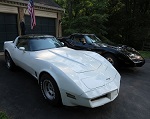


 My wifes C6 takes up the garage space that I have. I drive it about three times a week. It's hard but worth it when she is all cleaned up. I recommend a good clay bar and some light polishing with buffer. That really woke up my black paint.