When you click on links to various merchants on this site and make a purchase, this can result in this site earning a commission. Affiliate programs and affiliations include, but are not limited to, the eBay Partner Network.
Hey Guys,
I read from time to time where someone adds grease to their steering box and it's like a new box. Now, that sounds great but in reality, if the box is 45-50-55-60 years old and you pump in some grease though a cover bolt hole and you see it build up at another cover hole, it's not going to do much.
It will make you feel better I suppose, and the box may "feel" better, but the grease is not going to compensate for acid etched ball screws, bad bearings, pitting and rust, or one of the worst things with them, previous work done to them by incompetent people.
Now, far be it for me to tell you what you can or can't do with your own car. By all means have at it, I have been repairing others work for decades so do what you will.
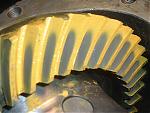
But here are some pictures of a C2 box I opened up yesterday and what I found. This is just for entertainment purposes. I am not going to get into blueprinting a box, other than to say if you think the common boxes all over the net are the same, well good luck with that thought.
Here you can see in the pictures, "newer" grease was added to this box. The original grease was an acidic sludge that already attacked the ball screw and bearings, wrecking them. The new grease did not mix, in fact it didn't do much of anything, other than make the person doing it feel they accomplished something- and they did. It didn't make a difference in the box but they did something.
When a box is in this condition, you need more than new grease. You need the right parts, the right tools, and more than a shop manual to correctly rebuild them. What I call a "shop manual" rebuild is limited. They will work, they are usually better than some of what I see online sold as "rebuilt boxes", but they are not close to how well these boxes can be set up to compete with some aftermarket examples. Again, do what you like.
what can/should a “ mechanically inclined” individual do to help prolong an old box?
in other words, can we buy a kit, replace bearings, ***** and seals and add fresh grease in a box that still feels decent…. Preventative maintenance type work…
personally, mine doesn’t feel too loose, but perhaps a weekend refreshing to replace grease, ***** and seals…
Excellent tutorial and pictures. Gives us something to think about when "servicing". A lot of our steering boxes have been "tweaked" and 'adjusted' over the years let alone not set up to high point center and installed correctly.
A blue printed box and proper install will give very good handing. Please keep going Gary.....I am 74 and still a line mech in Kona; did an IDG change a few weeks ago on a 321 NEO plus run-up . Still hurting...but ready for another challenge!
Aloha,
Rene'
Great info Gary,
Also we learned in the maintenance industry that mixing lithium based grease with moly greases of some formulas results in worthless mud with little lubrication value. I am betting the original grease in the box is lithium from the appearance.
If you don't know what was used, before using moly based grease, one should flush the old grease out of the box and pack it with the grease of their choice.
After watching a couple of utube videos I bought a new grease gun and a 14oz cartridge of greenish grease and, by using the fill hole on one side and the exit hole on the other side, put a hundred pumps into my box. Seems to be nicer now. (1965 250hp coupe)
Excellent tutorial and pictures. Gives us something to think about when "servicing". A lot of our steering boxes have been "tweaked" and 'adjusted' over the years let alone not set up to high point center and installed correctly.
A blue printed box and proper install will give very good handing. Please keep going Gary.....I am 74 and still a line mech in Kona; did an IDG change a few weeks ago on a 321 NEO plus run-up . Still hurting...but ready for another challenge!
Aloha,
Rene'
Good to hear from you again Rene, keep at it my friend. Aloha!
Great info Gary,
Also we learned in the maintenance industry that mixing lithium based grease with moly greases of some formulas results in worthless mud with little lubrication value. I am betting the original grease in the box is lithium from the appearance.
If you don't know what was used, before using moly based grease, one should flush the old grease out of the box and pack it with the grease of their choice.
Correct, I don't use lithium grease anymore, poly works better for this application.
what can/should a “ mechanically inclined” individual do to help prolong an old box?
in other words, can we buy a kit, replace bearings, ***** and seals and add fresh grease in a box that still feels decent…. Preventative maintenance type work…
personally, mine doesn’t feel too loose, but perhaps a weekend refreshing to replace grease, ***** and seals…
I don't know if I can answer your question. I don't know what the skill set is for a "mechanically inclined" person. I have had boxes come to me that were rebuilt by vette shops, vendors, local garages, bought outright off auction sites, etc. They all were bad- ALL of them. Those who did the work may be great mechanics, ASE certified, vette racers, local hot rod experts and they all had one thing in common- they didn't knowhow to correctly build these boxes. Going by the shop manual helps but knowing where to make the changes is what counts and isn't in any manual. Now some do them for money and time is the thing, use as little parts if any, paint them, pack with grease and sell them. Some flip worn out gears and sell them. Ask anyone of them to explain the difference between true center, high lash, arm position and see what you get, then ask them where they set the box to. Yes, you can buy kits from any vendor. They are decent but they don't have custom bushings, they're one size fits all. I size my own bushings to every sector after I polish them. I don't buy my parts from vendors.
Did this help explain?
Mine on my '63 has been leaking a dark reddish color fluid for a while now. Not sure what kind of grease that is, but it has stopped and now I am looking at replacing it, what grease are people using?
Actually, "grease" as is that which is commonly considered, is intended more for rubbing surface engagements and is a poor choice for most of these more modern (that as compared to something of several decades earlier) steering boxes as these example steering gear apparatuses contain roller ball bearings which are intended to "roll" not "slide", and grease tends to interfere with this function. Yes, GM, after realizing that there were multiple engineering deficiencies which resulted in unacceptable results with the use of a "gear-lube", as originally engineered intended, looked to the best, most cost effective solution, and someone said: "Simple, we'll just pack it full of "grease"!
One rather popular substitute in these instances currently is to use: John Deere "Corn Head Gearbox Grease" as this is a thixotropic type material which is for use where fluidity would be appreciated, but also an ability to re-solidify in order to reduce leakage and to hold the lubricant on the wear surfaces of concern is sought.
In another but similar example of the O.E.M.'s adopting the incorrect lubricant as a "simple" solution to solve other issues, would be in the application of "wheel bearing grease", say.......... for the front wheel hubs which mount to the spindles generally utilizing tapered-roller bearing sets. In a conversation I had with Timken's engineering representative on the subject, I was informed that Timken did not have a recommendation of, or even a specification for "grease" to be utilized on their roller-bearings as a "fluid" is the proper medium for use with rolling surface engagements of this nature.
Actually, "grease" as is that which is commonly considered, is intended more for rubbing surface engagements and is a poor choice for most of these more modern (that as compared to something of several decades earlier) steering boxes as these example steering gear apparatuses contain roller ball bearings which are intended to "roll" not "slide", and grease tends to interfere with this function. Yes, GM, after realizing that there were multiple engineering deficiencies which resulted in unacceptable results with the use of a "gear-lube", as originally engineered intended, looked to the best, most cost effective solution, and someone said: "Simple, we'll just pack it full of "grease"!
One rather popular substitute in these instances currently is to use: John Deere "Corn Head Gearbox Grease" as this is a thixotropic type material which is for use where fluidity would be appreciated, but also an ability to re-solidify in order to reduce leakage and to hold the lubricant on the wear surfaces of concern is sought.
In another but similar example of the O.E.M.'s adopting the incorrect lubricant as a "simple" solution to solve other issues, would be in the application of "wheel bearing grease", say.......... for the front wheel hubs which mount to the spindles generally utilizing tapered-roller bearing sets. In a conversation I had with Timken's engineering representative on the subject, I was informed that Timken did not have a recommendation of, or even a specification for "grease" to be utilized on their roller-bearings as a "fluid" is the proper medium for use with rolling surface engagements of this nature.
Scott.
I see you responded to this thread on C3 as well so here is the response as I posted earlier today.
HI Scott,
Just some notes.
GM used gear oil in C1 boxes and it wicked up the column onto your lap. I recall guys telling me there sometimes would be pans under them on the showroom floor. I was an infant at that time so clearly, I have no direct experience. However, many boxes come to me with all kinds of mixtures of oils, grease, and who knows what and they all leak- doesn't matter if the seals are new or not, it's an unvented box next the exhaust. The wrong type of grease will also leak.
I have heard of the John Deere grease but never used it, from what I have been told it sounds very similar to the poly grease I use. That might be something to check since it seems grease formulations seem to change over time.
Interesting on what the Timken tech told you, I too knew a Timken engineer, who was also a car guy. I don't know if he's still there, probably not since we're going back 15+ years now but maybe. I had a long talk with him one day on rear bearings - preload, endplay, and lubrication. He recommended using Timken red automotive grease, which I doubt they manufacture. I have used that and Lucas red & tacky on rear bearings for years, no issues.
Now if we were talking of precision ball bearings, used in machine tools, say for a mill spindle, huge concern with using the proper oil. Same for Way Lube on machines. I recall getting a service call for a new CNC mill not returning to the home position. I checked it and set it to move 1.00" from home and return, using a test indicator to mark the home position. With ball screws there is no backlash and there should be not lost motion. I found it was off 003-005" which might as well have been a mile. Since the machine was brand new, I checked with the maintenance guy on what way lube was used, the correct and expensive oil from Bridgeport or an aftermarket one. Well, it was a cheaper aftermarket way lube and it caused the drag. I removed the oil, cleaned it, and installed the correct lube and it came right back to home every time. Another similar story, this time with a South Bend lathe, guy was cheap, too cheap to use spindle oil so he went to NAPA and bought the thinnest oil he could for .50 a quart. He burned up the spindle bearings, which were not ball bearings but bonze bearings. So, yeah lube is critical in many ways.
GTR1999 is invisible Report Post
Great information Gary and precisely why my steering box will be coming to you come spring time. It was a pleasure chatting with you over PM's a little while back.
Actually, "grease" as is that which is commonly considered, is intended more for rubbing surface engagements and is a poor choice for most of these more modern (that as compared to something of several decades earlier) steering boxes as these example steering gear apparatuses contain roller ball bearings which are intended to "roll" not "slide", and grease tends to interfere with this function. Yes, GM, after realizing that there were multiple engineering deficiencies which resulted in unacceptable results with the use of a "gear-lube", as originally engineered intended, looked to the best, most cost effective solution, and someone said: "Simple, we'll just pack it full of "grease"!
One rather popular substitute in these instances currently is to use: John Deere "Corn Head Gearbox Grease" as this is a thixotropic type material which is for use where fluidity would be appreciated, but also an ability to re-solidify in order to reduce leakage and to hold the lubricant on the wear surfaces of concern is sought.
In another but similar example of the O.E.M.'s adopting the incorrect lubricant as a "simple" solution to solve other issues, would be in the application of "wheel bearing grease", say.......... for the front wheel hubs which mount to the spindles generally utilizing tapered-roller bearing sets. In a conversation I had with Timken's engineering representative on the subject, I was informed that Timken did not have a recommendation of, or even a specification for "grease" to be utilized on their roller-bearings as a "fluid" is the proper medium for use with rolling surface engagements of this nature.
Scott.
I have heard that John Deere "Corn Head Gearbox Grease" is in the right spot between gear oil and chassis grease. I used that, and we will see how that works.
The John Deere grease is a poly grease, same as I use from Lucas, I expect both will perform as expected.
"John Deere Corn Head Grease - AN102562. Polyurea thickened grease that is a superior corn head lubricant. Great problem solving grease for gear boxes with leaky seals. Excellent performance at extremely high and low temperatures. Resists corrosion and oxidation in wet operating conditions."
Just a note: There are 'lots' of different application intentioned "Poly" (polyurea) greases on the market, as this value in the description mostly has to do with the type of "thickener" (e.g. polyurea vs. lithium, etc.); the "poly" examples, because they don't contain metal soaps, such as calcium, lithium, etc., which are often addressed as pro-oxidants to varying degrees, tend to provide superior resistance in oxidation and "wash-off" so they are often preferred in high humidity or even wet conditions and the sealed "lubed for life" applications.
But do be aware that "poly" greases does demonstrate greater compatibility problems when exposed to other non such greases, so it might not be the best product if just "topping-off" grease reservoirs of old cars, that versus new clean assemblies.
Correct. Topping off a box with a poly grease that most likely has/had lithium grease in it, i s not going to work. They won't mix. Like the pictures shown in my first thread.
I personally don't see much value in topping off boxes that are 45-60 years old and have or had the original grease in the. The damage has been done to the box already. Now, if the box was rebuilt it shouldn't need topping off, but people do different things so who knows.
If I had a box and just wanted to regrease it, I would pull it out of the car, clean out all the old junk, check the gears for pitting or bottoming out, and then add the new poly grease. The high lash has to be set at that point and a new cover gasket will be needed. However, going that far and not addressing the box as a whole is foolish and not where pinching pennies should be made.


















 Steering Box greasing