When you click on links to various merchants on this site and make a purchase, this can result in this site earning a commission. Affiliate programs and affiliations include, but are not limited to, the eBay Partner Network.
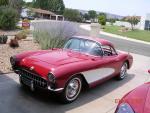
Hi, I just wanted to share a few pictures of the single WCFB carburetor to dual WCFB 2626S / 2627S conversion I performed on my 1960 Corvette. It was a full day’s job, after completely disassembling the dual carburetor setup, verifying that all the correct parts were present, thoroughly cleaning everything, and rebuilding both the 2626S and 2627S using new gaskets with float adjustment, ....
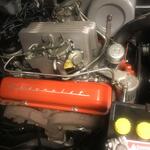
Once assembled, the car started immediately as soon as the new fuel filter bowl and the carburetor bowls were filled with fuel. Now I still need to tackle the tuning phase, dealing with the almost inaccessible idle mixture screws on the rear carburetor, the slightly more accessible idle speed screw, and figuring out how to avoid interference between the vacuum take‑off fitting at the rear of the primary carburetor and the distributor when adjusting the ignition timing advance. This is the initial set-up of my 1960 Corvette, 230 hp, single wcfb carburetor and the orange Chevrolet valve covers
Single carburetor and cooling circuit disassembly Intake manifold (and distributor) removed, new intake gaskets positionned with PRV on the china wall and on the front Aluminium intake manifold in place and bolted. Temperature sensor and temperature valve cover installed 2626S and 2627S dual carburetor installed on the intake manifold Fuel line installation Throttle linkage installation, progressive position on the front carburetor Carburetor assembly with the aliminum valve covers, passenger side Carburetor assembly with aliminum valve covers, driver side Engine view from the rear Engine from the front Next challenge: Engine tune-up, with dwell angle check, timing adjustment, idle mixture and idle speed. With still quite a few questions about how to access all the adjustment points now
A thousand thanks again to all the members of this incredibly valuable forum, who helped me get this far—without even mentioning all the other critical situations this forum has helped me resolve so effectively !
Bruno
Last edited by Projet1960; May 2, 2026 at 05:22 PM.
Looks good, Bruno. I went through a similar exercise on my 57, from a single 4 barrel to dual quads, though mine was a bit challenging since I’m running a 350. I did have to re-clock my distributor to gain access to the points window and still pull vacuum from the rear carb. Here’s a few pics of my setup.
Project 60
Is your engine the 270 HP engine .
Or the hydraulic.
My first corvette was a 60 with the 270 HP engine .
I bought it in May of 1968 upon my return from Vietnam . 58 years ago
I recently did something similar, albeit on a 1957 Chevrolet passenger car. Many tuning issues and I finally threw in the sponge and replaced the distributor with a correct Delco 891 series. 270 HP cars were centrifugal only (no vacuum advance) and passenger cars with additional hood to engine clearance used the Bat Wing air cleaner. Back in the day these air cleaners were discarded for small chrome bonnets, today one will spend big bucks to source one of these. I'm old school and wanted the original look... Al
Vernerey,
Very nice job on the dual carb swap...looks really nice. Quick question...did you do any head work or swap out the cam? If not, I'm curious as to how that original 230hp/283 is going to handle all that extra gasoline. Inquiring minds want to know.
Vernerey,
Very nice job on the dual carb swap...looks really nice. Quick question...did you do any head work or swap out the cam? If not, I'm curious as to how that original 230hp/283 is going to handle all that extra gasoline. Inquiring minds want to know.
Good point. I did indeed install a 097 Duntov camshaft last spring, and I also swapped my cylinder heads for Powerpacks. I’m not 100% confident that this combination is perfectly coherent overall; a 270 hp dual‑carb setup would probably have been a better choice, but I’ll do my best to get everything properly tuned.
Looks good, Bruno. I went through a similar exercise on my 57, from a single 4 barrel to dual quads, though mine was a bit challenging since I’m running a 350. I did have to re-clock my distributor to gain access to the points window and still pull vacuum from the rear carb. Here’s a few pics of my setup.
John
Nice setup, especially with the individual air cleaners! It does look like I need to get familiar with the process of re‑clocking the distributor. I’m currently waiting for delivery of a dial‑back timing light so I can seriously get started on this. Thanks for the pictures—I’ll speak up on the forum if I run into any difficulties with the re‑clocking
Project 60
Is your engine the 270 HP engine .
Or the hydraulic.
My first corvette was a 60 with the 270 HP engine .
I bought it in May of 1968 upon my return from Vietnam . 58 years ago
A great piece of history! I really love this kind of reference to what was being done 58 years ago. I installed a 097 Duntov camshaft with solid lifters last spring. I can’t really say my engine is a true 270 hp setup, since my new carburetors are 245 hp units, but some of the car’s behavior should now be getting pretty close to that!
I recently did something similar, albeit on a 1957 Chevrolet passenger car. Many tuning issues and I finally threw in the sponge and replaced the distributor with a correct Delco 891 series. 270 HP cars were centrifugal only (no vacuum advance) and passenger cars with additional hood to engine clearance used the Bat Wing air cleaner. Back in the day these air cleaners were discarded for small chrome bonnets, today one will spend big bucks to source one of these. I'm old school and wanted the original look... Al
A gorgeous piece of machinery with that style of air cleaner—it must spark quite a few passionate discussions! I am indeed wondering whether it really makes sense not to keep the vacuum advance. I’ll run some tests and do some tuning with and without it, and then I’ll see which setup best matches how I use the car (country roads, more or less winding, with little elevation change).
I just had a pair of 270hp carbs restored by Phil at Custom Rebuilt Carbs and he stated that even in a 270hp configured engine they ran pretty rich. He used the 245 rods and jets in for my 283 project.
I recently did something similar, albeit on a 1957 Chevrolet passenger car. Many tuning issues and I finally threw in the sponge and replaced the distributor with a correct Delco 891 series. 270 HP cars were centrifugal only (no vacuum advance) and passenger cars with additional hood to engine clearance used the Bat Wing air cleaner. Back in the day these air cleaners were discarded for small chrome bonnets, today one will spend big bucks to source one of these. I'm old school and wanted the original look... Al
In 1966 when I did the 6cyl to 283 conversion on my 51 Chevy I added a super cheap 2x4 setup to the engine. A few years later, I replaced the 283 with a 327 and Z28 intake and Q-jet and the 2x4s came off and went on the shelf for 35+yrs.
Present day, I replaced the 327 with a SB389 and pulled the 2x4s off the shelf. After 35yrs on the shelf, only the front carb needed a rebuild. I decided it also needed a batwing, so i bought a repo batwng (VERY NICE REPO!!!) for $1200. With the ancient air cond compressor (added in 66), the batwing had to be installed backward.
I just had a pair of 270hp carbs restored by Phil at Custom Rebuilt Carbs and he stated that even in a 270hp configured engine they ran pretty rich. He used the 245 rods and jets in for my 283 project.
As I see it getting the right jets and rods is 'seat of your pants' trial and error. I have tried different jets and rods trying to get a good driving car, with limited luck. I have an air/fuel meter that will not work on my car, seems it objects to ignition noise, I'm using solid core plug wires with non resistor plug and the manufacture tells me it will never work! Plugs #1 & #2 quickly fowl with soot so I believe I'm too rich on the front carburetor, I have smaller jets coming. Sociometric is 14.7:1 air to fuel, this is easy to attain in an airplane engine that is running at a constant power setting when measured with an exhaust temp gauge. It is not easy to maintain this A/F with constant power changes as found in automobiles. I think the best you can hope for is a good driver, reasonable fuel economy and maintenance free... Al
As I see it getting the right jets and rods is 'seat of your pants' trial and error. I have tried different jets and rods trying to get a good driving car, with limited luck. I have an air/fuel meter that will not work on my car, seems it objects to ignition noise, I'm using solid core plug wires with non resistor plug and the manufacture tells me it will never work! Plugs #1 & #2 quickly fowl with soot so I believe I'm too rich on the front carburetor, I have smaller jets coming. Sociometric is 14.7:1 air to fuel, this is easy to attain in an airplane engine that is running at a constant power setting when measured with an exhaust temp gauge. It is not easy to maintain this A/F with constant power changes as found in automobiles. I think the best you can hope for is a good driver, reasonable fuel economy and maintenance free... Al
Al, I run solid core wires and resistor plugs in my '60 which is equipped with Innovate air/fuel measuring equipment. I've never had an ignition noise problem. You might consider temporarily installing resistor plugs while you dial in those carburetors with your air/fuel equipment. Just a thought.....
Jim
[QUOTE=AlHewitt;1609619640] Back in the day these air cleaners were discarded for small chrome bonnets, today one will spend big bucks to source one of these. I'm old school and wanted the original look...
Of course we did, " Hot Rod" magazine told us to do this.. " better air flow, MORE horsepower" .... LOL ... Not sure if it was " Hot Rod" ( I can't remember too many other car mags back then) but I remember reading an article on getting rid of that cranky cantankerous Fuil Injection that was hard to work on and hard to find people who were capable of working on it.... Recommendation was a 4 barrel w/ aluminum intake that would produce MORE HORSEPOWER than the Fuel Injection would....... Different times....
Back in the day these air cleaners were discarded for small chrome bonnets, today one will spend big bucks to source one of these. I'm old school and wanted the original look...
Of course we did, " Hot Rod" magazine told us to do this.. " better air flow, MORE horsepower" .... LOL ... Not sure if it was " Hot Rod" ( I can't remember too many other car mags back then) but I remember reading an article on getting rid of that cranky cantankerous Fuil Injection that was hard to work on and hard to find people who were capapable of working on it.... Recommendation was a 4 barrel w/ aluminum intake that would produce MORE HORSEPOWER than the Fuel Injection would.......
Yep,I fell into the belief that a 4bl instead of 2x4s or FI was a much better way to go.
I replaced the old 283 with a 327, then a 350, and now I have an early 2x4 setup on a 389 and an FI unit on a SB400. Both work great and I can work on them-----------NO COMPUTER CRAP!
I had a 2x4 set up on my 62 (327) but eventually changed it to a single AFB on an Edlebrock 'medium' rise 180* manifold that would fit under hood. The improvement in 'seat of the pants' hp was amazing. 2x4s look cool, but are NOT the best for hp.
Shortly before I got out of the Army , I bought an Edelbrock C3b manifold and installed it with an unidentified AFB 4 barrel on my 270 HP engine in my 60 Corvette .
I was amazed at the differance in both HP and torque it made .
I could out sprint a few of the Army buddies who had 383 Roadrunners , up to about 80/90 mph .
Project 1960 - I have the same thought about my 60. I don't care if it is faster or not with dual WCFBs. But it definitely is stronger on the cool factor
Project 1960 - I have the same thought about my 60. I don't care if it is faster or not with dual WCFBs. But it definitely is stronger on the cool factor
Joe
Hey Joe, Great thought. I have to admit that it was also the technical challenge of the conversion and tuning, as well as the look of the dual carburetors in the engine, that motivated me! Not to mention the hope of improving performance. I’m not ruling out, however, another modification that would take me a bit further away from the original configurations in the future, once I’ve fully mastered these dual carburetors… without making any irreversible changes, of course.
I was able to re-clock the distributor with a 180° rotation. Double benefit: A very significant latitude to adjust the distributor advance and completely clear access to the distributor fixing screw (the access no longer being blocked by the vacuum capsule). The spark plug wires also had a 180° rotation on the distributor cap. The alignment of the distributor rotor finger is done on the terminal of spark plug No. 1 on the distributor cap, when the engine is at TDC compression on cylinder 1. Full access to the distributor fixing bracket and screw
Distributor from the driver side. Rotated 180° compared to initial situation.












 Single wcfb to dual wcfb convertion - Job done