When you click on links to various merchants on this site and make a purchase, this can result in this site earning a commission. Affiliate programs and affiliations include, but are not limited to, the eBay Partner Network.
Hi everyone.....
its me eva..i love this forum,,lots of expert advice here.....my husband pulled the engine and broke it down and said its never been bored or honed....my question is can i hone it 10 over with new pistons and rings and does anyone recommend where to get them and do the rings need to be steel because of iron block...hsband question not mine....lol..thank you all
In a word, no. To go to .010 " oversized pistons requires that the block be bored by a machine shop and finish honed. It's also difficult to know that .010 " will be enough for all cylinders and the machine shop will bore to clear the most worn cylinder and then tell you (or supply them) what size pistons you need. There's a good chance that the crankshaft might also need to be turned and that's a machining operation. Now, if the block and crankshaft show little wear then it is quite possible that standard sized rings with a light honing and standard sized bearing will work. In that case, almost any name brand rings and bearing will work.
BEFORE YOU DO ANYTHING TO THAT ENGINE, your best bet will be to reach out to CF member Westlotorn, Mark. He is the forum expert on what to do and what NOT to do.
sure... But do you know if the block needs to be bored out? The way to check is to measure the taper. Then let a reputable machine shop figure out the rest. I would not order pistons until they finish the machine work. Also might as well as to get new cam bearings and line honed. Have them mic the crank maybe magnaflux it. Figuring out the taper is fairly easy. Check out VICE GRIP GARAGE. Derek has a good video on how to check the taper. Are there any spots where you can catch a finger? Also talk to Westorn too! He helped me a lot with my engine. Also, try to not get it decked because you want to keep that stamp pad.
When the 327 in my coupe went bad I was looking around for a new engine, block, or long block... I found a block and took it to the machine shop... It had .027 taper in it.... LOL... Joke was run the hone through it and put in 030 pistons... As said previously on here, you need to have the block checked out..
This was a long time ago when I was young... And by coupe l meant this..
BEFORE YOU DO ANYTHING TO THAT ENGINE, your best bet will be to reach out to CF member Westlotorn, Mark. He is the forum expert on what to do and what NOT to do.
Sorry guys, I was out and about. First, Thanks for the confidence Jim but there are many parts and jobs I know little about. Pistons, Rings, Cylinder finish, crankshaft finish and Engine bearings we did spend a lot of time working with the guys that did that professionally and the engieering staff that designed those parts.
We all know Brandon and others offer top notch help every day on here.
You have already been given solid information about your rebuild.
Some facts. There are no standard manufactured pistons available at .010 for a 283 so you are stuck going to .020 over as the next oversize and as already mentioned .020 over may not be enough to really straighten your cylinders back to a quality finish. In the old days, say Pre 1985 the large rebuilders, those doing more than 250 engines per month would bore and hone to .040 over on the first cut because they knew many used engines would not clean up at .030. To save themselves time they bored all untouched engines to .040. Have it checked before doing anything and keep the new bore as small as you can to protect future rebuilds if necessary. Once measured a shop can advise you. When I did my 406 small block, they measured and we got pistons for .20 oversize. One cylinder would not clean up at .020 so I had to go .030 to get 8 clean cylinders. That is not unusual so expect things like that.
First thing you need as already advised is to get a professional shop involved that can Dial Bore gauge your cylinders and measure your crankshaft and establish your starting point. Undamaged used crankshafts will usually clean up at .010 under but if needed bearings are available all the way to ,040 under.
A quality hone job after it is bored makes all the difference in how well your rings will seal. A quality hone will use nearly zero oil. A bad hone will have you buring a quart every 1,000 miles or much less so spend the money on a quality hone. Speak to owners that have had engines built at the shop you choose and make sure they are not using oil after the rebuild.
Upgrade to Moly Top Piston rings because they seal better and last longer while wearing the cylinders much less. The cost is small, less than $25. to upgrade to Moly rings.
You may find your engine has been used little over its life and has very little wear, at this age the odds are very small but possible.
Make sure your shop of choice has good reviews, for oil control first but also for standing behind work they do. Some are fantastic and some are crooks.
Many others on this forum have extensive information to share and will help guide you as you proceed. You are not the first to go down this road.
I see you are in Anaheim, I worked with Machine Shops from Turlock to the Canadian border but we had another Rep that had Arizona and Southern California so I do not know the shops down there. I know a guy still working in the trade down there I could call if you can't find a name but you need to do your own verification before spending money anywhere.
I have been out of the business since 2019 so my information is getting older by the day and may not be current by today's standards.
Thank you guys very very much for helping me thru this....my husband does a fair amount of mechanics but nothing to what some of you do.....again thank you all very much......eva
There are several knowledgeable engine rebuild members here on the forum. You need to provide as much information as you can to help them guide you as they did me.
Do you know the miles on the engine? Does it have the original GM pistons and head gasket as an indication that it has not been previously rebuilt. Are you and / or your husband experienced with engine rebuilding and tolerances. Do you have the GM manual on overhaul of the engine which gives you the factory and service tolerances? Do you have the measuring equipment to measure the bore and piston diameters as well as the crankshaft diameters? Have you measured the bore, pistons, and crankshaft journals?
Are you looking for a factory fresh complete rebuild or a 're-ring' job. Do you have an unlimited budget or are you looking to do it with the least investment? Do you plan on driving the car 5,000 or more miles a year or just a couple of thousand miles to shows and cruises.
I did a re-ring on the 327 in R66 as the cylinders had only ~.002" wear and had no scoring. The valve guides were at the maximum 'service' wear specified by GM, but with new valves, they came within the high end of the clearance tolerance. I reused the pistons. Based on Mark's recommendation, I did NOT hone the cylinder walls for new moly rings, only removed the slight ring ridge. I did install new rod bearings, although the GM bearings were still perfect.
The engine had ~50,000 original miles. We use the car for car shows and cruising locally with an occasional trip of 300 miles or so. I doubt we will see 30,000 miles on the re-ring engine. The engine has ~800 miles now and has not used any oil. I lost oil pressure at idle as the new Cleveite rod bearings were .002" clearance as opposed to the original GM bearings were .0015" clearance.
R66, you mentioned you LOST oil pressure at idle. Might wish to clarify that you had less oil pressure at idle. Lost oil pressure sounds like it fell to zero. If memory is correct your pressure was well above zero but not where you were used to and all is well with that engine?
Thanks for the clarification Mark. YES, I still have ~15# of oil pressure at hot idle (600 rpm) which is acceptable by GM standards. I meant to say I lost approximate 5# of pressure at hot idle which I am attributing to the increased rod bearing clearance. Also, the Cleveite bearings were STD, but had the increased clearance.
Designer Imagines A Corvette That Looks More Like a Corvette Than the Corvette
Slideshow: A Jaguar designer's personal project imagines what a modern front-engined Corvette might look like if Chevrolet revisited the golden age of the Stingray.






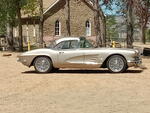
 59 corvette Honing the 283 and rings