When you click on links to various merchants on this site and make a purchase, this can result in this site earning a commission. Affiliate programs and affiliations include, but are not limited to, the eBay Partner Network.
Also, going LS means none of the factory brackets, exhaust, shrouding, and related stuff will properly fit.
With the 383, you "only" change the guts of the engine, basically.
And, I agree a properly build 383 will get you to 500+ hp for the lowest cost, most likely.
When you say " interstate driver' be advised that alot of the crate engines horsepower options are achieved with larger cams that can " lope' with an OD transmission cruising at lower RPMS.......
Before I went LS, I was looking at the Smeding performance crate engines. Many 383 SBC options
Cubic inches. Hp per cubic inch is easier and cheaper to build when your platform is bigger. I finished a Ford 302 into a 347 not long ago. 571HP naturally aspirated solid roller streetable build and his bill was close to $18k. Just before that I did a 427 BBC hydraulic roller at almost the same power level for $12k. Fast, cheap, or reliable; you can only pick two. Talk to your local speed shop and be present at the dyno if they will let you. If they won't, ask for the uncorrected numbers or at least get the full dyno print out and calculate it your self. (total fuel/bsfc) It is really easy to manipulate the numbers by moving the correction factor to make an engine seem powerful. Many crate manufacturers leave these items off the sheet for this reason.
I drive an LS and I like it, but it is much more expensive than building a gen 1 V8. There is radiator, accessory drive, hoses, mounts, wiring, ecu, exhaust, electronic tach, ect. I did mine on the cheap and still spent about eight grand.
I took an LS1 out of a 99 vette and had it rebuilt at a shop that specialises in LS engines. I put it in a 1986 K-5 Blazer and did all the work myself except the actual engine rebuild and tuning. I rebuilt the 4L80 and transfer case at the time but to the above points I had to fabricate a few things, new radiator, new wiring harness and so on. My best guess is I spent $15K ish doing everything on my own. It was worth it because I use this blazer as a mostly daily driver. I personally think that there is nothing better in an old car then an LS for drivability and dependability but car originality and budget play a huge part in that.
I will say, not that anyone asked, really spend time thinking about what you want to get out of the new engine. I've probably had 8 engines built and the 1st 5 or 6 I said make it as much horse power as you can. I personally don't think horse power and drivability go hand in hand. If you want a car that you are going to race then built it for as much torque and horse power as you can. If you want engine that you can drive, gets decent gas milage and holds up well have it built for drivability, small cam and so on. I built this engine in a 1970 Camaro. It looks and sounds awesome and it made 476 HP on the dyno. It drives horrible, gets about 7 miles a gallon and just sat in my garage because of how much I disliked driving it. The opposite is when I asked for an engine that I did not care about horse power I wanted to drive it comfortably and got just over 300hp and it's amazing in a 71 chevy truck..
Last edited by 3kiddos789; Jun 17, 2026 at 11:16 AM.
I took an LS1 out of a 99 vette and had it rebuilt at a shop that specialises in LS engines. I put it in a 1986 K-5 Blazer and did all the work myself except the actual engine rebuild and tuning. I rebuilt the 4L80 and transfer case at the time but to the above points I had to fabricate a few things, new radiator, new wiring harness and so on. My best guess is I spent $15K ish doing everything on my own. It was worth it because I use this blazer as a mostly daily driver. I personally think that there is nothing better in an old car then an LS for drivability and dependability but car originality and budget play a huge part in that.
I will say, not that anyone asked, really spend time thinking about what you want to get out of the new engine. I've probably had 8 engines built and the 1st 5 or 6 I said make it as much horse power as you can. I personally don't think horse power and drivability go hand in hand. If you want a car that you are going to race then built it for as much torque and horse power as you can. If you want engine that you can drive, gets decent gas milage and holds up well have it built for drivability, small cam and so on. I built this engine in a 1970 Camaro. It looks and sounds awesome and it made 476 HP on the dyno. It drives horrible, gets about 7 miles a gallon and just sat in my garage because of how much I disliked driving it. The opposite is when I asked for an engine that I did not care about horse power I wanted to drive it comfortably and got just over 300hp and it's amazing in a 71 chevy truck..
Cubic inches. Hp per cubic inch is easier and cheaper to build when your platform is bigger. I finished a Ford 302 into a 347 not long ago. 571HP naturally aspirated solid roller streetable build and his bill was close to $18k. Just before that I did a 427 BBC hydraulic roller at almost the same power level for $12k. Fast, cheap, or reliable; you can only pick two. Talk to your local speed shop and be present at the dyno if they will let you. If they won't, ask for the uncorrected numbers or at least get the full dyno print out and calculate it your self. (total fuel/bsfc) It is really easy to manipulate the numbers by moving the correction factor to make an engine seem powerful. Many crate manufacturers leave these items off the sheet for this reason.
Brandon Unklesbay
All-In Performance, LLC
Listen to this man. He does this for a living.
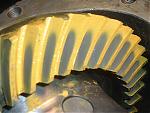
Another note many don't think of when dropping in an engine 2x the capacity of the original, depending on use, you may want to check everything south of the flywheel. C2 diff's were not good for example. Outer axles were good to about 450hp again depending on usage.
As a couple of people have brought up, the drivetrain is something to think about.
When I installed my ~600hp 540, I didn't just drop it in.
Basically, everything behind the engine has been upgraded.
I don't know what power level your drivetrain is good for, when new or what state it's in now.
Broken U-joints can do lots of damage.
My friend's Dad used to tell us this story about one of his friends when he was a teenager who dropped the clutch in his Mustang and the clutch shattered and he didn't have a scatter shield and the fragmented clutch basically chopped off his girlfriend's foot.
Dramatic story but it makes a point.
typical driveline upgrades in my over 500 hp rides have included built manual shift TH400 with a shield, 1350 series U joint driveline, 9" or 8.8" rear, good larger spline count axles, long 1/2" wheel studs, etc.
Of course intended use of the car has a lot to do with it. I went drag racing...shock loads are not so bad with street driving, or track racing. But there are other considerations for them.
Thank you Gary. I can tell you from many experiences, the sweet spot for the demographic that owns and likes to drive their C2's (and other higher-end muscle cars) is about 1.15hp/ci. (400-425hp) Dependable and well mannered is the key. Cheaper to build and easy on parts. You can certainly have a ton of HP and be well mannered, but it comes with a cost. And that cost isn't just a shop like mine, but everything behind the flywheel that needs to compliment the power source, as Gary said. Making power is easy. Making useable power is the challenge. The little Ford I spoke of made peak torque at 5200, peak HP at 7400. How often will you see that on the street? Pick a platform, focus on a flat torque curve, sub 4000rpm, and drivability. Everything else is just numbers on paper in regard to a big dyno figure.
Designer Imagines A Corvette That Looks More Like a Corvette Than the Corvette
Slideshow: A Jaguar designer's personal project imagines what a modern front-engined Corvette might look like if Chevrolet revisited the golden age of the Stingray.