When you click on links to various merchants on this site and make a purchase, this can result in this site earning a commission. Affiliate programs and affiliations include, but are not limited to, the eBay Partner Network.
Today I decided to unwrap the wiring mess that I had near the voltage regulator to sort it out and clean it up. I'm also seriously considering eliminating the voltage regulator and installing a new "GM one-wire" alternator. The two photo's below show what I found when I unwrapped layer upon layer of electrical tape and a drawing of how this mess of wires is actually connected. The third photo is a screen capture of the red distribution block (rated for 150 amps) I'm considering using to eliminate all the crimps and poorly soldered connections.
Both Zip and Summit Racing sell a regulator elimination connector block to allow the regulator wiring connector to be re-wired correctly for the one wire alternator. I'm not sure that device is absolutely necessary and may try to fashion my own. Thoughts?
On my drawing, I listed two questions that I haven't been able to sort out with my wiring chart.
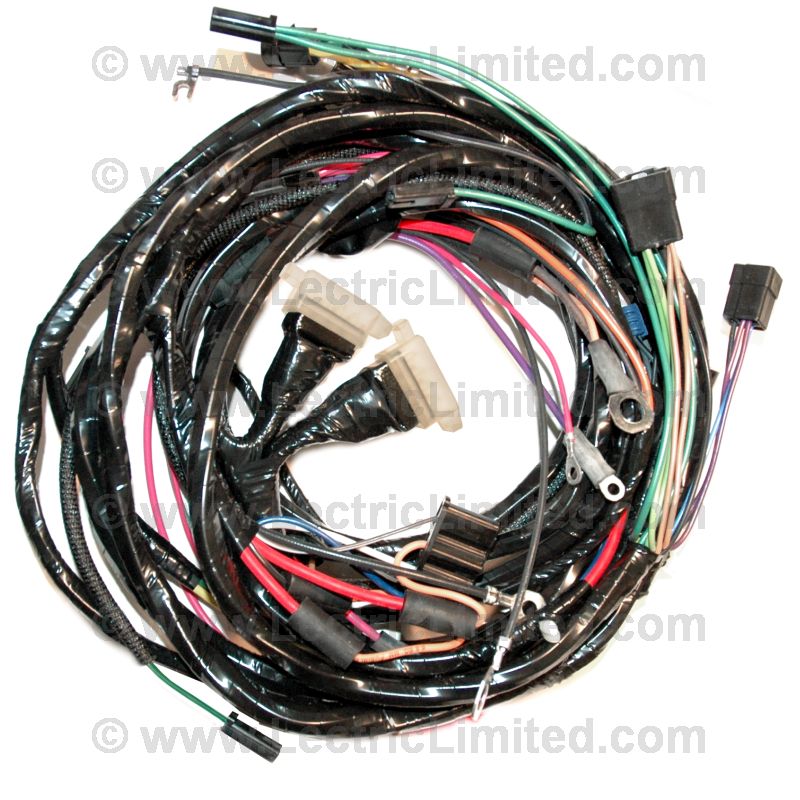
Here's a better solution...buy a new engine harness and re-wire the entire engine compartment. If that small area looks like that, who knows what the rest of the harness may look like. Cheap insurance for reliability and fire risk. And, here's a vote against going with a one-wire alternator.
Here's a better solution...buy a new engine harness and re-wire the entire engine compartment. If that small area looks like that, who knows what the rest of the harness may look like. Cheap insurance for reliability and fire risk. And, here's a vote against going with a one-wire alternator.
What is the vote against the one wire alternator based on?
What is the vote against the one wire alternator based on?
Switching a C2 Corvette from the original externally regulated alternator system to a modern “one-wire” internally regulated alternator is very common, but there are tradeoffs. The conversion simplifies the charging system considerably, yet it also changes some operational characteristics that matter on a vintage car.
Here are the primary downsides and considerations:
1. Poorer Low-RPM Charging Performance (Most Common Complaint)
Many traditional one-wire alternators do not begin charging until the alternator reaches a certain RPM threshold.
That means:
At idle, especially with:
a big cam,
low idle speed,
electric fans,
headlights,
AC,
or electric fuel pumps,
the alternator may not “turn on” immediately.
You often must:
blip the throttle after startup,
or rev the engine to 1200–1800 RPM once,
before charging begins.
After “exciting,” it usually continues charging at idle.
This is one of the biggest functional disadvantages versus the original Delco externally regulated system.
2. Less Accurate Voltage Sensing
Original GM externally regulated systems used:
remote voltage sensing.
The regulator could monitor system voltage farther away from the alternator itself, helping maintain more stable voltage throughout the car.
A one-wire alternator usually senses voltage internally at the alternator output stud only.
Result:
Slightly less precise voltage regulation,
especially under heavy electrical loads.
In a mostly stock C2, this usually is not catastrophic, but the original GM design was actually very sophisticated for its time.
3. Loss of Originality
For collectors and NCRS-oriented restorations of the Chevrolet Corvette C2, a one-wire conversion:
is not factory correct,
changes engine compartment appearance,
eliminates the original external regulator,
and may reduce authenticity/value in judged restoration environments.
If originality matters:
stay with the stock Delco setup.
4. GEN/ALT Warning Light Issues
The original charging system used the dash warning light as part of the excitation circuit.
With many one-wire alternators:
the warning light no longer functions properly,
or requires rewiring/modification.
Some conversions:
leave the light permanently disabled,
while others need resistors or special wiring tricks.
5. Potential Overcharging at Higher RPM
Some cheaper one-wire alternators:
regulate less accurately,
can run higher charging voltages,
and may overcharge batteries during long highway operation.
This is more common with:
inexpensive offshore units,
poorly rebuilt alternators,
or old hot-rod conversion kits.
A quality alternator minimizes this issue.
6. Electrical Noise / Tachometer Compatibility
Some aftermarket internally regulated alternators can introduce:
ignition noise,
tachometer instability,
or radio interference.
This is less common today but still occurs occasionally in vintage GM vehicles.
7. You Lose Some Diagnostic Simplicity
Ironically, the original external regulator system is often easier to diagnose because:
regulator,
alternator,
and wiring
are separate components.
With an internally regulated alternator:
failure of the internal regulator usually means alternator replacement/removal.
To answer your question about the brown wire, it's job is to supply power for the initial excitation of the field and requires a switched ignition source BUT it requires some form of inline resistance (or a diode to prevent run-on after the ignition is switched off. A common method is to wire a small lamp in series in that circuit and that becomes the generator indicator or can be tucked out of the way.
My preference is to keep the external regulator because it looks much more authentic. If you install one of the solid-state conversion kits, the regulator looks completely stock but functions much better.
Here's a better solution...buy a new engine harness and re-wire the entire engine compartment. If that small area looks like that, who knows what the rest of the harness may look like. Cheap insurance for reliability and fire risk. And, here's a vote against going with a one-wire alternator.






 Voltage Regulator wiring mess.......