When you click on links to various merchants on this site and make a purchase, this can result in this site earning a commission. Affiliate programs and affiliations include, but are not limited to, the eBay Partner Network.
Damn, tell me you dont understand the pcv system without telling me you dont understand the pcv system.
The catch can that OP has hooked up creates a vacuum in the crankcase. Follow the catch can lines IM vacuum->can->oil filler cap (crankcase). The catch can will pull a vaccuum in the crankcase during idle. Normally, outside air is pulled into the crankcase through what would generally be a fresh air port that usually pulls behind the air filter. if the ports on the valve cover are open, thats where it will pull from instead. As i mentioned in my previous post, you CAN put breathers on the VC, but at that point theres no point having a catch can as it will do nothing, and it is generally worse for your engine. Some will argue that it's potentially better for performance IF you have so much blowby that your catch can/PCV cant handle the vapors, causing some effective octane drop by oiling up the intake air.
You need to take your own advice and stop giving forum members bad advice.
When I answered to cap his NPP and fuel ports, he was not sure if his tuner removed NPP or if the new fuel system no longer had a purge valve system.
Regarding your "back in the days" comment - it's generally accepted nowdays that the PCV system extends engine life by removing blowby gasses from sitting in oil. Allowing the lower RPM/daily driving idle blowby back into your intake burns it and chucks it out of the exhaust instead of sitting in your engine oil.
If you are building a race car, do the PCV delete with breathers. If you are building a car to daily drive, or drive and park without doing an oil change very frequently, keep the PCV system operational.
No, my IM port next to the crankcase port is capped, the only port/line into that vented can is the crankcase port, and the other end goes into the oil cap/valve cover.
Damn, tell me you dont understand the pcv system without telling me you dont understand the pcv system.
You need to take your own advice and stop giving forum members bad advice.
...
Regarding your "back in the days" comment - it's generally accepted nowdays that the PCV system extends engine life by removing blowby gasses from sitting in oil. Allowing the lower RPM/daily driving idle blowby back into your intake burns it and chucks it out of the exhaust instead of sitting in your engine oil.
Exactly, Mr.Dez is giving bad advice and does not seem to understand PCV.
These are some major issues with breathers clearly stated:
1. Breathers on the crankcase create scalar pressure differential which originates at the piston ring which forces the ring to unseat early on the end of power stroke
2. Breathers allow maximum random collisions inside the crankcase for blow-by to deposit and enter engine oil
3. Breathers raise pressure below each piston rings which traps blow-by gas and oil in the ring pack which leads to oil and carbon buildup inside the rings
4. because of #3 this causes more oil to be drawn up into the combustion chamber on the intake stroke
5. Breather create pressure higher than atmospheric inside the crankcase which pushes oil into every engine oil seal(front main, valve cover, gaskets, rings, etc...) Which causes leaking
6. Breather create pressure higher than atmospheric which raises oil droplet density and oil droplet radius which causes more of the blow-by gas to contain oil as it flows around and out of the engine (Engine will blow more oil mass per volumetric unit of air being released)
The results of a breather system are: contamination, oil leaking, reduced engine life, increased blow-by, increased oil ingestion/burning, increased oil density and oil droplet radius inside the crankcase and what comes out of the crankcase will contain more oil, increased oil found inside the intake systems and baffle systems as it was being ingested, increased sludging and deterioration of oil quality.
Those are all scientific guarantees its just how engines work, blow-by tries to escape -> pressure changes as blow-by escapes -> this is what happens when molecules collide below the piston ring at random with other gasses in an elastic collision
If you are building a race car, do the PCV delete with breathers. If you are building a car to daily drive, or drive and park without doing an oil change very frequently, keep the PCV system operational.
Race cars should never use breathers. Real race cars use vacuum pumps to produce PCV which seals rings and controls oil. If there is a rule in your racing team against vacuum pumps then a (team) of engineers would design a kinetic energy PCV removal system such as venturi for exhaust, or airflow point on the vehicle, to produce a vacuum in the crankcase some other way. If you do not have a team of engineers and sponsors to develop these minute edge systems to defeat a level playing field while following all the racing rules then it isn't actually racing.
Exactly, Mr.Dez is giving bad advice and does not seem to understand PCV.
These are some major issues with breathers clearly stated:
1. Breathers on the crankcase create scalar pressure differential which originates at the piston ring which forces the ring to unseat early on the end of power stroke
2. Breathers allow maximum random collisions inside the crankcase for blow-by to deposit and enter engine oil
3. Breathers raise pressure below each piston rings which traps blow-by gas and oil in the ring pack which leads to oil and carbon buildup inside the rings
4. because of #3 this causes more oil to be drawn up into the combustion chamber on the intake stroke
5. Breather create pressure higher than atmospheric inside the crankcase which pushes oil into every engine oil seal(front main, valve cover, gaskets, rings, etc...) Which causes leaking
6. Breather create pressure higher than atmospheric which raises oil droplet density and oil droplet radius which causes more of the blow-by gas to contain oil as it flows around and out of the engine (Engine will blow more oil mass per volumetric unit of air being released)
The results of a breather system are: contamination, oil leaking, reduced engine life, increased blow-by, increased oil ingestion/burning, increased oil density and oil droplet radius inside the crankcase and what comes out of the crankcase will contain more oil, increased oil found inside the intake systems and baffle systems as it was being ingested, increased sludging and deterioration of oil quality.
Those are all scientific guarantees its just how engines work, blow-by tries to escape -> pressure changes as blow-by escapes -> this is what happens when molecules collide below the piston ring at random with other gasses in an elastic collision
Race cars should never use breathers. Real race cars use vacuum pumps to produce PCV which seals rings and controls oil. If there is a rule in your racing team against vacuum pumps then a (team) of engineers would design a kinetic energy PCV removal system such as venturi for exhaust, or airflow point on the vehicle, to produce a vacuum in the crankcase some other way. If you do not have a team of engineers and sponsors to develop these minute edge systems to defeat a level playing field while following all the racing rules then it isn't actually racing.
Holy moly, you're just like my son when he was 6-years-old and knew everything yet was wrong about it. Please stop, you're embarrassing yourself.
C3 Corvettes (like my 1974) came from Chevy with a breather.
Now stop embarrassing yourself trying to sound smart. Read, comprehend, learn.
Last edited by Corvette_Dez; Jun 2, 2026 at 06:49 PM.
Exactly, Mr.Dez is giving bad advice and does not seem to understand PCV.
These are some major issues with breathers clearly stated:
1. Breathers on the crankcase create scalar pressure differential which originates at the piston ring which forces the ring to unseat early on the end of power stroke
2. Breathers allow maximum random collisions inside the crankcase for blow-by to deposit and enter engine oil
3. Breathers raise pressure below each piston rings which traps blow-by gas and oil in the ring pack which leads to oil and carbon buildup inside the rings
4. because of #3 this causes more oil to be drawn up into the combustion chamber on the intake stroke
5. Breather create pressure higher than atmospheric inside the crankcase which pushes oil into every engine oil seal(front main, valve cover, gaskets, rings, etc...) Which causes leaking
6. Breather create pressure higher than atmospheric which raises oil droplet density and oil droplet radius which causes more of the blow-by gas to contain oil as it flows around and out of the engine (Engine will blow more oil mass per volumetric unit of air being released)
The results of a breather system are: contamination, oil leaking, reduced engine life, increased blow-by, increased oil ingestion/burning, increased oil density and oil droplet radius inside the crankcase and what comes out of the crankcase will contain more oil, increased oil found inside the intake systems and baffle systems as it was being ingested, increased sludging and deterioration of oil quality.
Those are all scientific guarantees its just how engines work, blow-by tries to escape -> pressure changes as blow-by escapes -> this is what happens when molecules collide below the piston ring at random with other gasses in an elastic collision
Race cars should never use breathers. Real race cars use vacuum pumps to produce PCV which seals rings and controls oil. If there is a rule in your racing team against vacuum pumps then a (team) of engineers would design a kinetic energy PCV removal system such as venturi for exhaust, or airflow point on the vehicle, to produce a vacuum in the crankcase some other way. If you do not have a team of engineers and sponsors to develop these minute edge systems to defeat a level playing field while following all the racing rules then it isn't actually racing.
1974 Corvette 350 CID pushrod V8 Passenger side valve cover. Another for you. Breather filter from the factory. Original 1974 Chevrolet parts. Showing factory 1974 Corvette air cleaner showing filter.
Now please stop giving bad information. Please stop embarrassing yourself. I'll lend you some of my books that explain this stuff. Just pm me your address. I'll even pay shipping.
Exactly, Mr.Dez is giving bad advice and does not seem to understand PCV.
These are some major issues with breathers clearly stated:
1. Breathers on the crankcase create scalar pressure differential which originates at the piston ring which forces the ring to unseat early on the end of power stroke
2. Breathers allow maximum random collisions inside the crankcase for blow-by to deposit and enter engine oil
3. Breathers raise pressure below each piston rings which traps blow-by gas and oil in the ring pack which leads to oil and carbon buildup inside the rings
4. because of #3 this causes more oil to be drawn up into the combustion chamber on the intake stroke
5. Breather create pressure higher than atmospheric inside the crankcase which pushes oil into every engine oil seal(front main, valve cover, gaskets, rings, etc...) Which causes leaking
6. Breather create pressure higher than atmospheric which raises oil droplet density and oil droplet radius which causes more of the blow-by gas to contain oil as it flows around and out of the engine (Engine will blow more oil mass per volumetric unit of air being released)
The results of a breather system are: contamination, oil leaking, reduced engine life, increased blow-by, increased oil ingestion/burning, increased oil density and oil droplet radius inside the crankcase and what comes out of the crankcase will contain more oil, increased oil found inside the intake systems and baffle systems as it was being ingested, increased sludging and deterioration of oil quality.
Those are all scientific guarantees its just how engines work, blow-by tries to escape -> pressure changes as blow-by escapes -> this is what happens when molecules collide below the piston ring at random with other gasses in an elastic collision
Race cars should never use breathers. Real race cars use vacuum pumps to produce PCV which seals rings and controls oil. If there is a rule in your racing team against vacuum pumps then a (team) of engineers would design a kinetic energy PCV removal system such as venturi for exhaust, or airflow point on the vehicle, to produce a vacuum in the crankcase some other way. If you do not have a team of engineers and sponsors to develop these minute edge systems to defeat a level playing field while following all the racing rules then it isn't actually racing.
My question is breather stuff aside, this catch can design is meant to grab and remove all of that nasty stuff is it not? My crankcase line is into this can, and other end into the oil cap/valve cover...but according to this cans functions its not allowing all of those contaminants to re enter
Last edited by zinsavage123; Jun 2, 2026 at 07:52 PM.
Racing
The vacuuming is racing, engineering, thinking. designing. inventing. This is the essence of racing refinement to gain an advantage. Crankcase evacuation is just one of the systems on a vehicle to be optimized. I think Nascar crankcase vacuum is needed to stabilize piston ring for ~9krpm, having a vacuum below rings helps rings do their jobs.
On crankcase system engineering Any vehicle with a breather is a mistake. Any combustion engine in the world could have done better if they wanted. Even lawnmowers.
If a factory ever produced a vehicle with a breather then it was against laws we have now(which doesn't matter in terms of reliability longevity) and goes against almost every engineering standpoint (where it does matter to engineers usually).
There is only one benefit to engineer a breather system: Breather are the laziest easiest cheapest way to reduce an engine's lifespan while adding something like a percent to its power output.
Breathers on a crankcase is like removing air filter. It will contaminate the engine. Blow-by must find an exit. Gas under pressure search their containers. They go randomly into every corner. Gas pressure is because of this searching behavior - they collide with something.
When two molecules collide they exchange velocity. For walls of a container this means energy transfer even if the wall doesn't move. For the gas molecule it takes a new velocity and goes a new direction. Imagine blow-by leaving the lower most piston ring, It will collide with another gas molecule and has a very short mean free path, maybe 10 to 100 nanometers and it collides. Collisions causes blow-by to bounce back the way it came as gas exchange energy during collisions. The more of these events that happen the more blow-by remains up in the ring over time, trapping blow-by and engine oil. This is very bad for an engine in the long term, this causes rings to accumulate oil, which dissolves blow-by carbon into sticky sludge tar in the rings. If it was just oil and clean engine oil being periodically ingested the effect wouldn't be so bad but because it also contains blow-by carbon which are partially reacted fragments forming conglomerates of sticky carbon which sticks to engine oil causing it to nucleate deposits which then grow as more and more stick together.
The only way for blow-by to get out of the ring is to have a clear path, which is the same as being sucked out by a vacuum, a direction that does not have another gas molecule or obstacle in the way gives the gas molecule a 'vacuum' to fly through. Producing a vacuum requires energy and then the crankcase gas can be moved out before the blow-by gets there. PCV is energy supplied which removes obstacles and it also creates organization in the gas, pulling it away from the piston ring. Even with a pressure drop of 3"Hg there is still a very short mean free path in the crankcase gas especially for high velocity hot exhaust gas leaving a ring, it isn't the difference in pressure that is so important - it is the direction/vector of the gas being all at once united in moving towards a single point in the crankcase where energy originates. Moving bulk of the gas, each molecule must move out of the way and produce a 'vacuum' behind it to move the next molecule and so forth, this does not happen instantly, crankcase volume directly influences the rate at which gas may be organized by a specific flow volume from the PCV system so having a tiny crankcase is optimizing for PCV organization energy, smaller hoses have higher flow velocities and organize more rapidly and fluids can rapidly gain momentum which may help or hurt depending what you are trying to accomplish (where the gas is going).
Air and Fuel vapor and Blow-by gas and water as a gas all behave like gasses- they search their containers and elastically collide.
----
Its popular for engineers and teachers to copy and paste their writing into ai for a overview, I really like what copilot points out
All I did was paste my above writing into copilot
Couldn't have said it better myself
People killing their own engines. Yeah
This one is pretty good emphasizing crankcase volume as a tuning feature for PCV evacuation. Smaller crankcase volumes and smaller hoses should improve gas organization rate, velocity, and help reduce crankcase pressure more easily/quickly. If enough energy is supplied then the volumes don't matter as much. This is more for OEM pcv systems which receive very low/limited organizing energy at wide open throttle (mostly natural aspirated engines) to help them evacuate a crankcase depression at wide open throttle often a OEM air filter is needed for the 1" to 2"Hg pressure drop.
haha negentropy. I would never have used that word. I'm not even comfortable using Entropy. Gas is going to want to spread out no matter what we do. The objective if you are trying to protect your engine and maximize reliability is to keep it out of the oil and out of the piston ring pack and out of the engine's seals and out of the oil system in general. The only way to do that is to vacuum it out somehow so it goes right from the ring to the exit point. It is simple as that. Other wise you are leaving it inside the crankcase. Most of the blow-by is going to find a spot and stick there, one tiny 800picometer length hydrocarbon chain you can't even see it with your eyes even if it was 1000 times bigger. But its there and its sticking to something and they are raining all over the place pretty soon the crankcase will change color and bits of carbon accumulating into various substance properties some are hard, crusty, sticky, sludge, goop, sandy, grainy. Its carbon+time+heat cycles+protection from rain/wind/etc... it will form all kinds of substances as the random bonds and preferences of each emerge in the crankcase as a deposit.
Pumping loss is the 'gas pressure scalar forcing up against the ring' . The same pressure applied to the whole piston area from below- most of the piston is solid and gas cannot pass through. So even though it has an impact on power I don't care about it, I am interested in the ring seal and that slice of exposed ring where gas pressure exerts force on the bottom of the ring trying to unseat it and trapping the blow-by in the ring pack
After reading copilots response chains I started to get the feeling that it was just agreeing with me, just because it was programmed to. Like it only said those things to try and appease me somehow. So I wrote something next just to see if it would still take my side and agree with me so easily.
Okay so, copilot is quick to tell me I am wrong and 'push back' at the slightly noise of nonsense. As it had always in the past based on the slightest nuance. not just agree agree agree yess master from the ai.
Breather filter from the factory. Original 1974 Chevrolet parts. Showing factory 1974 Corvette air cleaner showing filter.
Now please stop giving bad information. Please stop embarrassing yourself. I'll lend you some of my books that explain this stuff. Just pm me your address. I'll even pay shipping.
This is like showing the first human to invent fire used sticks and string. Or a rock. And then showing everybody the rock and saying 'THIS is how you make fire'
Its like showing a carb and saying 'this is the correct way to fuel an engine"
its like showing a distributor and saying 'this is how you distribute spark'
Stuff changes, those books have old information. You need to get the new information.
Here is the new information:
#33458: That is not a breather. Its a sticks and stone PCV system like the first fire, the first lightbulb invented.
Here is my #33458 but modern(after air filter instead of boxed with it) up to 2005's standards for PCV.
Notice the same exact tube which leads to an area sealed with the air cleaner somehow.
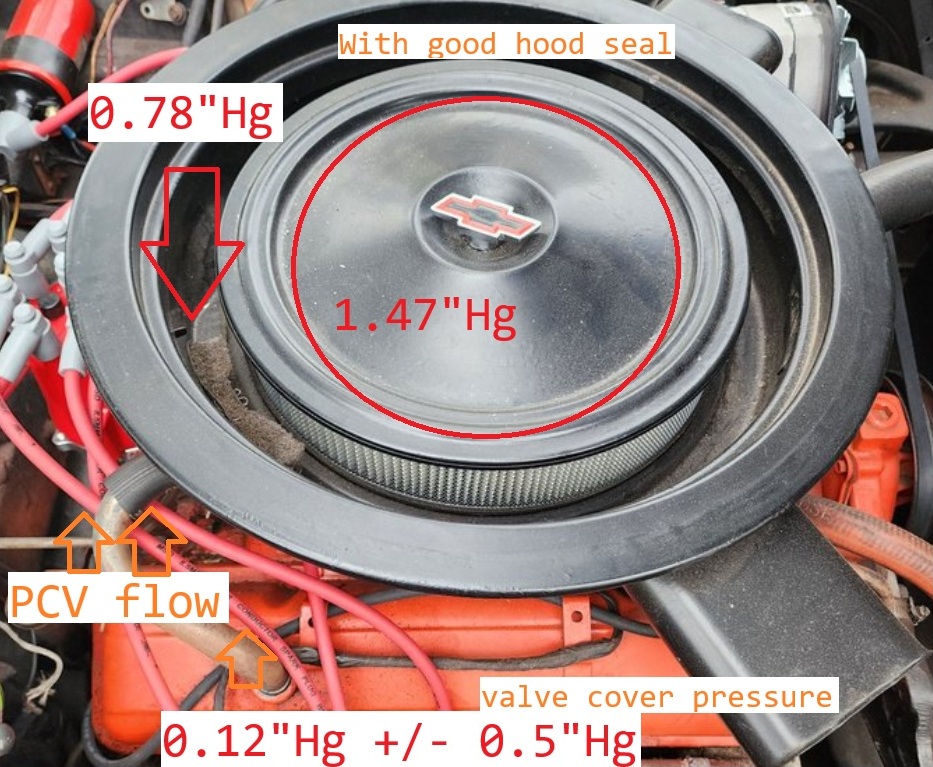
This is not just a breather, because the air filter is sealed with crankcase tube within a volumetric flow rate applied to the area(the area air entering from is restricted to produce a pressure change as it approaches the air filter)as long as the filter housing has not been modified or leaking air around its seals.
All engines have that one way or the other. Some can use venturi action, some depend on air filter pressure - OEM crankcase systems need fresh air and WOT pcv and that is what this tube evolves into especially 1980's and on and forever and ever after that. Even if emissions went away we would still have that tube because it protects engine oil. And this protection gets better with increasing years and technology and understanding.Many Engines last longer after 1980's.
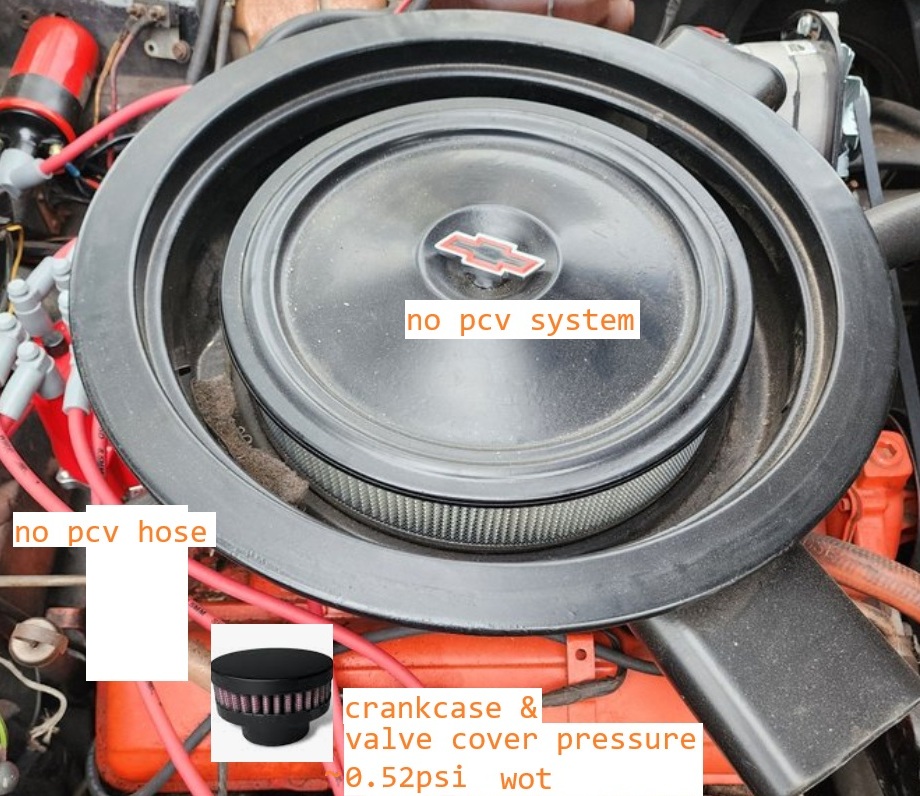
Here is your engine without that tube
And with it
You can pressure test the air filter housing for leaks, then attach a map sensor to measure the pressure with and without the tube at wide open throttle with an OEM air filter element after its accumulates at least 800miles of normal driving debris and these are close to the numbers produced from a healthy factory engine.
My question is breather stuff aside, this catch can design is meant to grab and remove all of that nasty stuff is it not? My crankcase line is into this can, and other end into the oil cap/valve cover...but according to this cans functions its not allowing all of those contaminants to re enter
All you need to do is produce a pressure below atmospheric in the crankcase at all times like an OEM engine. At times when blow-by flow is very low a sufficient evacuation rate(flow) out of the crankcase is more important than a pressure drop. During high blow-by situations the pressure drop becomes more important because it is the only way to really measure pcv performance (removing blow-by) since we cannot easily measure flow.
Look at some modern OEM diagrams(after 1990's okay) for different cars to give you knowledge on how to diy. If you add or change anything including an air filter you must measure the crankcase pressure yourself to see whether the changes have ruined the pcv system (blow-by removal at least).
This is like showing the first human to invent fire used sticks and string. Or a rock. And then showing everybody the rock and saying 'THIS is how you make fire'
Its like showing a carb and saying 'this is the correct way to fuel an engine"
its like showing a distributor and saying 'this is how you distribute spark'
Stuff changes, those books have old information. You need to get the new information.
Here is the new information:
#33458: That is not a breather. Its a sticks and stone PCV system like the first fire, the first lightbulb invented.
Here is my #33458 but modern(after air filter instead of boxed with it) up to 2005's standards for PCV.
Notice the same exact tube which leads to an area sealed with the air cleaner somehow.
This is not just a breather, because the air filter is sealed with crankcase tube within a volumetric flow rate applied to the area(the area air entering from is restricted to produce a pressure change as it approaches the air filter)as long as the filter housing has not been modified or leaking air around its seals.
All engines have that one way or the other. Some can use venturi action, some depend on air filter pressure - OEM crankcase systems need fresh air and WOT pcv and that is what this tube evolves into especially 1980's and on and forever and ever after that. Even if emissions went away we would still have that tube because it protects engine oil. And this protection gets better with increasing years and technology and understanding.Many Engines last longer after 1980's.
Here is your engine without that tube
And with it
You can pressure test the air filter housing for leaks, then attach a map sensor to measure the pressure with and without the tube at wide open throttle with an OEM air filter element after its accumulates at least 800miles of normal driving debris and these are close to the numbers produced from a healthy factory engine.
Did you google your own claim?
----
Its just new to you. But its always been there
Stop with the ai garbage. Are you familiar with the term garbage in garbage out?
"Hey Google can 10,000 men beat a lion?"
"Hey Google can 10,000 men beat a lion?"
You clearly have no basic understanding of the principles of a pushrod V8. That's what all of this is based on. At this point I cannot help you. No one can. You can continue to embarrass yourself with your inability to learn. You are not just embarrassing yourself your embracing your ignorance instead of trying to learn something. I'm out.
No, my IM port next to the crankcase port is capped, the only port/line into that vented can is the crankcase port, and the other end goes into the oil cap/valve cover.
Back to OP's question-
Ok, so your catch can sits between the oil cap/valve cover and which port exactly? The valley cover (lower, metal) port or the intake manifold port (plastic, upper)?
If to the lower - what is this catch can even doing? It's connecting the crankcase to the crankcase. Theres no significant motive pressure difference... Remember, flow of a fluid needs some pressure difference to move the fluid along its path. This is why everything goes to the intake manifold - because its low pressure and can pull things along!
If to the upper - this draws air through the catch can because the upper port is behind the throttle plate (vacuum is produced because the TP is closed). The air flows from the oil cap fitting, to the catch can, to this port. This is the right way for a catch can to operate.
HOWEVER, if the crankcase is not sealed (i.e. your open valve cover ports), its going to draw UNFILTERED air from the outside through your valve cover, through the catch can, into the intake manifold. It will catch some blowby vapor but not a lot and you're basically just allowing outside dust into your engine internals!!! terrible idea.
Dez/Kingalon: I think we fundamentally disagree on if a PCV system is useful or not. Dez, I know back in the day PCV systems were the boogeyman and tuners thought it just coked up the air filter, carb, and intake manifolds. Nowdays, research is showing that having a PCV system sucks harmful gasses from the crank back into the engine to be burnt and is good for engine longevity. If the blowby is allowed to vent, a lot of it does not actually vent and the gasses will drop contamination into the oil. Long term - bad.
If we are building a race engine, kingalon is right - a true vac pump system is best. However, I'd argue that some folks doing max effort builds may not want to go vac system due to complexity, packaging, cost. Then, a fully vented system makes sense. All other engines would run best with a catch can - caveat being if its so worn out that the blowby is SO bad that a catch can cannot remove the oil before its returned to the intake. At that point, youre now lowering octane of the fuel and it would be best to vent this too. However, its a half-assed fix of the real issue, which would be a worn out engine.
1974 Corvette 350 CID pushrod V8 Passenger side valve cover. Another for you. Breather filter from the factory. Original 1974 Chevrolet parts. Showing factory 1974 Corvette air cleaner showing filter.
Now please stop giving bad information. Please stop embarrassing yourself. I'll lend you some of my books that explain this stuff. Just pm me your address. I'll even pay shipping.
Dez - is there not a PCV valve on the other valve cover, going into the carb on a '74?
This PCV valve is pulling blowby from the crank into the carb (behind the throttle plate)
Flow goes:
Fresh air -> through that little filter in the air filter container (not the air filter itself) -> hose you have shown -> crankcase (where it exchanges fresh air with blowby through the rings) -> PCV valve -> behind carb throttle plate.
At WOT, you no longer have a vac behind the throttle plate and you have significantly more blowby so the flow actually reverses through the hose you have shown, and flows to the air filter canister where it will hopefully be drawn back into the engine to be burnt.
in my 82, the pcv is routed to the crossfire manifold, which is behind the tb, where there is vacuum.
Ok, so your catch can sits between the oil cap/valve cover and which port exactly? The valley cover (lower, metal) port or the intake manifold port (plastic, upper)?
If to the lower - what is this catch can even doing? It's connecting the crankcase to the crankcase. Theres no significant motive pressure difference... Remember, flow of a fluid needs some pressure difference to move the fluid along its path. This is why everything goes to the intake manifold - because its low pressure and can pull things along!
If to the upper - this draws air through the catch can because the upper port is behind the throttle plate (vacuum is produced because the TP is closed). The air flows from the oil cap fitting, to the catch can, to this port. This is the right way for a catch can to operate.
HOWEVER, if the crankcase is not sealed (i.e. your open valve cover ports), its going to draw UNFILTERED air from the outside through your valve cover, through the catch can, into the intake manifold. It will catch some blowby vapor but not a lot and you're basically just allowing outside dust into your engine internals!!! terrible idea.
Dez/Kingalon: I think we fundamentally disagree on if a PCV system is useful or not. Dez, I know back in the day PCV systems were the boogeyman and tuners thought it just coked up the air filter, carb, and intake manifolds. Nowdays, research is showing that having a PCV system sucks harmful gasses from the crank back into the engine to be burnt and is good for engine longevity. If the blowby is allowed to vent, a lot of it does not actually vent and the gasses will drop contamination into the oil. Long term - bad.
If we are building a race engine, kingalon is right - a true vac pump system is best. However, I'd argue that some folks doing max effort builds may not want to go vac system due to complexity, packaging, cost. Then, a fully vented system makes sense. All other engines would run best with a catch can - caveat being if its so worn out that the blowby is SO bad that a catch can cannot remove the oil before its returned to the intake. At that point, youre now lowering octane of the fuel and it would be best to vent this too. However, its a half-assed fix of the real issue, which would be a worn out engine.
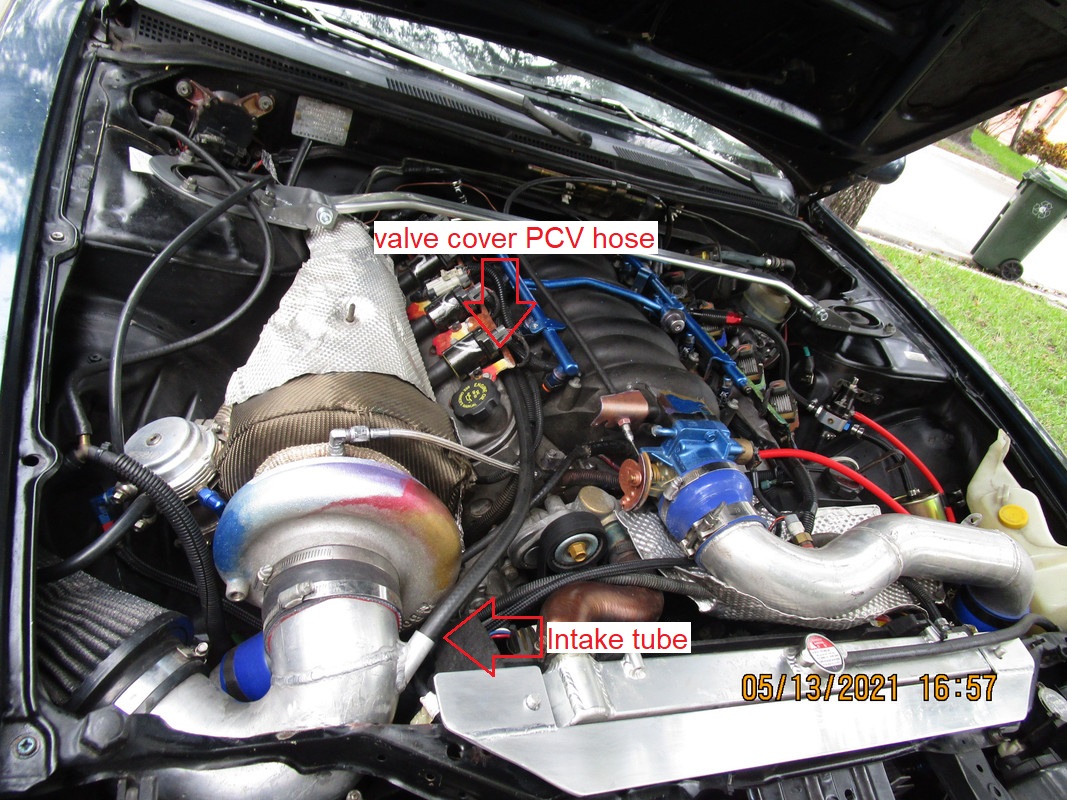
With this turbo kit the manifold port is capped as well as the tb port on other side. I am confused on how is the valve cover port I have open pulling air in or vaccum with them sealed if all vaccum ports/sourcesare sealed now with the car being turbo vs stock NA setup? I keep being told pressure releases and needs to release from the valve covers now for a turbo setup. What vaccum source with this setup is pulling air in the valve covers?
Last edited by zinsavage123; Jun 4, 2026 at 02:47 AM.
With this turbo kit the manifold port is capped as well as the tb port on other side. I am confused on how is the valve cover port I have open pulling air in or vaccum with them sealed if all vaccum ports/sourcesare sealed now with the car being turbo vs stock NA setup? I keep being told pressure releases and needs to release from the valve covers now for a turbo setup. What vaccum source with this setup is pulling air in the valve covers?
As i mentioned in my previous post, if the outlet line of the CC is going to the valley cover (metal port), you are connecting the crankcase to the crankcase so they would both be inlets to the can and the outlet would be to atmosphere through the top of the can.
If you are 100% set on having this vented setup, you can keep it how it is, but just put caps on the valve cover ports. If you dont cap the VC ports, some blowby will leave from there and will oil up your engine bay.
Finally, you would be relying on the pressure release valve on the MM can to vent blowby. There is a chance you have a race/draft version of the MM can which may not have the one way valve and may just be a vented can (? no experience with his race systems).
This is our RACE can not one of our PCV cans (not one of our wild PCV systems although it looks like it).
Hooking to the valley is not helpful, the tiny orifice is for PCV regulation not crankcase venting, but the big hose to the oil cap is already more than capable by itself.
If it was me I would hook to the passenger front cover instead of the valley to cut confusion.
Cap the valley and the driver cover.
Look for what else was left incomplete.
Then over time decide if you would rather have the fumes control and crankcase filtration of a functional PCV system vs. this RACE system you got.
We suggest our PCV systems for regular street drivers, our RACE systems for race cars, and email if you feel like you are in between; We build custom every day.
And please go straight to the source for any questions or concerns about our products. As you see all of the above did more harm than good.
Listen to the man.
Looking at the OP's pictures, it looks like the shop hooked the catch can half way between race but also PCV and neither at the same time. Based on the catch can, your car should be plumbed exactly as the diagram that MMS posted above. That means there is no PCV system.
And you would then need to cap off any unused ports as these will allow dirt, dust, etc. to get into the engine.
If you want your car set up with a PCV system, you need a different catch can that has an integrated 1-way check valve in it. I have a MM catch can with an integrated PCV valve in it.
For running PCV, it should look something like the following diagram:
Looking at the OP's pictures, it looks like the shop hooked the catch can half way between race but also PCV and neither at the same time. Based on the catch can, your car should be plumbed exactly as the diagram that MMS posted above. That means there is no PCV system.
And you would then need to cap off any unused ports as these will allow dirt, dust, etc. to get into the engine.
If you want your car set up with a PCV system, you need a different catch can that has an integrated 1-way check valve in it. I have a MM catch can with an integrated PCV valve in it.
For running PCV, it should look something like the following diagram:
Clear your inbox haha....cant respond back brother!
Shop did my twin turbo kit on my LS3 and has what appears to be the crankcase port if I am correct on that one into the can into oil cap, and the manifold port capped, and the valve cover ports just vented to atmosphere....here are pics. I know everyone does this all kinds of different ways I just want to be sure this isnt gping to cause any issues down the line.
Your servicing Chevrolet dealership is always the best resource to assist you regarding any concerns or repairs you may need on your Corvette. If interested, our team would like to serve as an additional layer of support to you throughout these efforts. To do so, please visit: https://s.chevy.com/support-requestand fill out the support request form with all pertinent details. This form helps our team gather the right information and ensures your request is routed appropriately.
Designer Imagines A Corvette That Looks More Like a Corvette Than the Corvette
Slideshow: A Jaguar designer's personal project imagines what a modern front-engined Corvette might look like if Chevrolet revisited the golden age of the Stingray.