




C4 Rear Geometry explained, please....

Thread Starter
Team Owner


Joined: Aug 2004
Posts: 21,543
Likes: 3,216
From: Park City Utah
 C4 Rear Geometry explained, please....
What is the geometrical down fall of the C4's rear suspension? Is it the way the tire moves through it's travel? Or how the forces are focused on the cars CG? Or both?
Looking at the rear on the C4 I recently got, one thing I notice is that the pivot point for the upper and lower lateral arms are closer in at the diff than out at the knuckle...making the the tire have significant camber change through the travel. It seems that spreading the inboard pivot points would help keep a flat tire on the pavement.
Other than that, I can't see what is "Wrong" w/the latera/trailing arm design of the C4, compared to newer designs.
Looking at the rear on the C4 I recently got, one thing I notice is that the pivot point for the upper and lower lateral arms are closer in at the diff than out at the knuckle...making the the tire have significant camber change through the travel. It seems that spreading the inboard pivot points would help keep a flat tire on the pavement.
Other than that, I can't see what is "Wrong" w/the latera/trailing arm design of the C4, compared to newer designs.
Team Owner


Joined: Mar 2001
Posts: 30,861
Likes: 293
From: Boston, Dallas, Detroit, SoCal, back to Boston MA
I believe that's what the DRM camber brackets correct.
Which is why waiting on buying a set.
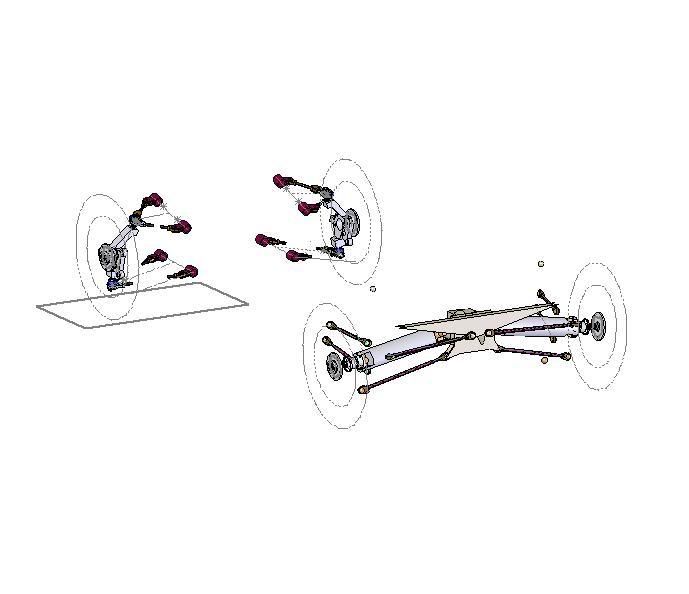
I did a CAD model out, that's the only odd thing I can see.
The engineers wanted to get as long a halfshaft as they could get.
Which is why waiting on buying a set.
I did a CAD model out, that's the only odd thing I can see.
The engineers wanted to get as long a halfshaft as they could get.
Thread Starter
Team Owner
Joined: Aug 2004
Posts: 21,543
Likes: 3,216
From: Park City Utah
That's a sweet tool you've got; the CAD. Nice.
I would think that ONE advantage of the C4 is the long half shaft you mentioned. The long 1/2 shaft and lower lat arm makes for less track-width changes as the suspension goes through it's travel than the shorter A arms on the C5 and C6.
it seems to me, anyway.
I would think that ONE advantage of the C4 is the long half shaft you mentioned. The long 1/2 shaft and lower lat arm makes for less track-width changes as the suspension goes through it's travel than the shorter A arms on the C5 and C6.
it seems to me, anyway.

Tech Contributor
Joined: Jun 2004
Posts: 20,944
Likes: 962
From: I tend to be leery of any guy who doesn't own a chainsaw or a handgun.
What is the geometrical down fall of the C4's rear suspension? Is it the way the tire moves through it's travel? Or how the forces are focused on the cars CG? Or both?
Looking at the rear on the C4 I recently got, one thing I notice is that the pivot point for the upper and lower lateral arms are closer in at the diff than out at the knuckle...making the the tire have significant camber change through the travel. It seems that spreading the inboard pivot points would help keep a flat tire on the pavement.
Other than that, I can't see what is "Wrong" w/the latera/trailing arm design of the C4, compared to newer designs.
Looking at the rear on the C4 I recently got, one thing I notice is that the pivot point for the upper and lower lateral arms are closer in at the diff than out at the knuckle...making the the tire have significant camber change through the travel. It seems that spreading the inboard pivot points would help keep a flat tire on the pavement.
Other than that, I can't see what is "Wrong" w/the latera/trailing arm design of the C4, compared to newer designs.

Instructor


Joined: Feb 2003
Posts: 179
Likes: 0
From: Lake Forest CA
^^^ we had to correct this with the Formula car we built in college. Maintaining a flat tire in a hard turn, had the tire skittish. Unfortunately in our case, we had to settle by adding camber to begin with, allowing the tire to flatten out in hard turns.
Thread Starter
Team Owner
Joined: Aug 2004
Posts: 21,543
Likes: 3,216
From: Park City Utah
Both. I drag track my cars and also run them out a Miller Motorsports Park.
I've read numerous times how "inferior" the C4 suspension is to the C5 & C6...also read articles about how that was ONE of the major reasons for a chassis redesign (the C5) was that the C4's rear was some kind of limiting factor. I don't under stand why, exactly. Objective performance numbers of a C4 and a C5/6 are similar (skid pad, slalom, etc) enough that tires would make a much bigger difference than the suspension designs, IMO.
I'm not sure why the C4's rear was a limitation to the Corvette engineers when they began the designing of the C5.
I've read numerous times how "inferior" the C4 suspension is to the C5 & C6...also read articles about how that was ONE of the major reasons for a chassis redesign (the C5) was that the C4's rear was some kind of limiting factor. I don't under stand why, exactly. Objective performance numbers of a C4 and a C5/6 are similar (skid pad, slalom, etc) enough that tires would make a much bigger difference than the suspension designs, IMO.
I'm not sure why the C4's rear was a limitation to the Corvette engineers when they began the designing of the C5.
Corvette Stories
The Best of Corvette for Corvette Enthusiasts

5 Best & 5 Worst Corvette Daily Drivers
Joe Kucinski
The Headlights of Every Corvette Generation Explained
Joe Kucinski
5 Best & 5 Most Overrated Corvette Track Packages of All Time!
Joe Kucinski
Every 2027 Corvette Engine Explained
Joe Kucinski
Designer Imagines A Corvette That Looks More Like a Corvette Than the Corvette
Verdad Gallardo
10 Ugly Corvettes That We Still Kinda Love
Joe Kucinski
Top 10 Most Expensive Corvettes Ever Sold on Bring A Trailer
Brett Foote
10 Things Every Corvette Owner Needs (2026 Edition)
Michael S. Palmer
8 Most "Only Corvette Owners Understand" Quirks and Problems
Pouria Savadkouei


Thread Starter
Team Owner
Joined: Aug 2004
Posts: 21,543
Likes: 3,216
From: Park City Utah
What problems were "solved" for GM by going to the C5 double A-arm design? Was it ride quality? Packaging? Cost? Actual handling (performance) improvements? Or a commbination of the above?
Thread Starter
Team Owner
Joined: Aug 2004
Posts: 21,543
Likes: 3,216
From: Park City Utah

Le Mans Master

Joined: Feb 2000
Posts: 5,708
Likes: 1
From: Bedford NH
Cruise-In II Veteran
The dynamics of the C6/C6 rear is superior in every reason.
The toe, camber, and lack of wheelbase change geometry is way better.
There are less joints to deflect and have geometry changes and binding
The frame structure is stiffer.
The unsprung mass is less.
The outer knuckle is interchangable with the fronts.
The use of CV joints in the half shafts of C5/C6 are smoother and more reliable.
Packaging is tighter, no mounts forward of the suspension.
Bigger tires can be used without having trailing arms in the way, or being located far inboard, which makes the geometry worse.
The toe, camber, and lack of wheelbase change geometry is way better.
There are less joints to deflect and have geometry changes and binding
The frame structure is stiffer.
The unsprung mass is less.
The outer knuckle is interchangable with the fronts.
The use of CV joints in the half shafts of C5/C6 are smoother and more reliable.
Packaging is tighter, no mounts forward of the suspension.
Bigger tires can be used without having trailing arms in the way, or being located far inboard, which makes the geometry worse.
Team Owner
Joined: Mar 2001
Posts: 30,861
Likes: 293
From: Boston, Dallas, Detroit, SoCal, back to Boston MA
I was mostly a packaging issue, I'm sure you've noticed the body work on the later cars need to be substantially bigger in the back.
Double a-arm does a lot of things better, save putting power down, they tend to hop.
The binding issues can be handled by going to rod-ends.
having the half shaft longer then the camber rods is a problem.
I live the way Guldstrand handled it on his custom C2/3's
Which is where GM got the idea in the 1st place.
http://www.guldstrand.com/scripts/pr...?idproduct=138

Double a-arm does a lot of things better, save putting power down, they tend to hop.
The binding issues can be handled by going to rod-ends.
having the half shaft longer then the camber rods is a problem.
I live the way Guldstrand handled it on his custom C2/3's
Which is where GM got the idea in the 1st place.
http://www.guldstrand.com/scripts/pr...?idproduct=138
Thread Starter
Team Owner
Joined: Aug 2004
Posts: 21,543
Likes: 3,216
From: Park City Utah
I totally understand the wheel base change; that is unavoidable in the C4 design.
I also understand "binding" to some degree...but that has to be pretty minimal. Right? The only binding I know of is that ther training arms are trying to be forced laterally somewhat, by the arc created by the axle and lower control arm. But that is a very long arc w/a large radius. Much more so than the C5/6 even. So binding should be pretty minimal....I think. Please correct me if I'm wrong.
What I don't understand is camber and toe. Can't you set up the C4 to do what ever you want camber/toe wise, but adjusting the pick up points of the lower arm and tie rods?
Thread Starter
Team Owner
Joined: Aug 2004
Posts: 21,543
Likes: 3,216
From: Park City Utah
How about this question:
What causes my '92 to want to oversteer under deceleration in a corner, and not, under acceleration, in the same corner at the same, or faster speeds?
What causes my '92 to want to oversteer under deceleration in a corner, and not, under acceleration, in the same corner at the same, or faster speeds?


Thread Starter
Team Owner
Joined: Aug 2004
Posts: 21,543
Likes: 3,216
From: Park City Utah
No. There is more at work here than that. My C6 has weight transfer too (any car does in that situation), yet it doesn't exhibit that symptom at all. The C4 makes an abrupt change in "rear steer" that while decelerating, throws it into oversteer. The rear is tight; it's not a loose tie rod end or bad bushing that I can feel anyway.
Team Owner
Joined: Mar 2001
Posts: 30,861
Likes: 293
From: Boston, Dallas, Detroit, SoCal, back to Boston MA
What's your alignment specs?
You can set the static spec to what you want.
It's what happens afterwards that's going on.
Yes, there's a lot of binding in all the links, which is why I'm going to rodends.
Take a look at this pic of my car under full droop.
Notice the dogbones, and how far over they are

Now take a look with the rodends

You can set the static spec to what you want.
It's what happens afterwards that's going on.
Yes, there's a lot of binding in all the links, which is why I'm going to rodends.
Take a look at this pic of my car under full droop.
Notice the dogbones, and how far over they are
Now take a look with the rodends
Thread Starter
Team Owner
Joined: Aug 2004
Posts: 21,543
Likes: 3,216
From: Park City Utah