





Voltage drop...

Thread Starter
Racer

Joined: Jan 2004
Posts: 277
Likes: 0
From: Bellevue WA
 Voltage drop...
I've got an SWC with the L76 340 engine, no A/C, with a 61 amp delco alternator and a solid state external regulator. I'm running a DeWitt radiator (SPO20) witha 16" 2360 cfm fan. The fan actuates at 195 degrees and when it does, the battery gauge immediately drops about 20 amps at idle and the engine starts running rough. I thought the regulator was supposed to signal the alternator to provide more voltage on its own without revving and the battery gauge would show positive amps but I also know that there is a kick up requirement for a/c systems which, I guess, is a similar situation.
I tested the following:
Static voltage before start 12.78
Voltage during starting 10.70
Voltage at idle builds to 14.2
Voltage at 2500 14.3
Voltage at idle with fan on 12.3
Voltage at higher revs fan on 14.1
It's a slight inconvenience in the overall scheme of things but I was wondering if there was something I should be doing to remedy it.
I tested the following:
Static voltage before start 12.78
Voltage during starting 10.70
Voltage at idle builds to 14.2
Voltage at 2500 14.3
Voltage at idle with fan on 12.3
Voltage at higher revs fan on 14.1
It's a slight inconvenience in the overall scheme of things but I was wondering if there was something I should be doing to remedy it.
Drifting

Joined: Mar 2005
Posts: 1,300
Likes: 0
From: Iowa
Your measurements indicate that the fan is drawing down the charging system. It is drawing all that the charging system is putting out. You've given alot of good info, but a couple more measurement are in order.
What is the current draw of the fan? Which alternator do you have? What is it's rating? What is it putting out (current) when this occurs?
I suspect that a diode has failed in your alternator and it no longer is putting out full charge. One check, with the fan off, turn on the headlights high beam. This should be close to the draw of the fan. If the charging system responds the same, get the alternator checked out. Since it is eventually charging the system, I do not suspect the regulator as the issue.
Your gauge is calibrated to show current in units of amps. Current measurements would be more beneficial in pinpointing the problem, but a little more tricky to measure. For measuring DC, it requires breaking the circuit to insert a meter, and the meter has to be able to handle the current seen then. I've witnessed meters blown up by incorrectly using them for current measurement, but it gives a better picture of what's going on.
What is the current draw of the fan? Which alternator do you have? What is it's rating? What is it putting out (current) when this occurs?
I suspect that a diode has failed in your alternator and it no longer is putting out full charge. One check, with the fan off, turn on the headlights high beam. This should be close to the draw of the fan. If the charging system responds the same, get the alternator checked out. Since it is eventually charging the system, I do not suspect the regulator as the issue.
Your gauge is calibrated to show current in units of amps. Current measurements would be more beneficial in pinpointing the problem, but a little more tricky to measure. For measuring DC, it requires breaking the circuit to insert a meter, and the meter has to be able to handle the current seen then. I've witnessed meters blown up by incorrectly using them for current measurement, but it gives a better picture of what's going on.
Le Mans Master


Joined: Nov 2000
Posts: 7,246
Likes: 21
From: Going too fast over the hill. Iowa
Originally Posted by rgs
Your gauge is calibrated to show current in units of amps.
The gauge needs less than 1 amp to get full deflection at 14volts. I protected my Battery gauge with a 1 or 2 amp fuse for years - no way it gets 30 or 40 amps to deflect the meter. It measures the voltage difference between the horn relay and the starter solenoid battery terminals. The units of the gauge are ficticious/arbitrary/whatever you want.
Stick:
Where is the fan connected? If it is connected at the horn relay (most advice is to connect it there, but I didn't), add an extra (minimum) 12 gauge wire between the alternator and the horn relay. It may help.
Alternators do not put out their full rating until the revs go up, but the larger the alternator capacity, the more they normally put out at idle. I am using a 135amp alternator on my 66 A-C car to prevent your problem in my car. My car will never pull 100amps in its current configuration, but the high alternator output at idle is what I wanted.
Last edited by magicv8; Jul 10, 2006 at 05:20 PM.
Burning Brakes


Joined: Aug 2005
Posts: 1,133
Likes: 2
From: Corona CA
This all seems pretty normal.
The fact that you get a voltage drop (I presume you see this instantly when the fan comes on) might mean your battery is getting tired. I assume you are measuring voltage at the battery terminals? Most alternators don't make full current at idle...typically it is more like 1200-1500 RPM. I suppose there could be some issue with the alternator itself but you say when you rev it up the voltage returns, assuming you see the voltage return under 2k RPM then I think the alternator is probably working as designed. You have added some significant extra load to the system with the electric fans the old alternators only make about 60 amps total and I don't know what they did for sure at idle but I would bet it is near 20 which is what the fan seems to be drawing (a bit on the high side of normal)
Sounds to me like the system is working but very borderline. Any chance you have reduction pulleys on the crank or alternator those would certainly lead in the direction of this sort of 'problem.' I would assume that what happens is the fan kicks in, the load goes up and exceeds the idle capacity of the alternator, then the battery should compensate for a short time if it is in good shape but will eventually drain. The regulator is telling the alternator to go full output but there is not enough RPM. The alternator is causing extra load on the motor slowing it the RPM more as it tries to fill in the current demand but it can't do it and now the voltage is sagging and possibly getting low enough to cause misfires which further reduces RPM and just makes the problem worse.
Suggestions....Check charging wire, should be very low resistance between the alternator output wire and the horn relay block and the starter, increaseing gauge might help especially on the long run from the relay to the starter, and of course check the battery cable back to the battery. Try smaller pulley on alternator, larger pulley on Crank, if somehow they are not stock. If you have another alternator or can get yours tested you might try that as it could be it is weak at low RPM. A newer higher performace unit might help in the long run considering the extra loads on the electrical system.
Hope some of that helps.
Darren
The fact that you get a voltage drop (I presume you see this instantly when the fan comes on) might mean your battery is getting tired. I assume you are measuring voltage at the battery terminals? Most alternators don't make full current at idle...typically it is more like 1200-1500 RPM. I suppose there could be some issue with the alternator itself but you say when you rev it up the voltage returns, assuming you see the voltage return under 2k RPM then I think the alternator is probably working as designed. You have added some significant extra load to the system with the electric fans the old alternators only make about 60 amps total and I don't know what they did for sure at idle but I would bet it is near 20 which is what the fan seems to be drawing (a bit on the high side of normal)
Sounds to me like the system is working but very borderline. Any chance you have reduction pulleys on the crank or alternator those would certainly lead in the direction of this sort of 'problem.' I would assume that what happens is the fan kicks in, the load goes up and exceeds the idle capacity of the alternator, then the battery should compensate for a short time if it is in good shape but will eventually drain. The regulator is telling the alternator to go full output but there is not enough RPM. The alternator is causing extra load on the motor slowing it the RPM more as it tries to fill in the current demand but it can't do it and now the voltage is sagging and possibly getting low enough to cause misfires which further reduces RPM and just makes the problem worse.
Suggestions....Check charging wire, should be very low resistance between the alternator output wire and the horn relay block and the starter, increaseing gauge might help especially on the long run from the relay to the starter, and of course check the battery cable back to the battery. Try smaller pulley on alternator, larger pulley on Crank, if somehow they are not stock. If you have another alternator or can get yours tested you might try that as it could be it is weak at low RPM. A newer higher performace unit might help in the long run considering the extra loads on the electrical system.
Hope some of that helps.
Darren
Last edited by macdarren; Jul 10, 2006 at 03:22 PM.
Drifting
Joined: Mar 2005
Posts: 1,300
Likes: 0
From: Iowa
Originally Posted by magicv8
I disagree. That is a Battery meter, and the alternator is 61 amps - which A-C cars came with in 63. That alternator then would be able to spike the gauge off the cluster in order to get the meter to read 61 under full load.
The gauge needs less than 1 amp to get full deflection at 14volts. I protected my Battery gauge with a 1 or 2 amp fuse for years - no way it gets 30 or 40 amps to deflect the meter. It measures the voltage difference between the horn relay and the starter solenoid battery terminals. The units of the gauge are ficticious/arbitrary/whatever you want.
The gauge needs less than 1 amp to get full deflection at 14volts. I protected my Battery gauge with a 1 or 2 amp fuse for years - no way it gets 30 or 40 amps to deflect the meter. It measures the voltage difference between the horn relay and the starter solenoid battery terminals. The units of the gauge are ficticious/arbitrary/whatever you want.
The meter only indicates the current to/from the battery while the key is on. If the entire capacity of the 61 amp alternator were to go to the battery, then yes, the gauge would be pegged. Under normal operation, the alternator is supplying current to operate the vehicle, which is not represented by any movement of the "Battery" gauge. Anything in excess, or deficient to operating the car, is represented by deflection of the meter.
Le Mans Master
Joined: Nov 2000
Posts: 7,246
Likes: 21
From: Going too fast over the hill. Iowa
[QUOTE=rgs] If the entire capacity of the 61 amp alternator were to go to the battery, then yes, the gauge would be pegged. QUOTE]
If one tenth of the capacity of the alternator went through the Battery gauge it would be fried - not pegged. The c1s had ammeters with shunts. This gauge is a cheap and sturdy little beast, but an ammeter it is not.
I have quit tracking this post, so I am just adding an edit. I apologize if you feel I insulted you, since none was intended. I respect your technical ability, and with a couple of fried meters in mind, the thought struck me funny. OK, I have a wierd sense of humor. Pick a bar in Davenport or Iowa City, and a date to meet - I'll buy the beer and we'll laugh about Corvette problems.
I will guess that whoever designed the meter in 1961 or 1962 though they had a cheap way of approximating the look of an ammeter handling the output of a 37amp alternator. When the cars got A-C in late 63 production, and the 61amp alternator was substituted, nothing needed to be changed, since the meter is not labeled in amps. IMO the gauge just indicates the direction of whatever small current is running though the meter.
If one tenth of the capacity of the alternator went through the Battery gauge it would be fried - not pegged. The c1s had ammeters with shunts. This gauge is a cheap and sturdy little beast, but an ammeter it is not.
I have quit tracking this post, so I am just adding an edit. I apologize if you feel I insulted you, since none was intended. I respect your technical ability, and with a couple of fried meters in mind, the thought struck me funny. OK, I have a wierd sense of humor. Pick a bar in Davenport or Iowa City, and a date to meet - I'll buy the beer and we'll laugh about Corvette problems.
I will guess that whoever designed the meter in 1961 or 1962 though they had a cheap way of approximating the look of an ammeter handling the output of a 37amp alternator. When the cars got A-C in late 63 production, and the 61amp alternator was substituted, nothing needed to be changed, since the meter is not labeled in amps. IMO the gauge just indicates the direction of whatever small current is running though the meter.
Last edited by magicv8; Jul 11, 2006 at 09:19 AM.
Drifting
Joined: Mar 2005
Posts: 1,300
Likes: 0
From: Iowa
[QUOTE=magicv8]
You're mis-reading my posts. Look carefully. I said "If the entire capacity of the 61 amp alternator were to go to the battery, then yes, the gauge would be pegged" I did not say: {If the entire capacity of the 61 amp alternator were to go THROUGH THE METER to the battery, then yes, the gauge would be pegged} As I pointed out, all D'Arsonvol movements use only a small portion of the current through the meter. Even the C1 meter has an internal bypass or shunt resistor.
I believe we are talking about symantics. If the gauge is calibrated in units of current, it is an ampmeter. If it is calibrated in units of volts, it is a voltmeter. This gauge is calibrated in units of current.
I'm curious, what units of measure do you think it is calibrated in?
Originally Posted by rgs
If the entire capacity of the 61 amp alternator were to go to the battery, then yes, the gauge would be pegged. QUOTE]


If one tenth of the capacity of the alternator went through the Battery gauge it would be fried - not pegged.
The c1s had ammeters with shunts. This gauge is a cheap and sturdy little beast, but an ammeter it is not.
If one tenth of the capacity of the alternator went through the Battery gauge it would be fried - not pegged.
The c1s had ammeters with shunts. This gauge is a cheap and sturdy little beast, but an ammeter it is not.
I believe we are talking about symantics. If the gauge is calibrated in units of current, it is an ampmeter. If it is calibrated in units of volts, it is a voltmeter. This gauge is calibrated in units of current.
I'm curious, what units of measure do you think it is calibrated in?
Corvette Stories
The Best of Corvette for Corvette Enthusiasts

10 Reasons the C6 Z06 is Still A Performance Benchmark After 20 Years
Joe Kucinski
How Much Horsepower Every Corvette Engine "LOST" in 1972
Joe Kucinski
Top 10 DOs and DON'Ts for Protecting Your Convertible Top!
Michael S. Palmer
Top 10 Most Explosive Corvettes Ever Made: Power-to-Weight Ratio Ranked!
Joe Kucinski
150 hp to 1,250 hp: Every Corvette Generation Compared by the Specs That Matter
Joe Kucinski
8 Coolest Corvette Pace Cars (and Replicas) of All Time
Verdad Gallardo
Top 10 Corvette Engines RANKED by Peak Torque (70+ Years of Muscle!)
Joe Kucinski
Corvette ZR1X Will Be Pacing the Indy 500, And Could Probably Race, Too!
Verdad Gallardo
Top 10 Corvettes Coming to Mecum Indy 2026!
Brett Foote
CF Senile Member


Joined: Aug 2005
Posts: 5,738
Likes: 2
From: Central Plains
St. Jude Donor '08
Originally Posted by magicv8
It measures the voltage difference between the horn relay and the starter solenoid battery terminals.

Stick:
If it is connected at the horn relay (most advice is to connect it there, but I didn't), add an extra (minimum) 12 gauge wire between the alternator and the horn relay.
Stick:
If it is connected at the horn relay (most advice is to connect it there, but I didn't), add an extra (minimum) 12 gauge wire between the alternator and the horn relay.

Dave

Last edited by 63C2splitter; Jul 10, 2006 at 10:08 PM.

Le Mans Master


Joined: Apr 2002
Posts: 5,537
Likes: 280
From: Egg Harbor Township NJ
2015 C2 of Year
St. Jude Donor '04-'05-'06-'07-'08-'09-'10, '14-'15
Alternators do not put out their full rating until the revs go up, but the larger the alternator capacity, the more they normally put out at idle. I am using a 135amp alternator on my 66 A-C car to prevent your problem in my car. My car will never pull 100amps in its current configuration, but the high alternator output at idle is what I wanted
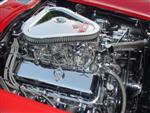
I'm running a Dewitts BB Rad with 2 Spal Fans. Each one pulls about 10 Amps when running... Or a total of 20 Amps. I have an in line Current meter under the hood and can see the loads change as Lights are turned on and off as the head lights are on the same circuit. I'm using the "MAD Electrical" Relay system modification.
I'm running a Power Master 140 Amp Alternator. As the Magic Man has stated.. the Idle thing is what I'm after also. My Voltage pick point is at the Horn Relay. The feed line is # 8 Gauge "Stinger" Pure Copper super stranded wire to fan and Headlight fuses.
At idle.. with the fans running and headlights on as well as the heater blower motor cranken.. The Battery meter is only about 1/16" off center to the plus side. In other words.. the alternator is what runs your electrical system not the battery.
You might want to consider a larger Alternator as Magic and I have done.
These are older Pic's ....The Air Cleaner has been changed and a few other items but the electrical set up is the same.


Last edited by Viet Nam Vett; Jul 10, 2006 at 10:26 PM.
Melting Slicks


Joined: Apr 2005
Posts: 2,777
Likes: 105
Stick - I am running the same fan as you, with a 60 amp alternator and solid state VR on my BBC 67.
This Spal fan draws 20 amps when running. When my engine is idling I have 14 volts on a separate battery guage. The ammeter in dash reads straight up in the middle. When I switch on the fan, the ammeter needle deflects to the right approx. 15 amps and the battery voltages remains at 14 volts. I have the fan wired as recommended through a fan relay and the 12v lead to the relay is connected directly to the battery. When I switch the fan on my engine rpm's drop about 50-100 rpm, very little not very noticeable, probably due to the increased alternator output putting more drag on the alternator belt.
Nothing is connected to the horn relay. Did you use a fan relay with your fan? If you didnt you are putting a 20 amp load on your front harness wiring which is not recommended.I suspect that either your alternator is marginal or your battery is not up to par....
The headlights do not pull any where near 20 amps when they are on. When you turn them on the ammeter guage moves very slightly to the left when engine is off....and very little to thr right when engine is idling......
This Spal fan draws 20 amps when running. When my engine is idling I have 14 volts on a separate battery guage. The ammeter in dash reads straight up in the middle. When I switch on the fan, the ammeter needle deflects to the right approx. 15 amps and the battery voltages remains at 14 volts. I have the fan wired as recommended through a fan relay and the 12v lead to the relay is connected directly to the battery. When I switch the fan on my engine rpm's drop about 50-100 rpm, very little not very noticeable, probably due to the increased alternator output putting more drag on the alternator belt.
Nothing is connected to the horn relay. Did you use a fan relay with your fan? If you didnt you are putting a 20 amp load on your front harness wiring which is not recommended.I suspect that either your alternator is marginal or your battery is not up to par....
The headlights do not pull any where near 20 amps when they are on. When you turn them on the ammeter guage moves very slightly to the left when engine is off....and very little to thr right when engine is idling......
Last edited by babbah; Jul 11, 2006 at 01:57 AM.
Thread Starter
Racer
Joined: Jan 2004
Posts: 277
Likes: 0
From: Bellevue WA
Originally Posted by babbah
Stick - I am running the same fan as you, with a 60 amp alternator and solid state VR on my BBC 67.
This Spal fan draws 20 amps when running. When my engine is idling I have 14 volts on a separate battery guage. The ammeter in dash reads straight up in the middle. When I switch on the fan, the ammeter needle deflects to the right approx. 15 amps and the battery voltages remains at 14 volts. I have the fan wired as recommended through a fan relay and the 12v lead to the relay is connected directly to the battery. When I switch the fan on my engine rpm's drop about 50-100 rpm, very little not very noticeable, probably due to the increased alternator output putting more drag on the alternator belt.
Nothing is connected to the horn relay. Did you use a fan relay with your fan? If you didnt you are putting a 20 amp load on your front harness wiring which is not recommended.I suspect that either your alternator is marginal or your battery is not up to par....
The headlights do not pull any where near 20 amps when they are on. When you turn them on the ammeter guage moves very slightly to the left when engine is off....and very little to thr right when engine is idling......
This Spal fan draws 20 amps when running. When my engine is idling I have 14 volts on a separate battery guage. The ammeter in dash reads straight up in the middle. When I switch on the fan, the ammeter needle deflects to the right approx. 15 amps and the battery voltages remains at 14 volts. I have the fan wired as recommended through a fan relay and the 12v lead to the relay is connected directly to the battery. When I switch the fan on my engine rpm's drop about 50-100 rpm, very little not very noticeable, probably due to the increased alternator output putting more drag on the alternator belt.
Nothing is connected to the horn relay. Did you use a fan relay with your fan? If you didnt you are putting a 20 amp load on your front harness wiring which is not recommended.I suspect that either your alternator is marginal or your battery is not up to par....
The headlights do not pull any where near 20 amps when they are on. When you turn them on the ammeter guage moves very slightly to the left when engine is off....and very little to thr right when engine is idling......
Melting Slicks
Joined: Apr 2005
Posts: 2,777
Likes: 105
From what I understand the main 12V supply source to the relay is supposed to be wired directly to the battery.
This way the 12V source that supplies the fan voltage will run on its own dedicated wire to the battery. The way you are wired now has the 20 amp load of the fan running within your existing harness, which IMO putting a load on your harness wiring that was not designed to carry this type of load. From the relay there is a wire that should be connected to the plus side of the fan motor. Im running a Optima Red Top also - Awesome battery!!
IMO You could try wiring the 12V source wire to the battery directly and see if this changes your present situation...
This way the 12V source that supplies the fan voltage will run on its own dedicated wire to the battery. The way you are wired now has the 20 amp load of the fan running within your existing harness, which IMO putting a load on your harness wiring that was not designed to carry this type of load. From the relay there is a wire that should be connected to the plus side of the fan motor. Im running a Optima Red Top also - Awesome battery!!
IMO You could try wiring the 12V source wire to the battery directly and see if this changes your present situation...
Last edited by babbah; Jul 12, 2006 at 12:22 AM.
Drifting
Joined: Mar 2005
Posts: 1,300
Likes: 0
From: Iowa
Originally Posted by Stick
I am using a relay but it is connected to the alternator rather than the battery. The only strange thing that happened during the installation was that the relay I got with the order didn't work. I got a replacement from Tom DeWitt and it didn't work either. We happened to have a different relay on hand and it worked. The alternator is a rebuilt that's about two years old and exhibits no other abnormal behavior that I can tell and the battery is an optima that passes the cranking test as noted in my initial post. Could it be that connecting to the alternator rather than the battery is causing too much of a load? I assumed that it wouldn't make any difference since the fan was on a relay...
Le Mans Master
Joined: Nov 2000
Posts: 7,246
Likes: 21
From: Going too fast over the hill. Iowa
I run my Derale electric fan, the derale fan control, and the relay supplying 130 watts of auxiliary headlamps right off the 135amp alternator. No problems.
To keep the factory harness happy when the factory A-C runs all day, I added a 10 guage wire to the horn relay from the alternator.
To keep the factory harness happy when the factory A-C runs all day, I added a 10 guage wire to the horn relay from the alternator.
Thread Starter
Racer
Joined: Jan 2004
Posts: 277
Likes: 0
From: Bellevue WA
Originally Posted by babbah
From what I understand the main 12V supply source to the relay is supposed to be wired directly to the battery.
This way the 12V source that supplies the fan voltage will run on its own dedicated wire to the battery. The way you are wired now has the 20 amp load of the fan running within your existing harness, which IMO putting a load on your harness wiring that was not designed to carry this type of load. From the relay there is a wire that should be connected to the plus side of the fan motor. Im running a Optima Red Top also - Awesome battery!!
IMO You could try wiring the 12V source wire to the battery directly and see if this changes your present situation...
This way the 12V source that supplies the fan voltage will run on its own dedicated wire to the battery. The way you are wired now has the 20 amp load of the fan running within your existing harness, which IMO putting a load on your harness wiring that was not designed to carry this type of load. From the relay there is a wire that should be connected to the plus side of the fan motor. Im running a Optima Red Top also - Awesome battery!!
IMO You could try wiring the 12V source wire to the battery directly and see if this changes your present situation...
