






ammeter gauge

Thread Starter
Racer

Joined: Jul 2006
Posts: 400
Likes: 0
From: Enterprise Al
 ammeter gauge
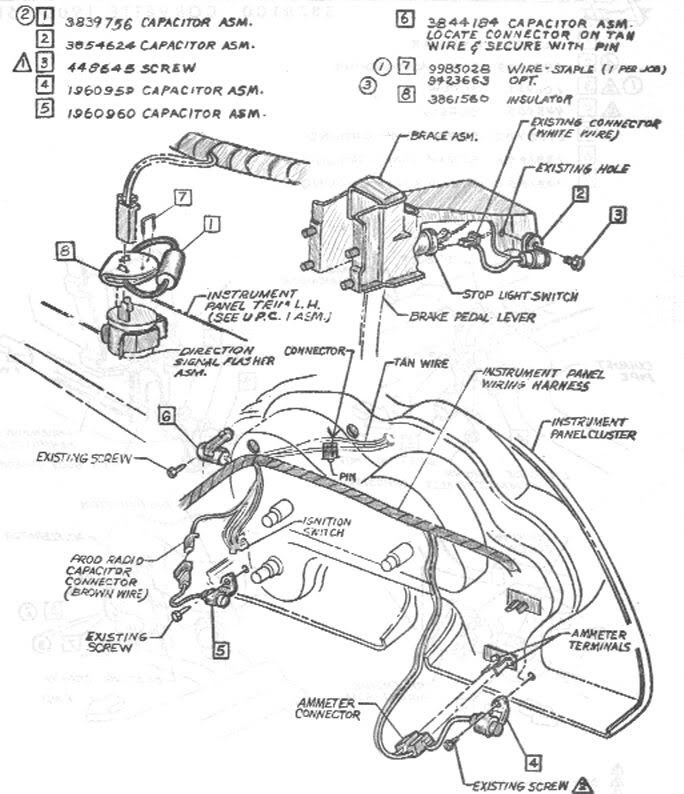
My ammeter hasn't worked since i've had the car. I am replacing all 3 of the major harnesses. Light, ignition, and dash. As i look at the back of the dash at the ammeter gauge it appears to be loose to the touch but the attaching screws that hold the connectors appear tight. the gauge above it has a stud below the two connectors but the ammeter gauge only has a hole with what appears to be plastic below it. Should i just wish on a star and put the dash back in to see if it works with the new harnesses installed or buy another one while its apart? Any way to test an ammeter? Maybe by applying two positive leads up from two different batteries to see if it deflects? my last question is when the capacitor comes in for it, to what wire do i attach it? "t" slice it in? please help me. thanks Bob

Burning Brakes


Joined: May 2005
Posts: 1,012
Likes: 10
From: Fairfield County CT
Sounds like a question for the "Instrument Wizard," Jason Oliver.
He worked wonders on several of my instruments, as he has for myriads of Forum members. My ammeter had a few rather wierd behavioral conditions, which Jason set right within a few days.
I believe his email address is VetteInstruments@aol.com.
Hopefully he'll weigh in to answer your question.
If you need to send the ammeter off for repair, he's "da man."
He worked wonders on several of my instruments, as he has for myriads of Forum members. My ammeter had a few rather wierd behavioral conditions, which Jason set right within a few days.
I believe his email address is VetteInstruments@aol.com.
Hopefully he'll weigh in to answer your question.
If you need to send the ammeter off for repair, he's "da man."

Burning Brakes


Joined: Jul 2003
Posts: 868
Likes: 5
alright lets see here .....first the answer is YES you can check the battery gauge with a simple square 9 volt battery ...a 9 volt is easy to use and you won't run the risk of smoking the gauge if it isn't already.
Two wires 12v and Ground and one to one and tap the other terminal.The gauge won't jump real far but it should move a tad if it moves at all the gauge is GOOD.Then if it doesn't the gauge is bad.
The capacitor goes on the far left terminal (looking at the gauge from the drivers seat)....right terminal from behind or leaning under the dash.
if you need anything else
email me
Jason
VetteInstruments@aol.com
Two wires 12v and Ground and one to one and tap the other terminal.The gauge won't jump real far but it should move a tad if it moves at all the gauge is GOOD.Then if it doesn't the gauge is bad.
The capacitor goes on the far left terminal (looking at the gauge from the drivers seat)....right terminal from behind or leaning under the dash.
if you need anything else
email me
Jason
VetteInstruments@aol.com
Le Mans Master

Joined: Nov 2000
Posts: 7,246
Likes: 21
From: Going too fast over the hill. Iowa
Originally Posted by vetarun
I didn't quite catch your explaination on how to test the ammeter. Can you rephrase your response please? thanks
IMO if the needle doesn't move, it probably has a hole burned in the wire winding. IMO in that case you have nothing to lose by removing the back cover from the Battery meter and checking to see if the burned spot is where you can fix it with a small soldering iron.

Le Mans Master


Joined: Oct 2000
Posts: 8,897
Likes: 1,357
From: Santa Ana CA
The wirings on the gauge on my '64 was burned through and I was able to remove the wire windings and rewind them with new magnetic wire. It's just a matter of getting the right size/kind of wire and counting the number of turns as you pull it off. (I seem to recall it was only about 23 turns.)
I still have the spool around and can send you some wire (what I used) if you can't get it.
You don't specify your year, but on the 63-64 gauges the wire is easily accessable. It might be more difficult on the later flat faced gauges, but if your coild is burned through, what have you got to loose?
As an alternative, when the gauge on my '70 fried, Steve LuVisi (of Overhaulin' fame) was able to mate the existing face and needle to a later gauge and re-rivet it so there was no NCRS deduction. THis could be an alternative.
I still have the spool around and can send you some wire (what I used) if you can't get it.
You don't specify your year, but on the 63-64 gauges the wire is easily accessable. It might be more difficult on the later flat faced gauges, but if your coild is burned through, what have you got to loose?
As an alternative, when the gauge on my '70 fried, Steve LuVisi (of Overhaulin' fame) was able to mate the existing face and needle to a later gauge and re-rivet it so there was no NCRS deduction. THis could be an alternative.
Corvette Stories
The Best of Corvette for Corvette Enthusiasts

Every 2027 Corvette Engine Explained
Joe Kucinski
Designer Imagines A Corvette That Looks More Like a Corvette Than the Corvette
Verdad Gallardo
10 Ugly Corvettes That We Still Kinda Love
Joe Kucinski
Top 10 Most Expensive Corvettes Ever Sold on Bring A Trailer
Brett Foote
10 Things Every Corvette Owner Needs (2026 Edition)
Michael S. Palmer
8 Most "Only Corvette Owners Understand" Quirks and Problems
Pouria Savadkouei
10 Reasons the C6 Z06 is Still A Performance Benchmark After 20 Years
Joe Kucinski
How Much Horsepower Every Corvette Engine "LOST" in 1972
Joe Kucinski
Top 10 DOs and DON'Ts for Protecting Your Convertible Top!
Michael S. Palmer
Thread Starter
Racer
Joined: Jul 2006
Posts: 400
Likes: 0
From: Enterprise Al
lol. i'm not too worried about ncrs deductions. I bought a fix-er-uper and i'm just trying to make it a pleasant driver. its a blk 65 cpe with a NOM but i have the original block freshly machined to put in when funds allow. thanks for all the help today.

Le Mans Master
Joined: Oct 2000
Posts: 8,897
Likes: 1,357
From: Santa Ana CA
Originally Posted by vetarun
9 volt battery moved the needle all the way to the right. when i reversed it , it went all the way to the left. good?
Burning Brakes
Joined: Jul 2003
Posts: 868
Likes: 5
Gauge is fine then.....start chasing the wires.
Also there has been many on here saying that the bulkhead connection/horn relay is a good place to start
since your gauge is good you'll need to hook a meter up to the wires going in a see what they're giving out.
Jason
Also there has been many on here saying that the bulkhead connection/horn relay is a good place to start
since your gauge is good you'll need to hook a meter up to the wires going in a see what they're giving out.
Jason
