


Heat Riser

Thread Starter
Burning Brakes


Joined: Sep 2005
Posts: 1,014
Likes: 11
From: Greenwich CT
 Heat Riser
As purchased my car didn't have the heat riser valve, should I replace it?
I recently purchased the correct 3124 carb. which will be installed, does the hrv work in conjunction with the choke?
Brett
I recently purchased the correct 3124 carb. which will be installed, does the hrv work in conjunction with the choke?
Brett

Team Owner


Joined: Oct 2000
Posts: 38,897
Likes: 1,927
From: Washington Michigan
The heat riser valve works independently of the choke - it directs exhaust gases from the right bank through a passage below the floor of the intake plenum (and out the left side exhaust) to pre-heat the air-fuel charge for improved cold driveability, then opens as it heats up. Some folks wire it in the open position so it's always open.
In any event, you either need the valve in place or a spacer the same thickness in order for the right side exhaust pipe to fit correctly.
In any event, you either need the valve in place or a spacer the same thickness in order for the right side exhaust pipe to fit correctly.

Le Mans Master


Joined: Jul 2003
Posts: 6,808
Likes: 24
From: Westport CT
Brett, will you be driving the car (once you put it all back together  ) in the winter, ever? Since I don't really, I did as John suggests as one possibility - rather than worry about it functioning properly, or staying wired open or not, I replaced it with the "FI Spacer" (Fuelies used the same size manifold as the SHP cars like mine, and they did not have use for the HR, so a spacer was produced and available in the repro market - Paragaon, LICS, etc.
) in the winter, ever? Since I don't really, I did as John suggests as one possibility - rather than worry about it functioning properly, or staying wired open or not, I replaced it with the "FI Spacer" (Fuelies used the same size manifold as the SHP cars like mine, and they did not have use for the HR, so a spacer was produced and available in the repro market - Paragaon, LICS, etc.
Thread Starter
Burning Brakes
Joined: Sep 2005
Posts: 1,014
Likes: 11
From: Greenwich CT
John / Jack,
Thanks for the replies / information.
I won't be using the car during the colder months.
The car currently has a spacer which you both have alluded to.
Still a bit unclear as to how the HR valve is connected to the intake, then to the left side exhaust.
Thanks,
Brett
Thanks for the replies / information.
I won't be using the car during the colder months.
The car currently has a spacer which you both have alluded to.
Still a bit unclear as to how the HR valve is connected to the intake, then to the left side exhaust.
Thanks,
Brett
Le Mans Master
Joined: Jul 2003
Posts: 6,808
Likes: 24
From: Westport CT
Originally Posted by BrettG
John / Jack,
Thanks for the replies / information.
I won't be using the car during the colder months.
The car currently has a spacer which you both have alluded to.
Still a bit unclear as to how the HR valve is connected to the intake, then to the left side exhaust.
Thanks,
Brett
Thanks for the replies / information.
I won't be using the car during the colder months.
The car currently has a spacer which you both have alluded to.
Still a bit unclear as to how the HR valve is connected to the intake, then to the left side exhaust.
Thanks,
Brett
Such is why, if you have done something like RESTRICT or BLOCKED the crossover (many SHP owners do, to avoid fuel perc and other issues) then you REALLY want to ensure your HR valve is wired open or been replaced with the spacer.
Team Owner
Joined: Oct 2000
Posts: 38,897
Likes: 1,927
From: Washington Michigan
Originally Posted by BrettG
Still a bit unclear as to how the HR valve is connected to the intake, then to the left side exhaust.
Thanks,
Brett
Thanks,
Brett
When the heat riser valve opens, the passenger side exhaust gases exit normally through that exhaust manifold, exhaust pressure equalizes on both sides of the intake manifold, and flow through the crossover passage in the intake manifold stops - it's still hot, but there's little to no flow.
.jpg)


Instructor


Joined: Sep 2006
Posts: 227
Likes: 1
From: Bay Area, California
So when people suggest using a exhaust manifold gasket that "Blocks off the heat riser", is it really that simple. I mean, it sounds too easy to just use a gasket that covers the middle port.
Le Mans Master

Joined: Jan 2002
Posts: 8,914
Likes: 283
Originally Posted by cookie_monster
So when people suggest using a exhaust manifold gasket that "Blocks off the heat riser", is it really that simple. I mean, it sounds too easy to just use a gasket that covers the middle port.
Here is pic of the gasket, the gaskets are blue (Felpro) and the block of plate is tin or stainless??
The gasket here is sprayed with copper RTV spray silicone. I use that to "Tack" it in place.
Mark

Corvette Stories
The Best of Corvette for Corvette Enthusiasts

5 Best & 5 Worst Corvette Daily Drivers
Joe Kucinski
The Headlights of Every Corvette Generation Explained
Joe Kucinski
5 Best & 5 Most Overrated Corvette Track Packages of All Time!
Joe Kucinski
Every 2027 Corvette Engine Explained
Joe Kucinski
Designer Imagines A Corvette That Looks More Like a Corvette Than the Corvette
Verdad Gallardo
10 Ugly Corvettes That We Still Kinda Love
Joe Kucinski
Top 10 Most Expensive Corvettes Ever Sold on Bring A Trailer
Brett Foote
10 Things Every Corvette Owner Needs (2026 Edition)
Michael S. Palmer
8 Most "Only Corvette Owners Understand" Quirks and Problems
Pouria Savadkouei
Le Mans Master
Joined: Jul 2003
Posts: 6,808
Likes: 24
From: Westport CT
for my 65 L76, I used an intake gasket set that choked the crossover passage, but didn't block it off (I do have my heat riser removed and replaced with the FI spacer) - you can see the passage is the port that lines up in the middle, where the metal plate is located:
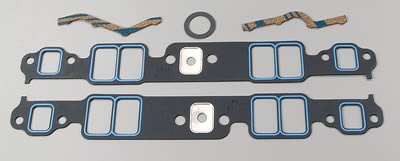
and you can also buy the intake gasket set with the passage fully blocked, but make sure you don't have a functioning heat riser valve still on there (the below set is the "correct-o" version from Paragon, complete with the tab that judges look for, me I don't care to do my intake manifold installs with any frequency, so I went with the above unit from Fel-pro, it's da way to go if you ask me):

and you can also buy the intake gasket set with the passage fully blocked, but make sure you don't have a functioning heat riser valve still on there (the below set is the "correct-o" version from Paragon, complete with the tab that judges look for, me I don't care to do my intake manifold installs with any frequency, so I went with the above unit from Fel-pro, it's da way to go if you ask me):
Last edited by ctjackster; Nov 17, 2006 at 08:14 AM.


Le Mans Master
Joined: Jul 2003
Posts: 6,808
Likes: 24
From: Westport CT
Originally Posted by woodsdesign
If you don't know which gasket you have is there a way to tell with out taking the heads off?
second, if you question relates to whether you have an intake gasket that has the crossover passage blocked, perhaps you could blow air into the p-side exhaust manifold from where it gets bolted to the head pipe and see if you have air flowing over at the d-side?

Melting Slicks


Joined: Jul 2000
Posts: 2,097
Likes: 99
From: Boston MA
Originally Posted by woodsdesign
If you don't know which gasket you have is there a way to tell with out taking the heads off?

Le Mans Master
Joined: Feb 2006
Posts: 6,048
Likes: 5
From: "cutesy" TN
Originally Posted by woodsdesign
If you don't know which gasket you have is there a way to tell with out taking the heads off?


Team Owner
Joined: Mar 2003
Posts: 26,118
Likes: 1,874
From: Greenville, Indiana
It might be a little easier to start your engine and plug one of your dual exhaust pipes. If your crossover is blocked, you'll hear the exhaust sound change out the other pipe or hear exhaust escaping or both. The pressure will start to build on the plugged pipe also.
If you want to block the heat crossover, cut a piece of shim stock, loosen the manifold and slide the shim in place. Tighten the manifold. Sometimes you'll tear the gasket in which case you get to pull the intake anyway.
If you want to block the heat crossover, cut a piece of shim stock, loosen the manifold and slide the shim in place. Tighten the manifold. Sometimes you'll tear the gasket in which case you get to pull the intake anyway.
