



Powdercoating Engine?

Thread Starter
Drifting

Joined: Jul 2005
Posts: 1,919
Likes: 4
From: Clovis NM
 Powdercoating Engine?
I have seen some places offer tp powdercoat engines rather than paint them.. how exactly do they do this?? I thought 500 degrees the the point at which this stuff melts and adheres to the metel?

Safety Car


Joined: Feb 2006
Posts: 4,142
Likes: 704
I'm not sure if you are worried about the heat of powdercoating damaging your block, or that the powdercoating will melt once your engine is running. Neither will occur.
Most powdercoating is done at between 350 and 400 degrees F for 15 to 20 minutes. This temperature will not harm your block. Most machine shops now use thermal cleaning ovens instead of ' hot tanks ' to clean parts. These ovens bake parts at over 700 degrees F.
The block and heads will never see much more temparature than the water in the block, except for the area where the exhaust manifolds are bolted on, but the gasket acts as an insulator.
Most powdercoating is done at between 350 and 400 degrees F for 15 to 20 minutes. This temperature will not harm your block. Most machine shops now use thermal cleaning ovens instead of ' hot tanks ' to clean parts. These ovens bake parts at over 700 degrees F.
The block and heads will never see much more temparature than the water in the block, except for the area where the exhaust manifolds are bolted on, but the gasket acts as an insulator.
Drifting
Joined: Mar 2005
Posts: 1,300
Likes: 0
From: Iowa
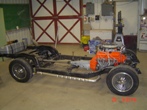
I powdercoated mine myself. Many people powder coat the block and heads prior to machining, I chose to do it after partial assembly. I used an infrared lamp to heat the surfaces to cure temperature (target of 375 for 15 minutes for the powder I used). Using an infrared thermometer, I monitored the temperature of the surface beneth the lamp and cured an area at a time. Moving the lamp as the current area finished curing. It is a slow tedious process, but I was able to direct the heat and precisely control it. In the picture below, the valve springs never got above 200 degrees. I used sacrificial spark plugs, head gaskets, and timing cover. I used asbestos tape to mask other areas where I didn't want powder to go. The sheet metal parts were done separately in an oven where the temperature could be controlled more precisely. Intake, carb, water pump, fan, starter, just about everything was powdercoated.


Thread Starter
Drifting
Joined: Jul 2005
Posts: 1,919
Likes: 4
From: Clovis NM
Wow that looks great... I was mostly concerned abouthte area close to the exhaust ports.. where exhaust manifolds/headers will go. My last engine had consistant EGTs of 1450 degrees and didn't know how much of that would transfer to the surface of the powder coated areas.

Le Mans Master


Joined: Sep 2001
Posts: 5,404
Likes: 45
From: Arlington Tx
St. Jude Donor '08
Originally Posted by mikeyandem1
Wow that looks great... I was mostly concerned abouthte area close to the exhaust ports.. where exhaust manifolds/headers will go. My last engine had consistant EGTs of 1450 degrees and didn't know how much of that would transfer to the surface of the powder coated areas.
I started a side business doing it and its been cool so far.
Drifting
Joined: Mar 2005
Posts: 1,300
Likes: 0
From: Iowa
Originally Posted by mikeyandem1
Wow that looks great... I was mostly concerned abouthte area close to the exhaust ports.. where exhaust manifolds/headers will go. My last engine had consistant EGTs of 1450 degrees and didn't know how much of that would transfer to the surface of the powder coated areas.
The exhaust manifolds on the Vett engine were done with a special high temp cast iron color that is supposed to be good to 1200 degrees. I don't plan on pushing this car hard for very long durations so I am confident that it will hold up. If i were racing it, I'd be a little concerned.
I'm a little surprised at your EGTs of 1450. When we raced the 240Z, 1275 was the magic limit. Anything above that and we started having troubles.
Corvette Stories
The Best of Corvette for Corvette Enthusiasts

Top 10 Most Expensive Corvettes Ever Sold on Bring A Trailer
Brett Foote
10 Things Every Corvette Owner Needs (2026 Edition)
Michael S. Palmer
8 Most "Only Corvette Owners Understand" Quirks and Problems
Pouria Savadkouei
10 Reasons the C6 Z06 is Still A Performance Benchmark After 20 Years
Joe Kucinski
How Much Horsepower Every Corvette Engine "LOST" in 1972
Joe Kucinski
Top 10 DOs and DON'Ts for Protecting Your Convertible Top!
Michael S. Palmer
Top 10 Most Explosive Corvettes Ever Made: Power-to-Weight Ratio Ranked!
Joe Kucinski
150 hp to 1,250 hp: Every Corvette Generation Compared by the Specs That Matter
Joe Kucinski
8 Coolest Corvette Pace Cars (and Replicas) of All Time
Verdad Gallardo
Thread Starter
Drifting
Joined: Jul 2005
Posts: 1,919
Likes: 4
From: Clovis NM
Originally Posted by rgs
This engine hasn't been started yet, but I also did my Jeep engine the same way but in Gold. The header was stainless steel so I left it alone, but the mating surfaces were powdercoated and show no signs of heat discoloring.
The exhaust manifolds on the Vett engine were done with a special high temp cast iron color that is supposed to be good to 1200 degrees. I don't plan on pushing this car hard for very long durations so I am confident that it will hold up. If i were racing it, I'd be a little concerned.
I'm a little surprised at your EGTs of 1450. When we raced the 240Z, 1275 was the magic limit. Anything above that and we started having troubles.
The exhaust manifolds on the Vett engine were done with a special high temp cast iron color that is supposed to be good to 1200 degrees. I don't plan on pushing this car hard for very long durations so I am confident that it will hold up. If i were racing it, I'd be a little concerned.
I'm a little surprised at your EGTs of 1450. When we raced the 240Z, 1275 was the magic limit. Anything above that and we started having troubles.
I was told by the guy running the dyno that 1500 was max..lower the better.. We did a number of runs and a couple temps measured that high worse case. Was your 240z gas I assume? Not alchy?