



DZAuto

Thread Starter
Pro


Joined: Dec 2005
Posts: 725
Likes: 3
From: Tolland MA
 I Beg The Indulgence of the Forum Members
By going off on a tangent with this stuff.
Thank you guys for sharing the memories and providing those wonderful pictures.
My Dad who is 83, lives next door in an apartment over my barn and who drives his '56 around told me this story:
It was WWII in Burma, he was a motor pool sergeant and one day while looking through an American destroyed vehicle impound for badly needed parts, looked up to see a zero and a P-38 in a fight. He had been told the P-38 was an incredibly strong platform but was not any where near as manueverable as the zero. Dad figured the P-38 was a goner but the pilot climbed out like a rocket with the Zero on his tail then dove straight down towards the ground. At the last minute the guy in the P-38 pulled up and the zero trying to duplicate the manuever ripped his wings off and crashed to the ground. My Dad was 18 years old at the time and it shook him up.
His stories are priceless and it takes a couple glasses of wine to coax them out but when these guys are gone there will be a bit of history gone forever.
Merry Christmas
Ralph
Thank you guys for sharing the memories and providing those wonderful pictures.
My Dad who is 83, lives next door in an apartment over my barn and who drives his '56 around told me this story:
It was WWII in Burma, he was a motor pool sergeant and one day while looking through an American destroyed vehicle impound for badly needed parts, looked up to see a zero and a P-38 in a fight. He had been told the P-38 was an incredibly strong platform but was not any where near as manueverable as the zero. Dad figured the P-38 was a goner but the pilot climbed out like a rocket with the Zero on his tail then dove straight down towards the ground. At the last minute the guy in the P-38 pulled up and the zero trying to duplicate the manuever ripped his wings off and crashed to the ground. My Dad was 18 years old at the time and it shook him up.
His stories are priceless and it takes a couple glasses of wine to coax them out but when these guys are gone there will be a bit of history gone forever.
Merry Christmas
Ralph

Team Owner


Joined: Nov 2005
Posts: 28,218
Likes: 2,872
From: Beach & High Desert Southern California
This engine always got me ... knowing I helped in a small way with identifying crankshaft issues in the Air Racers when I was a ME student at Cal Poly Pomona.
Pratt & Whitney R-4360 Wasp Major

from:
http://www.eagle.ca/~harry/aircraft/fury/reno.htm
"Frank Sanders had obtained the fairly complete airframe of Burmese Air Force T Mk.20 VZ368 (serialed UB-451 in Burmese service) and had the aircraft stored in its wooden shipping crate at the family's Chino, California, hangar during 1979. The two-seater was an ideal candidate for Sanders' project, so the Centaurus engine was removed, the airframe thoroughly cleaned and stripped, and a search begun for missing components while Sanders began tackling the engineering needed for the conversion. There was no doubt that the big Sea Fury could handle the R-4360, but problems such as a new cowling, motor mount, propeller, and new internal systems all had to be solved. By the end of its development life, the R-4360 was developing well over 4,000 horsepower, and in the early 1980s complete engines were available, along with a strong parts supply. With the help of sons Dennis and Brian and wife Ruth, work on the new racing aircraft began to proceed rapidly. Sanders also subcontracted some of the work to the vast aviation talent pool at Chino.
Sanders put lots of detail work into his new racer, some of which is not readily visible at first glance. For example, the rather clunky two-seat canopy arrangement was subtly refined to produce a unit that created much less drag than the normal canopies. As usual, the British air-brake system was dispensed with in favor of much more efficient American equipment, including brakes from an F-102. The completed aircraft made its first flight from Chino on 6 August 1983, and few problems were encountered. However, it soon became apparent that a larger vertical stabilizer and rudder were needed to handle the increased power and larger propeller, so the vertical surfaces were suitably enlarged. The two-seat, dual-control configuration was retained (unique for an all-out Unlimited, but Sanders wanted the aircraft to be useful as a possible high-speed test bed). Dreadnought created a sensation when it arrived on the ramp at Reno 1983. Finished in a sparkling Royal Air Force scheme of silver and red, Dreadnought was one of 32 Unlimited aircraft set to qualify that year. In the cockpit was General Dynamics executive Neil Anderson, an ex-Marine Corps fighter pilot and test pilot for the F-l 6. However, Anderson was regarded as a rookie because he had never raced in an Unlimited event. Anderson took Dreadnought out on the 9.187-mile course and hit 446.39 miles per hour, making him the fastest qualifier. Anderson did not hold back in Sunday's Cold race and went on to win at 425.24 miles per hour. Over the years, Dreadnought has been a regular Unlimited participant and has enjoyed its share of success, but the big Sea Fury has been partially eclipsed by Rare Bear and the new generation of highly modified Mustangs. At Reno 1995, Dennis Sanders qualified the racer at 434.667 miles per hour, which put the plane in fifth place (giving some idea how Unlimited speeds had increased since Dreadnought's first Reno outing). Immediately after winning the Gold heat race on 14 September (at 426.122 miles per hour), Sanders declared a Mayday and safely put the racer down on the runway-after years of faithful performance, the big R-4360 had finally come apart, and Dreadnought was on the ground for the rest of Reno 1995."
I am lucky to live in a location where a DC3 flys near my house at least twice a day (to enjoy the raspy radial sound).

Pratt & Whitney R-4360 Wasp Major
from:
http://www.eagle.ca/~harry/aircraft/fury/reno.htm
"Frank Sanders had obtained the fairly complete airframe of Burmese Air Force T Mk.20 VZ368 (serialed UB-451 in Burmese service) and had the aircraft stored in its wooden shipping crate at the family's Chino, California, hangar during 1979. The two-seater was an ideal candidate for Sanders' project, so the Centaurus engine was removed, the airframe thoroughly cleaned and stripped, and a search begun for missing components while Sanders began tackling the engineering needed for the conversion. There was no doubt that the big Sea Fury could handle the R-4360, but problems such as a new cowling, motor mount, propeller, and new internal systems all had to be solved. By the end of its development life, the R-4360 was developing well over 4,000 horsepower, and in the early 1980s complete engines were available, along with a strong parts supply. With the help of sons Dennis and Brian and wife Ruth, work on the new racing aircraft began to proceed rapidly. Sanders also subcontracted some of the work to the vast aviation talent pool at Chino.
Sanders put lots of detail work into his new racer, some of which is not readily visible at first glance. For example, the rather clunky two-seat canopy arrangement was subtly refined to produce a unit that created much less drag than the normal canopies. As usual, the British air-brake system was dispensed with in favor of much more efficient American equipment, including brakes from an F-102. The completed aircraft made its first flight from Chino on 6 August 1983, and few problems were encountered. However, it soon became apparent that a larger vertical stabilizer and rudder were needed to handle the increased power and larger propeller, so the vertical surfaces were suitably enlarged. The two-seat, dual-control configuration was retained (unique for an all-out Unlimited, but Sanders wanted the aircraft to be useful as a possible high-speed test bed). Dreadnought created a sensation when it arrived on the ramp at Reno 1983. Finished in a sparkling Royal Air Force scheme of silver and red, Dreadnought was one of 32 Unlimited aircraft set to qualify that year. In the cockpit was General Dynamics executive Neil Anderson, an ex-Marine Corps fighter pilot and test pilot for the F-l 6. However, Anderson was regarded as a rookie because he had never raced in an Unlimited event. Anderson took Dreadnought out on the 9.187-mile course and hit 446.39 miles per hour, making him the fastest qualifier. Anderson did not hold back in Sunday's Cold race and went on to win at 425.24 miles per hour. Over the years, Dreadnought has been a regular Unlimited participant and has enjoyed its share of success, but the big Sea Fury has been partially eclipsed by Rare Bear and the new generation of highly modified Mustangs. At Reno 1995, Dennis Sanders qualified the racer at 434.667 miles per hour, which put the plane in fifth place (giving some idea how Unlimited speeds had increased since Dreadnought's first Reno outing). Immediately after winning the Gold heat race on 14 September (at 426.122 miles per hour), Sanders declared a Mayday and safely put the racer down on the runway-after years of faithful performance, the big R-4360 had finally come apart, and Dreadnought was on the ground for the rest of Reno 1995."
I am lucky to live in a location where a DC3 flys near my house at least twice a day (to enjoy the raspy radial sound).

Team Owner


Joined: Oct 2000
Posts: 38,897
Likes: 1,926
From: Washington Michigan
The R-4360 "corncob" was used in the B-36 ("six turnin' and four burnin'") - a B-36 plug change required 336 spark plugs at $18.00 each ($6,048.00). Used to watch B-36's take off at Carswell AFB in Texas when I was flying Hueys for a living in '63.
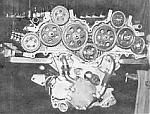
The Bristol Centaurus used in the Hawker Sea Fury was the ultimate development of the sleeve-valve engine - here's a shot of the gear train in the accessory case that drove the sleeves. How'd you like to set all THOSE gears "dot-to-dot".


The Bristol Centaurus used in the Hawker Sea Fury was the ultimate development of the sleeve-valve engine - here's a shot of the gear train in the accessory case that drove the sleeves. How'd you like to set all THOSE gears "dot-to-dot".
Race Director


Joined: Mar 2001
Posts: 14,632
Likes: 4,683
From: Mustang OK
2026 Corvette of the Year Finalist - Modified
2025 c1 of the Year - Modified Winner
2024 C1 of the Year Finalist - Modified
2023 C1 of the Year Finalist - Modified
2015 C1 of the Year Finalist
The R-4360 "corncob" was used in the B-36 ("six turnin' and four burnin'") - a B-36 plug change required 336 spark plugs at $18.00 each ($6,048.00). Used to watch B-36's take off at Carswell AFB in Texas when I was flying Hueys for a living in '63.
The Bristol Centaurus used in the Hawker Sea Fury was the ultimate development of the sleeve-valve engine - here's a shot of the gear train in the accessory case that drove the sleeves. How'd you like to set all THOSE gears "dot-to-dot".
The Bristol Centaurus used in the Hawker Sea Fury was the ultimate development of the sleeve-valve engine - here's a shot of the gear train in the accessory case that drove the sleeves. How'd you like to set all THOSE gears "dot-to-dot".
Nothin' to it man, just "connect the dots"!!!!
Drifting

Joined: Nov 2005
Posts: 1,601
Likes: 4
From: Texas
Let's see 336...hmmm
If I change 1 spark plug per minute and take 2 ten minute breaks...
336 minutes + 20 minutes = 356 minutes..
"Hey... I'll see ya'll in 6 hours.. gotta change the plugs."
My pipe smoking Engineer cousin Jim Thurman designed the landing gear for the B-36...
He said the General that layed out the B-36's specifications originally wanted the gear to be
capable of landing in a field dotted with 3 foot high tree stumps.... but Jim and his cohorts
talked him out of that idea...
If I change 1 spark plug per minute and take 2 ten minute breaks...
336 minutes + 20 minutes = 356 minutes..
"Hey... I'll see ya'll in 6 hours.. gotta change the plugs."
My pipe smoking Engineer cousin Jim Thurman designed the landing gear for the B-36...
He said the General that layed out the B-36's specifications originally wanted the gear to be
capable of landing in a field dotted with 3 foot high tree stumps.... but Jim and his cohorts
talked him out of that idea...
Last edited by KyleDallas; Dec 19, 2006 at 12:26 PM.
Team Owner
Joined: Nov 2005
Posts: 28,218
Likes: 2,872
From: Beach & High Desert Southern California
In the mid-80's I was employed as a control systems engineer and helped with fire alarm system testing on the Hughes Flying Boat (“Spruce Goose”) when it was displayed in Long Beach, CA. The FLS system had smoke detector heads and horn/strobes in the wings (important for a wood plane).
The Flying Boat used eight Pratt & Whitney R-4360 engines, and the learning experience while servicing the alarm system was that each wing had a catwalk system and vestibules so that each engine could be serviced in-flight. No need to land for engine service, just freewheel the prop and change the plugs (all 56 of them).
The docents (guys who worked for Hughes and on R-4360 engines who volunteered to help maintain the aircraft) commented that the engine rooms on the Flying Boat were unusually clean. The P&W corncob engines were prone to leaking oil, and the Flying Boats limited service was not enough to soil the plane. I do not know if the B36 had the same in-flight engine service capability, but clean up at altitude would have been interesting (and I imagine OSHA would have condemned the procedure).
Last edited by 63 340HP; Dec 19, 2006 at 01:07 PM.
Race Director
Joined: Mar 2001
Posts: 14,632
Likes: 4,683
From: Mustang OK
2026 Corvette of the Year Finalist - Modified
2025 c1 of the Year - Modified Winner
2024 C1 of the Year Finalist - Modified
2023 C1 of the Year Finalist - Modified
2015 C1 of the Year Finalist
Yep, you could go out into the wing for certain types of service/maintenance during flight.
Melting Slicks


Joined: Nov 2004
Posts: 2,302
Likes: 26
From: Cave Creek AZ
Roy
Corvette Stories
The Best of Corvette for Corvette Enthusiasts

Top 10 Most Expensive Corvettes Ever Sold on Bring A Trailer
Brett Foote
10 Things Every Corvette Owner Needs (2026 Edition)
Michael S. Palmer
8 Most "Only Corvette Owners Understand" Quirks and Problems
Pouria Savadkouei
10 Reasons the C6 Z06 is Still A Performance Benchmark After 20 Years
Joe Kucinski
How Much Horsepower Every Corvette Engine "LOST" in 1972
Joe Kucinski
Top 10 DOs and DON'Ts for Protecting Your Convertible Top!
Michael S. Palmer
Top 10 Most Explosive Corvettes Ever Made: Power-to-Weight Ratio Ranked!
Joe Kucinski
150 hp to 1,250 hp: Every Corvette Generation Compared by the Specs That Matter
Joe Kucinski
8 Coolest Corvette Pace Cars (and Replicas) of All Time
Verdad Gallardo
Racer

Joined: Mar 2004
Posts: 266
Likes: 0
From: Wellsboro PA
JohnZ
The R-4360 "corncob" was used in the B-36 ("six turnin' and four burnin'") - a B-36 plug change required 336 spark plugs at $18.00 each ($6,048.00). Used to watch B-36's take off at Carswell AFB in Texas when I was flying Hueys for a living in '63.
The Bristol Centaurus used in the Hawker Sea Fury was the ultimate development of the sleeve-valve engine - here's a shot of the gear train in the accessory case that drove the sleeves. How'd you like to set all THOSE gears "dot-to-dot".
The Bristol Centaurus used in the Hawker Sea Fury was the ultimate development of the sleeve-valve engine - here's a shot of the gear train in the accessory case that drove the sleeves. How'd you like to set all THOSE gears "dot-to-dot".
While attending Oskosh a few years ago I remarked to Ellsworth Getchell that I was glad to see that he had kept the Centaurus engine when it seemed that most others had gone to the Wright R-3350. He said that he had one extra set of replacement sleeves and when they were gone be forced to do the same.
Questions: Do the have a shorter life than "standard" valves?
Do you have any pictures that show the valve area? Your picture of "clockwork" is something I could never have imagined. It simply blew me away!
Thanks, Tom
Team Owner
Joined: Oct 2000
Posts: 38,897
Likes: 1,926
From: Washington Michigan
The Centaurus had 18 cylinders (two rows of 9), and each cylinder had a sleeve moving up and down, with the piston also moving up and down inside the sleeve; the sleeves were moved up and down by (18) separate camshafts, followers, and toggle linkages, to maintain valve timing with the pistons moving up and down inside them. The photo below shows a cylinder with its sleeve removed; the odd-shaped holes in the sleeve and the degree to which they were covered/uncovered by the piston crown were the "valves" - the cylinder head was just a flat cap with the spark plugs in it. Machining tolerances between the O.D. of the sleeve and the cylinder bore and between the I.D. of the sleeve and the piston were extremely critical, as was lubrication between all three components moving relative to each other. Not a cheap engine to build or maintain.
Team Owner
Joined: Nov 2005
Posts: 28,218
Likes: 2,872
From: Beach & High Desert Southern California
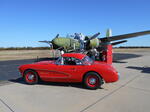
Since the thread took a tangent line off the radial, what would you think this would sound like  if it pulled up next to the Corvette?

With all the radical choppers and H-D engine builders it's a shame none have teamed up with an experimental aircraft enthusiast and machined a block and master rod configuration for a H-D radial aircraft engine (?maybe they have?).
Merry Christmas!
if it pulled up next to the Corvette?With all the radical choppers and H-D engine builders it's a shame none have teamed up with an experimental aircraft enthusiast and machined a block and master rod configuration for a H-D radial aircraft engine (?maybe they have?).
Merry Christmas!
