



Using French Locks

Thread Starter
Intermediate


Joined: Jul 2006
Posts: 48
Likes: 0
From: Southlake Texas
 Using French Locks
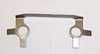
I need some advice from the experts.....I'm installing the half shafts to the rear diff. and trailing arms. There are 2 frenck locks on each half shaft flange with a pair of bolts running thru each to attach the flange to the trailing arm. According to the shop manual the bolts are to be torqued to 70-90 ftlbs, when I torgue them in this range it just rips the frenck lock apart. There are no washers underneath the bolts to provide a slip/bearing surface and there is not enough clearance for an SAE flat washer. I think I can keep the lock from tearing apart by lubing the side of the lock where the bolt head bears against it and using less torque on the bolt but I'm not sure this is advisable. The car is a 63 and uses the locks pictured below.
Any suggestions would be appreciated!
Any suggestions would be appreciated!

Race Director

Joined: Jul 2002
Posts: 11,593
Likes: 173
From: Clayton NC
I've done just as you are planning to, put a little bit of antiseize on the bolt head and it should help. I say help because it will still want to rotate the french lock and destroy it.  Dave
Dave
Dave

Melting Slicks


Joined: Aug 2004
Posts: 3,078
Likes: 101
From: Riverhead New York
Any bolt that requires a Torque to Specification should have the Threads cleaned by Wire Brush or Wheel and then be well Lubricated with an appropriate material. By this I mean sometimes an light Oil, other times a Lubricant Sealer such as Teflon. Other times a grease is a better choice. As to your French Locks, try a drop or two of engine assembly Lubricant. And remember, only one Tab needs to be engaged completely. Al W.
Thread Starter
Intermediate
Joined: Jul 2006
Posts: 48
Likes: 0
From: Southlake Texas
Any bolt that requires a Torque to Specification should have the Threads cleaned by Wire Brush or Wheel and then be well Lubricated with an appropriate material. By this I mean sometimes an light Oil, other times a Lubricant Sealer such as Teflon. Other times a grease is a better choice. As to your French Locks, try a drop or two of engine assembly Lubricant. And remember, only one Tab needs to be engaged completely. Al W.
Melting Slicks
Joined: Jun 2006
Posts: 2,660
Likes: 7
From: DFW
If the photo is of the actual locks you are using, the problem may be the locks.
They should be relatively flat to start with, with only a raised boss on the section that spans the two holes. The one in your photo has that section (the one that spans the two holes) turned 90* to the mounting surface, and would account for the tendency to turn as you turn the bolts.
Adding a flat washer, by the way, may limit thread engagement. A risky modification...
Last year I bought some correct locks from Paragon. Try their web site for a photo.
http://www.corvette-paragon.com/cata...4-A77725953DBA
I understand 63-64 was different, but these should work in any case as the GM parts book lists them as fitting 63 to 67.
They should be relatively flat to start with, with only a raised boss on the section that spans the two holes. The one in your photo has that section (the one that spans the two holes) turned 90* to the mounting surface, and would account for the tendency to turn as you turn the bolts.
Adding a flat washer, by the way, may limit thread engagement. A risky modification...
Last year I bought some correct locks from Paragon. Try their web site for a photo.
http://www.corvette-paragon.com/cata...4-A77725953DBA
I understand 63-64 was different, but these should work in any case as the GM parts book lists them as fitting 63 to 67.
Last edited by 66since71; Sep 4, 2007 at 04:54 PM. Reason: link to photo

Le Mans Master

Joined: Apr 2005
Posts: 6,359
Likes: 428
From: Seattle Area WA
I suggest only using the Stainless version of these locks or they will definately tear apart at around 60 pounds. I've found that anti sieze does help, but there is a night and day difference when you use the stainless ones from Paragon.

Race Director


Joined: Apr 1999
Posts: 10,866
Likes: 717
From: Beverly Hills/Pine Ridge Florida
If the photo is of the actual locks you are using, the problem may be the locks.
They should be relatively flat to start with, with only a raised boss on the section that spans the two holes. The one in your photo has that section (the one that spans the two holes) turned 90* to the mounting surface, and would account for the tendency to turn as you turn the bolts.
Adding a flat washer, by the way, may limit thread engagement. A risky modification...
Last year I bought some correct locks from Paragon. Try their web site for a photo.
http://www.corvette-paragon.com/cata...4-A77725953DBA
I understand 63-64 was different, but these should work in any case as the GM parts book lists them as fitting 63 to 67.
They should be relatively flat to start with, with only a raised boss on the section that spans the two holes. The one in your photo has that section (the one that spans the two holes) turned 90* to the mounting surface, and would account for the tendency to turn as you turn the bolts.
Adding a flat washer, by the way, may limit thread engagement. A risky modification...
Last year I bought some correct locks from Paragon. Try their web site for a photo.
http://www.corvette-paragon.com/cata...4-A77725953DBA
I understand 63-64 was different, but these should work in any case as the GM parts book lists them as fitting 63 to 67.
The style you describe is later.....65 and up.

Chuck
Melting Slicks
Joined: Jun 2006
Posts: 2,660
Likes: 7
From: DFW
Thanks, that's what I suspected, Chuck. It is interesting though that GM serviced 63's and 64's with the later lock (P&A 30B). Either just out of convenience, or the newer lock actually fixed a problem (like this one?).
Corvette Stories
The Best of Corvette for Corvette Enthusiasts

Top 10 Most Expensive Corvettes Ever Sold on Bring A Trailer
Brett Foote
10 Things Every Corvette Owner Needs (2026 Edition)
Michael S. Palmer
8 Most "Only Corvette Owners Understand" Quirks and Problems
Pouria Savadkouei
10 Reasons the C6 Z06 is Still A Performance Benchmark After 20 Years
Joe Kucinski
How Much Horsepower Every Corvette Engine "LOST" in 1972
Joe Kucinski
Top 10 DOs and DON'Ts for Protecting Your Convertible Top!
Michael S. Palmer
Top 10 Most Explosive Corvettes Ever Made: Power-to-Weight Ratio Ranked!
Joe Kucinski
150 hp to 1,250 hp: Every Corvette Generation Compared by the Specs That Matter
Joe Kucinski
8 Coolest Corvette Pace Cars (and Replicas) of All Time
Verdad Gallardo
Race Director
Joined: Apr 1999
Posts: 10,866
Likes: 717
From: Beverly Hills/Pine Ridge Florida
The "late" style was sold as a service replacement for 63 and 64.
BTW, EARLY 63's didn't use the locks at all.
I suppose the change was to prevent "twisting", although I've crunched and twised a few of the later style too.
Chuck
Melting Slicks
Joined: Aug 2004
Posts: 3,078
Likes: 101
From: Riverhead New York
Thanks for thr reply Al W. But lubricating the threads before assembly is not proper. Most torque specs are given for "dry" installation, the only time it's acceptable is when the torque spec specifically mentions a specific lubricant and the corresponding torque. Each lubricant reduces friction differently and would change the corresponding spec. For a simple test you can tighten a new nut on a new bolt till failure and record the torque required and then lube another new bolt and nut and try the same. Big difference, as 95% of the torque is used to overcome friction and the remaining 5% is used to preload the fastener.

Melting Slicks

Joined: Nov 2004
Posts: 2,302
Likes: 26
From: Cave Creek AZ
Check out this Bolt Torque Calculator. Select your bolt grade & size, coarse, fine or extra fine thread, click on "calculate" and it gives you the correct torque for dry, plated and lubricated threads. There is quite a difference between dry/clean threads & lubricated threads.
Roy
Roy
Melting Slicks
Joined: Aug 2004
Posts: 3,078
Likes: 101
From: Riverhead New York
Interesting Thread! So, I stand corrected as to Dry VS Lubricated. But for all my assemblies I will continue to practice Due Diligence. I still feel more confident in a good tightening with a lubricated thread VS a dry one. Just me. Al W.

Le Mans Master
Joined: Jan 2002
Posts: 8,913
Likes: 283
Mark
Thread Starter
Intermediate
Joined: Jul 2006
Posts: 48
Likes: 0
From: Southlake Texas
Thanks for the advice.....I'm going to lube the washer face of the cap screw with "Tri-flow", in my past experiences with torque/tension relationships this lubricant is the slickest and should ease the friction significantly. I'll then torque the cap screw till the lock starts to twist and quit.
I'll report back in a week with results as I'm waiting on new locks from Paragon as I have already destroyed 2 I previously got from them.
I'll report back in a week with results as I'm waiting on new locks from Paragon as I have already destroyed 2 I previously got from them.
