



# Match? How do I know?

Thread Starter
Drifting


Joined: Oct 2002
Posts: 1,383
Likes: 20
From: Georgetown SC
Cruise-In VI Veteran
Cruise-In VII Veteran
 # Match? How do I know?
My Dad gave me his 57 Vette a couple years ago. I'm thinking of selling it. He pulled the engine that was in the car when he bought it and put a 350 in it. I have the engine , but I need to find out if it's the original engine. How do I do this?
Joe
Joe

Team Owner

Joined: Aug 2007
Posts: 58,061
Likes: 7,146
Army
http://www.corvette-world.com/corvet...tion_codes.php
and this:
http://www.corvette-world.com/corvet...ng-Numbers.php
for a start.
The engine "code" [using the first link above] is embedded in the stamp pad numbers. This doesn't guarantee originality (the Corvette world is awash in restamped motors) but gives a pretty good indication. IIRC when you decipher the engine casting date it should be no more than 6 months before the cars "build date" to meet NCRS guidelines.
Last edited by Frankie the Fink; Oct 7, 2008 at 10:13 AM.
Thread Starter
Drifting
Joined: Oct 2002
Posts: 1,383
Likes: 20
From: Georgetown SC
Cruise-In VI Veteran
Cruise-In VII Veteran
The casting number is correct. Now what is this number on the stamp pad? where will I find it?
What about numbers on the intake and exhaust manifolds?
What about numbers on the intake and exhaust manifolds?

Administrator


Joined: Jul 2000
Posts: 53,988
Likes: 6,212
From: About 1100 miles from where I call home.
Just understand that on a 1957 the numbers never "match." The numbers can be correct, both in casting numbers and also in assembly dates. However, '57s had no VIN derivative on the block pad, so there is no "match" to the car's body VIN.
This term is misused regularly.
This term is misused regularly.
Thread Starter
Drifting
Joined: Oct 2002
Posts: 1,383
Likes: 20
From: Georgetown SC
Cruise-In VI Veteran
Cruise-In VII Veteran
Just understand that on a 1957 the numbers never "match." The numbers can be correct, both in casting numbers and also in assembly dates. However, '57s had no VIN derivative on the block pad, so there is no "match" to the car's body VIN.
This term is misused regularly.
This term is misused regularly.

Team Owner


Joined: Oct 2000
Posts: 38,897
Likes: 1,926
From: Washington Michigan
The block casting date is on the rear flange of the block, about 4" toward the passenger side from the distributor - post what you see there.
The car's serial number is on an aluminum plate screwed to the driver's side hinge pillar - post what you see there.
With the block casting date, the front pad stamping, and the serial number, we can tell you if the numbers make sense with each other.

Team Owner
Joined: Aug 2007
Posts: 58,061
Likes: 7,146
Army
Just understand that on a 1957 the numbers never "match." The numbers can be correct, both in casting numbers and also in assembly dates. However, '57s had no VIN derivative on the block pad, so there is no "match" to the car's body VIN.
This term is misused regularly.
This term is misused regularly.
Sorry Blue Flame-less Joe - I should have told you where to find the stamp pad number...posting a good picture is better than just supplying the number as folks like JohnZ can examine the 'broach marks' and give some opinion on if its an original stamp or not (if they care to that is)...
Last edited by Frankie the Fink; Oct 7, 2008 at 05:12 PM.
Thread Starter
Drifting
Joined: Oct 2002
Posts: 1,383
Likes: 20
From: Georgetown SC
Cruise-In VI Veteran
Cruise-In VII Veteran
OK here is what I found on the engine block.
Casting # 3731548
Stamped # F305EG
Vin # 57S101471
Intake # 3739653
OK Guys tell me what I have here.
Casting # 3731548
Stamped # F305EG
Vin # 57S101471
Intake # 3739653
OK Guys tell me what I have here.
Corvette Stories
The Best of Corvette for Corvette Enthusiasts

Top 10 Most Expensive Corvettes Ever Sold on Bring A Trailer
Brett Foote
10 Things Every Corvette Owner Needs (2026 Edition)
Michael S. Palmer
8 Most "Only Corvette Owners Understand" Quirks and Problems
Pouria Savadkouei
10 Reasons the C6 Z06 is Still A Performance Benchmark After 20 Years
Joe Kucinski
How Much Horsepower Every Corvette Engine "LOST" in 1972
Joe Kucinski
Top 10 DOs and DON'Ts for Protecting Your Convertible Top!
Michael S. Palmer
Top 10 Most Explosive Corvettes Ever Made: Power-to-Weight Ratio Ranked!
Joe Kucinski
150 hp to 1,250 hp: Every Corvette Generation Compared by the Specs That Matter
Joe Kucinski
8 Coolest Corvette Pace Cars (and Replicas) of All Time
Verdad Gallardo
Melting Slicks

Joined: Jul 2004
Posts: 2,867
Likes: 195
From: Maryland
Engine casting number is correct for 57 model year. Intake manifold is correct for EG suffix 270 HP w Hi lift cam. However the engine pad indicates 3/5/57 engine assembly date but VIN 01471 is a 12/27/56 DOB for the car. Are you sure of the engine pad and VIN accuracy? Also can you provide the engine casting date?
Last edited by Donald #31176; Oct 8, 2008 at 05:47 PM.

Race Director


Joined: Apr 1999
Posts: 10,866
Likes: 717
From: Beverly Hills/Pine Ridge Florida
F 305 EG is Flint (the assembly plant) 305 is March (third month) 5th day.
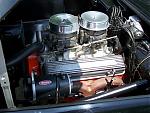
EG is the suffix for 270 HP manual trans. That's a 2x4 motor.
Nice.
Chuck


Pro


Joined: Jul 2005
Posts: 549
Likes: 3
Check the frame and see what the Vin# is on it.
Regards
Team Owner
Joined: Oct 2000
Posts: 38,897
Likes: 1,926
From: Washington Michigan
Appears to be an "EG" (270hp) engine out of a later car; the block casting date will confirm that. Although it may be a mechanically-correct 270hp engine, from a judging perspective, a block cast and assembled after the car was built is a 175-point deduction.
If you pull the valve covers and look at the head casting number and date and they're the correct 3740997 heads with the raised casting symbols on the ends machined flat (vs. rough-cast surface), the heads alone are worth big bucks.
If you pull the valve covers and look at the head casting number and date and they're the correct 3740997 heads with the raised casting symbols on the ends machined flat (vs. rough-cast surface), the heads alone are worth big bucks.


Racer


Joined: Aug 2006
Posts: 410
Likes: 0
From: Near Zanesville Ohio
57
Not any of my business but IF my dad left me a car or gave me a car I would be really hard pressed to cut it loose. Lost my dad a long time ago and the last car we worked on together is long gone wished I would have kept it. Hind sight is always 20/20 Moral of the story you may want to rethiink the selling. Again none of my business just my 2 cents Mike

Thread Starter
Drifting
Joined: Oct 2002
Posts: 1,383
Likes: 20
From: Georgetown SC
Cruise-In VI Veteran
Cruise-In VII Veteran
Not any of my business but IF my dad left me a car or gave me a car I would be really hard pressed to cut it loose. Lost my dad a long time ago and the last car we worked on together is long gone wished I would have kept it. Hind sight is always 20/20 Moral of the story you may want to rethiink the selling. Again none of my business just my 2 cents Mike
