


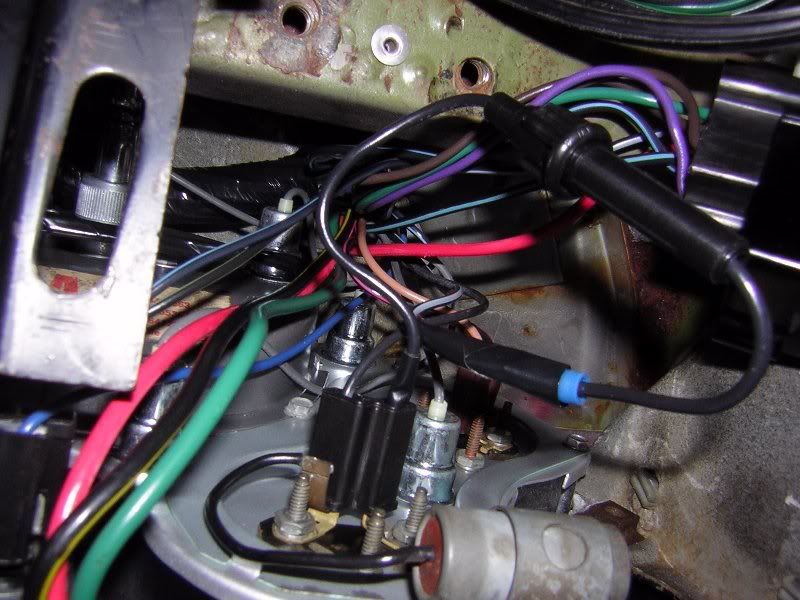

63 ammeter capacitor

Thread Starter
Burning Brakes

Joined: Jan 2009
Posts: 922
Likes: 2
From: Delta BC
 63 ammeter capacitor
The ammeter in my 63 doesn't work. I notice that the black wire (with a gold metal tab at the end) on the ammeter capacitor is just hanging there. Its not plugged into anything. Does anyone know where it plugs in and it this would be the reason the guage doesn't work?
Thanks,
Zora
Thanks,
Zora

Tech Contributor


Joined: May 2005
Posts: 15,576
Likes: 118
From: Conroe Texas
The capacitor just slips into one of the female terminals that connects to the gauge, before the terminal is connected to the gauge. It has nothing to do with the operation of your gauge.
Tech Contributor
Joined: May 2005
Posts: 15,576
Likes: 118
From: Conroe Texas
How do you know the gauge doesn't work? The one on my 65 barely moves as it is.
I don't know for sure about 63, but suspect it is the same as my 65, in which this gauge does not measure amperage like on pre 63 models, but instead measures a voltage difference between a lug on the horn relay, and the starter.
Remove the connection from the gauge, and with the car running, measure the voltage between each connector, and ground. If you get voltage on both of them, and yet your gauge does not move at all, then maybe the gauge is bad.
When my gauge was bad, the person who rebuilt it told me to quickly put a 9V battery across the terminals and see if the needle moved, then connect the battery 180 degrees to swap the +/- and see if the needle moved the other direction. If it did, the gauge was likely OK.
I don't know for sure about 63, but suspect it is the same as my 65, in which this gauge does not measure amperage like on pre 63 models, but instead measures a voltage difference between a lug on the horn relay, and the starter.
Remove the connection from the gauge, and with the car running, measure the voltage between each connector, and ground. If you get voltage on both of them, and yet your gauge does not move at all, then maybe the gauge is bad.
When my gauge was bad, the person who rebuilt it told me to quickly put a 9V battery across the terminals and see if the needle moved, then connect the battery 180 degrees to swap the +/- and see if the needle moved the other direction. If it did, the gauge was likely OK.
Thread Starter
Burning Brakes
Joined: Jan 2009
Posts: 922
Likes: 2
From: Delta BC
Well the gauge just stays at 0 all the time. Even when I honk the horn or turn on the headlights. It never fluctuates at all. I will check to see if there is voltage at each connector as ou have suggested and if so will proceed with the "9V battery test". Thanks for your help.
Cheers,
Zora
Cheers,
Zora
Tech Contributor
Joined: May 2005
Posts: 15,576
Likes: 118
From: Conroe Texas
Just don't do the 9V test any longer for an instant. You don't want to hold the battery in place while you look at the gauge, take measurements, call your neighbors, etc  Just touch the battery terminals to the gauge and see what the gauge does.
Just touch the battery terminals to the gauge and see what the gauge does.
Corvette Stories
The Best of Corvette for Corvette Enthusiasts

Every 2027 Corvette Engine Explained
Joe Kucinski
Designer Imagines A Corvette That Looks More Like a Corvette Than the Corvette
Verdad Gallardo
10 Ugly Corvettes That We Still Kinda Love
Joe Kucinski
Top 10 Most Expensive Corvettes Ever Sold on Bring A Trailer
Brett Foote
10 Things Every Corvette Owner Needs (2026 Edition)
Michael S. Palmer
8 Most "Only Corvette Owners Understand" Quirks and Problems
Pouria Savadkouei
10 Reasons the C6 Z06 is Still A Performance Benchmark After 20 Years
Joe Kucinski
How Much Horsepower Every Corvette Engine "LOST" in 1972
Joe Kucinski
Top 10 DOs and DON'Ts for Protecting Your Convertible Top!
Michael S. Palmer
Le Mans Master


Joined: Oct 2000
Posts: 8,897
Likes: 1,357
From: Santa Ana CA
This has been discussed at length. Use a 1.5 volt battery.
Some say that the 9 volt battery doesn't have enough current to move the gauge and others (like me) recognize that 9 volts is way to much and if the battery has/had the amperage, could peg the gauge (and harm the needle/movement).
BTW, due to the "open design," the '63 and '64 gauges are a cinch to rebuild yourself. Typically, the windings burn open. It is a simple matter to disassemble the gauge, and rewind the armature. Just use a magnetic wire similar in gauge to what you remove, and count the number of windings while disassembling so you can put the same number back on. There are not that many windings to deal with (only about 23 turns if memory serves).
Last edited by toddalin; Jan 4, 2009 at 09:46 PM.

Team Owner


Joined: Oct 2000
Posts: 38,897
Likes: 1,926
From: Washington Michigan
If the gauge check is OK (deflection in both directions), it's probably a bad connection/corroded terminals for the two sense wires in the multiple connector on the engine compartment side of the fuse block; very common midyear issue. 
