


remove return spring on clutch peddle?

Thread Starter
Racer


Joined: Apr 2000
Posts: 430
Likes: 15
From: eureka, ca
 remove return spring on clutch peddle?
I was reading my shop manual for my 66 and found that it said you could remove the return spring on the clutch peddle for "heavy duty conditions". Since this would lower the peddle on my car about 2 inches and now make it about level with the brake peddle it would make using the clutch much more comfortable. Anyone done this ? If it's in the manual It shouldn't hurt anything?

Le Mans Master


Joined: Nov 2008
Posts: 5,691
Likes: 12
From: columbus oh
I was reading my shop manual for my 66 and found that it said you could remove the return spring on the clutch peddle for "heavy duty conditions". Since this would lower the peddle on my car about 2 inches and now make it about level with the brake peddle it would make using the clutch much more comfortable. Anyone done this ? If it's in the manual It shouldn't hurt anything?

Thread Starter
Racer
Joined: Apr 2000
Posts: 430
Likes: 15
From: eureka, ca

Le Mans Master

Joined: Sep 2003
Posts: 8,934
Likes: 657
From: Norwalk ohio
2019 Corvette of the Year Winner
St. Jude Donor '15
I dont have a stock clutch OR pressure plate, I have a McLeod set up. When I put the car together, several people on the forum said that the fingers on the pressure plate would suffice for the pedal return. It has been fine. I don't know anything about your set up, but ask JohnZ, he would have a good opinion on if it would be ok for your set up or not...I like mine and there is no big honking a$$ spring to contend with.

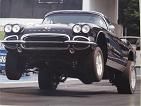
you can see in the photo above that the clutch pedal is about an inch below the brake pedal.....
you can see in the photo above that the clutch pedal is about an inch below the brake pedal.....
Drifting


Joined: Feb 2006
Posts: 1,840
Likes: 29
From: Towaco NJ
I dont have a stock clutch OR pressure plate, I have a McLeod set up. When I put the car together, several people on the forum said that the fingers on the pressure plate would suffice for the pedal return. It has been fine. I don't know anything about your set up, but ask JohnZ, he would have a good opinion on if it would be ok for your set up or not...I like mine and there is no big honking a$$ spring to contend with.
you can see in the photo above that the clutch pedal is about an inch below the brake pedal.....
you can see in the photo above that the clutch pedal is about an inch below the brake pedal.....
There was a thread a few weeks ago covering this.

http://forums.corvetteforum.com/c1-a...-question.html
Thread Starter
Racer
Joined: Apr 2000
Posts: 430
Likes: 15
From: eureka, ca
[QUOTE=firstgear;1570530758]I dont have a stock clutch OR pressure plate, I have a McLeod set up. When I put the car together, several people on the forum said that the fingers on the pressure plate would suffice for the pedal return. It has been fine. I don't know anything about your set up, but ask JohnZ, he would have a good opinion on if it would be ok for your set up or not...I like mine and there is no big honking a$$ spring to contend with.
My thought exactly--John ?
My thought exactly--John ?

Safety Car

Joined: Jun 2003
Posts: 3,596
Likes: 8
From: Grosse Ile MI
I was reading my shop manual for my 66 and found that it said you could remove the return spring on the clutch peddle for "heavy duty conditions". Since this would lower the peddle on my car about 2 inches and now make it about level with the brake peddle it would make using the clutch much more comfortable. Anyone done this ? If it's in the manual It shouldn't hurt anything?
Corvette Stories
The Best of Corvette for Corvette Enthusiasts

Corvette ZR1X Will Be Pacing the Indy 500, And Could Probably Race, Too!
Verdad Gallardo
Top 10 Corvettes Coming to Mecum Indy 2026!
Brett Foote
Top 10 C9 Corvette MUST-HAVES to Fix These C8 Generation Flaws!
Michael S. Palmer
10 Revolutionary 'Corvette Firsts' Most People Don't Know
Joe Kucinski
5 Reasons to Upgrade to an LS6-Powered Corvette; 5 Reasons to Stay LT2
Michael S. Palmer
2027 Corvette vs The World: Every C8 vs Its Closest Competitor
Joe Kucinski
10 Most Common Corvette Problems of the Last 20 Years!
Joe Kucinski
5 MOST and 5 LEAST Popular Corvette Model Years in History!
Joe Kucinski
2027 Corvette Buyer's Guide: Everything You Need to Know!
Joe Kucinski
Thread Starter
Racer
Joined: Apr 2000
Posts: 430
Likes: 15
From: eureka, ca
[QUOTE=buns;1570531647]^...It really is there. Page 7-2. "Adjust free travel to 2"-2-1/2" for heavy duty operation. The return spring may be removed for heavy duty conditions."
John Z?
John Z?
Le Mans Master
Joined: Sep 2003
Posts: 8,934
Likes: 657
From: Norwalk ohio
2019 Corvette of the Year Winner
St. Jude Donor '15
http://forums.corvetteforum.com/c1-a...uestion-2.html
Duntov54 made his own spring bracket, why not just use a lighter spring with the stock locations and mounting tabs? Besides the throw out bearing possibly wearing out, what else am I missing on the location of the mounting and just using a lighter spring?
Duntov54 made his own spring bracket, why not just use a lighter spring with the stock locations and mounting tabs? Besides the throw out bearing possibly wearing out, what else am I missing on the location of the mounting and just using a lighter spring?
Melting Slicks

Joined: Aug 2004
Posts: 3,078
Likes: 101
From: Riverhead New York
The one item overlooked in this Thread is , where does the Clutch Adjustment Actuate and what can be expected by any Modification of Throw? The Spring, as pointed out by vetrod, can be changed to lessen Depression Force. No Spring at all can only result in Metal to Metal contact. Al W.

Team Owner

Joined: Mar 2003
Posts: 26,118
Likes: 1,873
From: Greenville, Indiana
I think the "spring" referred to here in the '62/back model is an assist "over center" spring to help depress the clutch pedal with the B/B clutch. That's not the same as the mid-year spring discussed here.
The mid-year used the diaphragm clutch which doesn't require that spring but it does have a spring to pull the clutch pedal back up to the pedal stop under the dash.
If you change to the fast action position, which reduces pedal travel, it also drops the clutch pedal toward the floor. But, if you leave the pull back spring on the linkage, it'll pull the pedal all the way back up to the stop anyway with the same travel as before but with maybe half that action a dead zone and you've gained nothing.
Maybe you could rig a longer pedal stop under the dash and keep the pull back spring? Or maybe you could just leave it alone?
The mid-year used the diaphragm clutch which doesn't require that spring but it does have a spring to pull the clutch pedal back up to the pedal stop under the dash.
If you change to the fast action position, which reduces pedal travel, it also drops the clutch pedal toward the floor. But, if you leave the pull back spring on the linkage, it'll pull the pedal all the way back up to the stop anyway with the same travel as before but with maybe half that action a dead zone and you've gained nothing.
Maybe you could rig a longer pedal stop under the dash and keep the pull back spring? Or maybe you could just leave it alone?
Thread Starter
Racer
Joined: Apr 2000
Posts: 430
Likes: 15
From: eureka, ca
[QUOTE=MikeM;
Maybe you could rig a longer pedal stop under the dash and keep the pull back spring? Or maybe you could just leave it alone?[/QUOTE]
Leaving it alone leaves me with the 2 inch "dead zone" as you said. Leaving the spring on and just lowering the stop would work, but it seems to me the factory would not say you could leave the spring off if it would harm the throw out bearing.
Maybe you could rig a longer pedal stop under the dash and keep the pull back spring? Or maybe you could just leave it alone?[/QUOTE]
Leaving it alone leaves me with the 2 inch "dead zone" as you said. Leaving the spring on and just lowering the stop would work, but it seems to me the factory would not say you could leave the spring off if it would harm the throw out bearing.
Team Owner
Joined: Mar 2003
Posts: 26,118
Likes: 1,873
From: Greenville, Indiana
Just for the sake of discussion, if you remove the spring for anticipated "heavy duty conditions", there may be a great likelyhood you will wear the clutch out or tear it up with those "heavy duty condtions", before the throwout bearing goes bad. Which it will, sooner than if you left the spring on it. The more that bearing drags on the clutch fingers and the more you spin it, the shorter the bearing life. Makes sense, doesn't it?
Are you anticipating any really continuous "heavy duty conditions"? If not, I'd put the pedal back to the stock height.

Race Director


Joined: Nov 2000
Posts: 10,338
Likes: 663
From: Beverly Hills (Pine Ridge) Florida
From personal experience, the TO bearing will fail in 2000 miles or less (if it constantly rides on the clutch pressure plate fingers even if just light contact, since the TO bearing will be constantly turning - and it is not designed to do that).
Plasticman
Plasticman

Drifting


Joined: Jun 2007
Posts: 1,552
Likes: 99
From: Lake Villa Illinois
St. Jude Donor '14
Now if we change to the heavy duty or quick release position or whatever it's called, when you release the clutch pedal to the point where the throw out bearing just comes off contact with the clutch, the pedal just might be forward of the lowest point of it's arc, and as the pedal swings to the lowest point of it's arc it is actually drawing the throw out bearing away from the clutch.
This is just a theory that should be further tested.

Gerry
Safety Car
Joined: Jun 2003
Posts: 3,596
Likes: 8
From: Grosse Ile MI
I looked in the 63 shop manual, as I don't have the 66, and Section 7 covers the 3 speed transmission. There is no mention of removing the return spring in the 63 shop or the 65 supplement manuals. Guess it was something new for the 66 model year.
Dave

Team Owner

Joined: Oct 2000
Posts: 38,897
Likes: 1,920
From: Washington Michigan
It's a misprint - do NOT remove the clutch pedal return spring unless you really enjoy pulling transmissions and replacing fried throwout bearings, 'cuz that's what you'll end up with. Midyears don't have a "big honkin' return spring" - that's the solid-axle setup.