


L84 vs L76

Team Owner


Joined: Mar 2003
Posts: 26,118
Likes: 1,874
From: Greenville, Indiana

Some may want to argue the carb job was as fast in a straight line but I'd say the FI engine will pick up faster off a corner than the carbed engine. There is no question the FI engine had much quicker throttle response and low speed dirveability. Much smoother also.

Race Director


Joined: Jun 2006
Posts: 17,901
Likes: 751
From: Inverness FL
St. Jude Donor '07
the biggest problem with FI is the size of the airmeter bore; they run out of air at high rpms...
BUT, it has been my experience, with the same engine, that FI seems to provide more low end torque, possibly due to runner length.
Bill
BUT, it has been my experience, with the same engine, that FI seems to provide more low end torque, possibly due to runner length.
Bill
Last edited by wmf62; Dec 15, 2009 at 09:30 PM.
Le Mans Master


Joined: Dec 2004
Posts: 5,233
Likes: 419
That doesn't sound like they run out of air.
Race Director


Joined: Mar 2001
Posts: 14,641
Likes: 4,688
From: Mustang OK
2026 Corvette of the Year Finalist - Modified
2025 c1 of the Year - Modified Winner
2024 C1 of the Year Finalist - Modified
2023 C1 of the Year Finalist - Modified
2015 C1 of the Year Finalist
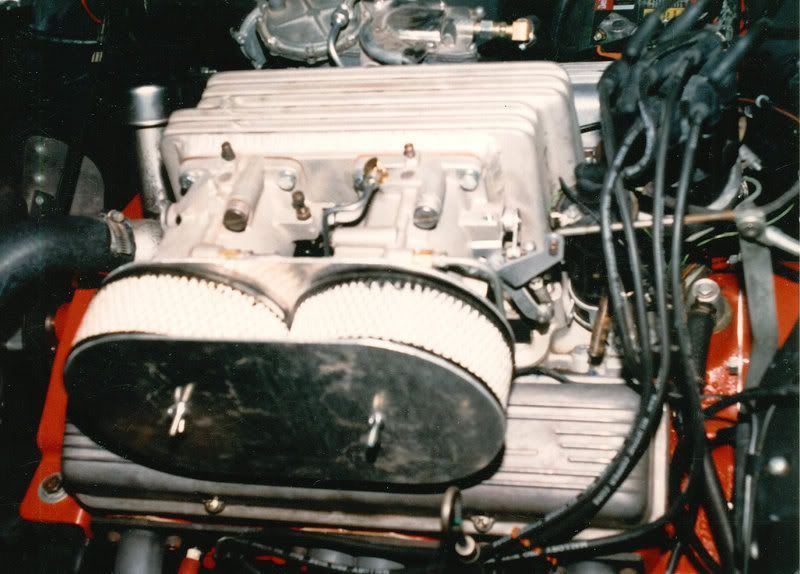
I can only add personal experience with a single air meter, BUT, realistically, it's comparring apples to oranges. My 56 has a SB400 with plenty of cam for the upper rpm ranges. The FI unit is an early plenum which has been cut in half and severely hogged out by Bill Thomas, probably back in the 60-61 time frame. The runners are short because the upper ends of the ram tubes (INSIDE the plenum) have been completely removed. Thus, low end velocity is not what it would be with full length runners. Although, the greater displacement pulls much more air volume through the unit, thus, you would EXPECT the velocity to be pretty high. The air meter is a 62 unit, which provides (theoretically) the same cfm as the 63-65 air meters.
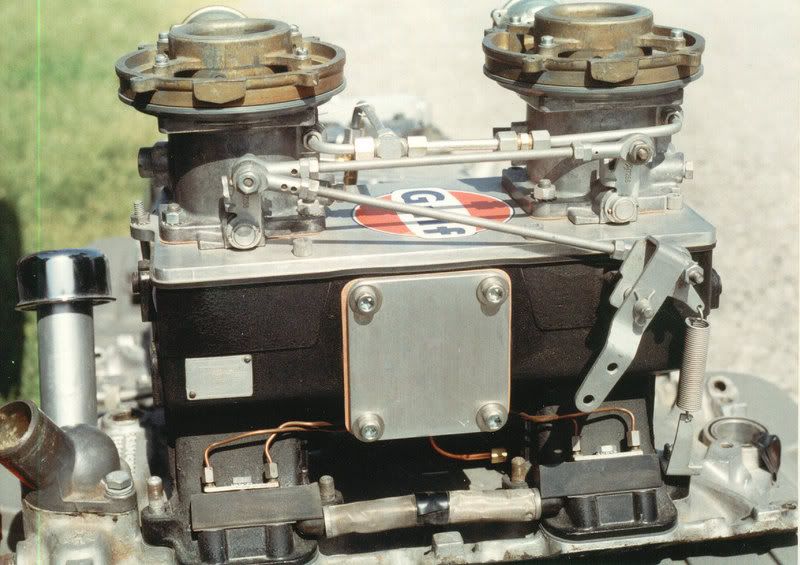
Now, with all of this said, my FI unit ABSOLUTELY does start running out of air above 5000rpm and by 6000rpm, it's a waste to keep pushing it. So, yes, I do feel that the FI units are limited by the single air meter. There were a few 63-65 FI units which were modified with two air meters and it took someone with intimate knowledge of how the added air volume affected the unit so that the fuel meter could be adequately modified. So far, I haven't learned those secrets (there are 1 or 2 people who are very profecient at setting up a dual air meter unit, but they are most reluctant to share that information).
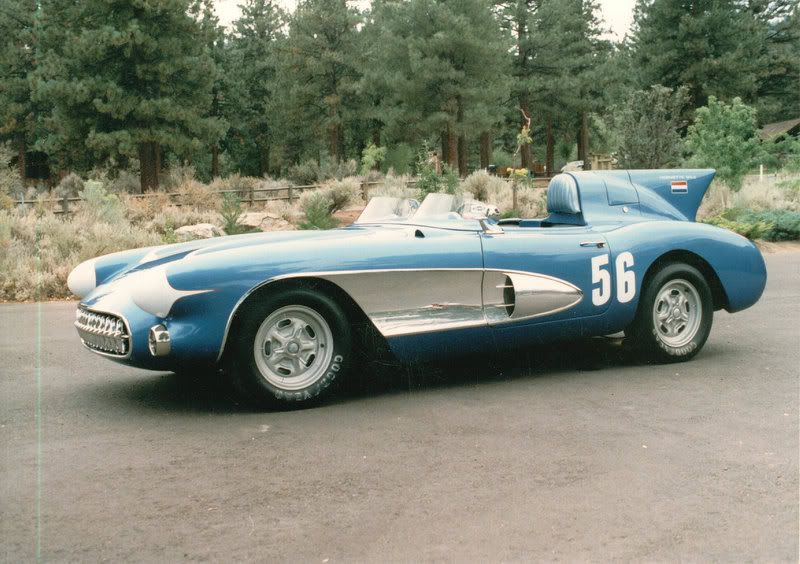
The Gulf Oil cars and some of Bill Thomas' Cheetahs had dual air meter FI units on their engines, as seen below. Obviously, the primary purpose was to provide adequate air under race conditions.
Here's one of the early Cheetahs with a dual air meter unit.


And this is Rich Mason's SR2 with a VERY early dual air meter FI unit on a 350.
As I understand (Never had the privilege of driving one), the engines with dual air meters are awsome!

Tom Parsons
Last edited by DZAUTO; Dec 15, 2009 at 11:00 PM.
Instructor

Joined: Jan 2009
Posts: 144
Likes: 0
From: Go'n 2 Surf City.. it's 2 to 1
the torque sweet spot will be.. Chrysler proved this with their Cross Rams.
.. It's also the reason different Webber and Kinsler FI manifolds and stack extentions are used... to tune the inlet length to the desired torque sweet spot.
The old Chrysler Sonoramic Manifolds were 27 inches long... they were made for Big/Heavy over 4000lb cars-long runner for low rpm band torque... while the Hemi/Racing crossrams had a 15 inch or so runner length- a shorter runner for higher rpm torque sweet spot.. These were used in Light Weight drag cars.. under 3100 lbs that needed more power at the big end of the track since they already had plenty of torque to get the lightweight car moving... Some of the shortest runners you will see are on high RPM road race cars, like
Cobra Webber set ups- Very short runner length, and short Webber extentions- made for high rpm track use... torque sweet spots in conventional motors normally cover about 4000 rpm's.
1500rpm to 5500rpm = 4000rpm
2000rpm to 6000rpm = 4000 rpm
2500rpm to 6500rpm = 4000rpm
Do the figures above look familiar?.. like when you're choosing a
camshaft?
Runner lengths help determine where that sweet spot will be.
All rules have exceptions... but for the most part Conventional naturally aspirated designed V-8's run best in a given 4000 rpm sweet spot... Don't NASCAR motors run from 5000 to 9000rpms... again- 4000 rpm sweet spot.
Last edited by ZLX; Dec 16, 2009 at 12:51 AM.

Le Mans Master

Joined: Dec 2003
Posts: 5,727
Likes: 39
From: Fremont CA
Last time I checked the L-76 had a 600CFM Holley 4bbl and a 380 series Rochester FI unit flows around 670CFM in a stock state so, I would tip my hat to the L-84 motor in any race INCLUDING fuel mileage.
Instructor


Joined: Oct 2004
Posts: 125
Likes: 5
From: Santa Rosa CA
See VETTE Magazine November 2009 dyno test comparison..."The fuelie 327 produced almost exactly 10 more hp than our carbureted combination, and offered more power 4300 through 6500 rpm. Below 4300rpm, the carbed motor made slightly more torque" Peak hp was 355hp at 5700rpm for the L76, 365hp also at 5700rpm for the L84.
Corvette Stories
The Best of Corvette for Corvette Enthusiasts

5 Best & 5 Worst Corvette Daily Drivers
Joe Kucinski
The Headlights of Every Corvette Generation Explained
Joe Kucinski
5 Best & 5 Most Overrated Corvette Track Packages of All Time!
Joe Kucinski
Every 2027 Corvette Engine Explained
Joe Kucinski
Designer Imagines A Corvette That Looks More Like a Corvette Than the Corvette
Verdad Gallardo
10 Ugly Corvettes That We Still Kinda Love
Joe Kucinski
Top 10 Most Expensive Corvettes Ever Sold on Bring A Trailer
Brett Foote
10 Things Every Corvette Owner Needs (2026 Edition)
Michael S. Palmer
8 Most "Only Corvette Owners Understand" Quirks and Problems
Pouria Savadkouei
Race Director
Joined: Jun 2006
Posts: 17,901
Likes: 751
From: Inverness FL
St. Jude Donor '07
my experience with a larger than stock FI engine has been the same as Tom's. once upon a time i built a special intake manifold and injection drive distributor (had a 6 foot long pump drive cable because the dist was in the front of the engine) for a 383 Plymouth. i was running the 426 wedge solid cam and it had so little low end torque that i had to run a 4.89 rear end to make it streetable.
when i changed from carb to FI i got enough low end back that i was able to go back to a 3.23 gear; BUT, in either rear gear case the engine just flat ran out of air about 5000.
in a way, the reverse has happened with my EFI conversion for my 350 LT1 in my 62. i have gone from a 600ish cfm airmeter to a 950ish airmeter, and my low has now disappeared...

Bill
when i changed from carb to FI i got enough low end back that i was able to go back to a 3.23 gear; BUT, in either rear gear case the engine just flat ran out of air about 5000.
in a way, the reverse has happened with my EFI conversion for my 350 LT1 in my 62. i have gone from a 600ish cfm airmeter to a 950ish airmeter, and my low has now disappeared...
Bill
