


C1 Racing modifications

Race Director


Joined: Oct 2000
Posts: 12,687
Likes: 3,139
From: Shamong, NJ

150 MPH at 5k rpm would require something like a 2.65:1 rear end and/or tall tires. Assume a wide ratio gear box (2.54:1) would also be required. What kind of HP and torque would be required at only 5k rpm to get 150 MPH and how would engine be set up to attain this?
In 1960, Corvette News did a article on the 60 Le Mans race and the Corvettes. Unfortunetly there are no specs given on the cars. The author of the article (who's name is not given) descibes a lap at Le Mans, a portion of his description is:
"From the Esses there is a brief straightaway, but you must be wary as you approach the extremely diffucult Tetre Rouge Corner. Brake down - because at anything over 40 mph, you will find yourself in the sandbank that lies off Tetre Rouge. As you come out of this corner you find yourself barrelling down the fastest and most famous straightaway in sports car racing - the Mulsanne Straight. You quickly build to over 155 mph, flat out. You should have reached this speed about one third of the way along the straight........"
"Some 500 meters from Mulsanne Hairpin you begin to brake down - ever so gently. In the 500 meters you must reduce the Corvette's speed approximately 90 miles per hour. You must, if you desire to negotiate the turn properly."
"It is a mile from the Mulsanne Corner to Indianapolis, .... There is a slight righthander followed by a much sharper lefthander, a short straight between thick pine woods, then a 90 degree turn to the right at Arnage Corner. Your speeds through this series have gone from 140 to 90 to 60 to 30 miles per hour. You are still two miles from the checkered flag........ You zoom by the pits at 130 mph and you are home. It has taken just over four minutes to run the complete circuit."
During one lap at Le Mans in a 1960 Corvette, speeds varied from a slowest of 30 mph, to a top speed of 155 mph. If, as the article says, you come off Tetre Rouge at 40 mph and reach top speed of 155 within 3/4 of a mile (1/3 of the 2 1/2 mile long straight), could a 1960 290 horse fuelie motor do that with a 3.08 rear? I don't consider the 283/290, or any of the early fuelie motors, as being very strong on low end torque. I think rear ratio in the mid, or maybe even upper 3's, might have been needed???

Race Director

Joined: Jul 2005
Posts: 13,685
Likes: 61
OK, lets state as a given that driving both C1 and C2 Corvettes (or Cobras) at "very high speed" can be a challenging prospect. That's what racing is all about. As stated, they are not at all aerodynamic, and subject to loads of lift. However, the Firestone T-170 tires of the day were very tall and had aspect ratios of around .80. Using Doug's calc of 79mph at 3000rpm with a 3.07 rear, that gives 26.33mph/1000 rpm, or about 5700rpm at 150mph. Also using his calc of approx 300rwhp, which was certanly achievable from a FACTORY effort of that day, I feel that it was not viable to run a state of the art Chevy pushrod motor at that speed for anywhere near 24 hours (or even 2.4 hours). Therefore, I would assume (without documentation) that the 150mph speed was simply a qualifying speed set during LeMans qualifying and not one routinely turned during the race.


Le Mans Master


Joined: Apr 2001
Posts: 9,556
Likes: 288
From: Granbury Texas
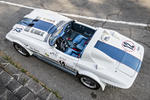
I love the efforts at aerodynamic imrovement on C1 #3 in the lower picture. Rear of hood is propped open to release trapped air up rather than down, reducing lift. The headlight buckets are partially raised, forming mini-spoilers. Also jacked rear, unless driver is panic-braking!
Mickey Thompson had cut "doors" in the inner fender of the front wheel wells so that the driver could check the wear on the front tires, however, when the rains came, fog/mist from the heated water entered the cockpit and made the 427 car undrivable because of limited/no vilibility.
Note the size of the Firestone T-170 race tire.

Last edited by 63Corvette; Feb 3, 2010 at 02:12 PM.
Race Director
Joined: Oct 2000
Posts: 12,687
Likes: 3,139
From: Shamong, NJ
Nope, the near car is the #3 Mickey Thompson 427 "Mystery Engine" car, and the #4 far car is a (stock) 327 Z06 in the RAIN on the Daytona banking.
Mickey Thompson had cut "doors" in the inner fender of the front wheel wells so that the driver could check the wear on the front tires, however, when the rains came, fog/mist from the heated water entered the cockpit and made the 427 car undrivable because of limited/no vilibility.
Note the size of the Firestone T-170 race tire.
Mickey Thompson had cut "doors" in the inner fender of the front wheel wells so that the driver could check the wear on the front tires, however, when the rains came, fog/mist from the heated water entered the cockpit and made the 427 car undrivable because of limited/no vilibility.
Note the size of the Firestone T-170 race tire.
I've never seen a picture of the 427 in that car. I've always wondered how deep it was set in the chassis, or what it used for an intake, that it fit under the stock 63 hood. It may be over simplifing it, but the mystery 427 used a block that was dimentionally similar to the 348/409 block and 396/427 "porcupine" style heads. Is it possible that the blocks deck height was short enough that the engine fit under the stock hood? The mystery 427 was the same engine that Junior Johnson, and others, raced in 63 Impalas in NASCAR that year.

Race Director


Joined: Oct 2000
Posts: 15,102
Likes: 79
From: central FL, near the beach.

u have me mocking up a deflector right now! my 61 has an open BB scoop, which i think works against it. the deflector should allow it to pull more air thru the radiator and reduce drag.

Le Mans Master
Joined: Apr 2001
Posts: 9,556
Likes: 288
From: Granbury Texas
Mystery engine in car
I've never seen a picture of the 427 in that car. I've always wondered how deep it was set in the chassis, or what it used for an intake, that it fit under the stock 63 hood. It may be over simplifing it, but the mystery 427 used a block that was dimentionally similar to the 348/409 block and 396/427 "porcupine" style heads. Is it possible that the blocks deck height was short enough that the engine fit under the stock hood? The mystery 427 was the same engine that Junior Johnson, and others, raced in 63 Impalas in NASCAR that year.

Race Director
Joined: Oct 2000
Posts: 12,687
Likes: 3,139
From: Shamong, NJ
Wow, how the heck did they close the hood? Doesn't look like there's enough clearence without an air cleaner, let alone with one. That's a pretty tall manifold, looking at the rough finish of the casting, it almost has a hand made or prototype look to it. I like the Mallory distributor (magneto?). David, thanks for the picture.
Corvette Stories
The Best of Corvette for Corvette Enthusiasts

Every 2027 Corvette Engine Explained
Joe Kucinski
Designer Imagines A Corvette That Looks More Like a Corvette Than the Corvette
Verdad Gallardo
10 Ugly Corvettes That We Still Kinda Love
Joe Kucinski
Top 10 Most Expensive Corvettes Ever Sold on Bring A Trailer
Brett Foote
10 Things Every Corvette Owner Needs (2026 Edition)
Michael S. Palmer
8 Most "Only Corvette Owners Understand" Quirks and Problems
Pouria Savadkouei
10 Reasons the C6 Z06 is Still A Performance Benchmark After 20 Years
Joe Kucinski
How Much Horsepower Every Corvette Engine "LOST" in 1972
Joe Kucinski
Top 10 DOs and DON'Ts for Protecting Your Convertible Top!
Michael S. Palmer


Burning Brakes

Joined: Dec 2008
Posts: 915
Likes: 213
From: Niagara Ontario
2022 C2 of the Year Finalist - Modified
2021 C2 of the Year Finalist - Modified
C2 of the Year Finalist - Modified 2020
C2 of Year Finalist (track prepared) 2019
2017 C2 of Year Finalist
2015 C2 of Year Finalist
With all these early Vettes racing, what carbueration, intake, & head combination were being used on the 283/327 engines?? And then the '63 Grand Sports with 377 and 427 eng blocks ?
Race Director
Joined: Jul 2005
Posts: 13,685
Likes: 61
377 Grand Sports started with single air-meter Rochester FI, experimented with dual-meter FI, then ended up with quad Weber carbs. FIA spec sheet called for dual-plug hemi heads, but I don't believe any of these made it as far as a race track.
To my knowledge, all cars that later received 427 "mystery" motors used single quads.
Race Director
Joined: Jul 2005
Posts: 13,685
Likes: 61
Mickey Thompson: "Then run it without. Chevy GAVE me the motor, if we win nobody'll care if it's junk afterwards."
Le Mans Master
Joined: Apr 2001
Posts: 9,556
Likes: 288
From: Granbury Texas


Drifting

Joined: Oct 2008
Posts: 1,936
Likes: 92
From: Rochester Hills Michigan
Chevrolet engines are tested at full throttle for 200 hours at peak torque to peak HP. For a '60 fuelie that's from 5000 to 6200 rpm.

Burning Brakes
Joined: Dec 2000
Posts: 1,203
Likes: 1
From: Sarasota FL
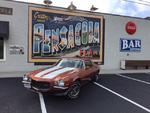
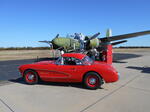
My car seems reasonably stable at ~120:

Stable enough that I could take this (in CO a few years later):

I'm not saying that I'd do it all the time, and I do run radials (as opposed to those pie-pan originals) but...that's what these cars were made to do!
Stable enough that I could take this (in CO a few years later):
I'm not saying that I'd do it all the time, and I do run radials (as opposed to those pie-pan originals) but...that's what these cars were made to do!


Race Director


Joined: Mar 2001
Posts: 14,640
Likes: 4,687
From: Mustang OK
2026 Corvette of the Year Finalist - Modified
2025 c1 of the Year - Modified Winner
2024 C1 of the Year Finalist - Modified
2023 C1 of the Year Finalist - Modified
2015 C1 of the Year Finalist


Melting Slicks


Joined: Oct 2004
Posts: 2,730
Likes: 92
From: Lakeland FL
Bill-You actually put your top up?
Tyler says it takes a blizzard or monsoon for that to happen.
