



accelerator ground strap
Thread Starter
Racer


Joined: Oct 2006
Posts: 470
Likes: 2
From: Hunterdon County NJ
 accelerator ground strap
I've been reading recently about the lexus problems with unintended acceleration and also listened to the youtube 911 call which is down right scary. also after having my sisters Lexus in the shop for three weeks after it went from 80 mph, to suddenly unable to go above 30 mph on the highway, with no real explanation from them, made me a bit concerned when I was attaching my ground strap to the accelerator linkage. I noticed that it affects the motion of the linkage. Should the spring break the carb would be left in the open position. Perhaps this would happen if it were not attached but I didn't remove it yet to try.
My questions:
Have others noted this interference or is it a routing issue.
Would anyone have a picture of the correct orientation?
Have others installed a secondary spring of some sort?
also, I'd like to know what type of bolt and washer is used at this point.
Thanks
My questions:
Have others noted this interference or is it a routing issue.
Would anyone have a picture of the correct orientation?
Have others installed a secondary spring of some sort?
also, I'd like to know what type of bolt and washer is used at this point.
Thanks

Tech Contributor


Joined: May 2005
Posts: 15,576
Likes: 118
From: Conroe Texas
If the spring breaks, the engine would suck carb open, I believe.
Here's how I have my ground strap routed, on my non NCRS 65

And I keep 2 springs on all of my carbureted cars, after seeing a friend flip her 63 at a autocross when her carb spring broke. Double springs:

Here's how I have my ground strap routed, on my non NCRS 65
And I keep 2 springs on all of my carbureted cars, after seeing a friend flip her 63 at a autocross when her carb spring broke. Double springs:
Le Mans Master

Joined: Nov 2008
Posts: 5,691
Likes: 12
From: columbus oh
i would not worry about the ground strap giving you any of the problems associated with the recent throttle problems with the radio controlled linkages of today....im sure that someone at sometime has experienced a broken throttle spring but i have not, ever....mechanical linkage is really fool proof save for the spring and a broken motor mount on the driver's side...jmo...
Safety Car


Joined: Aug 2006
Posts: 3,548
Likes: 36
From: Location, Location QC,NY
I have power nothing on my '62, just turn the key off.
That being noted, just move the linkage through its full travel and see if it binds or sticks anywhere. I did have the linkage binding a bit on the shielding at one point on mine, some tweaking and it was fine.
Paul
That being noted, just move the linkage through its full travel and see if it binds or sticks anywhere. I did have the linkage binding a bit on the shielding at one point on mine, some tweaking and it was fine.
Paul

Team Owner

Joined: Aug 2007
Posts: 58,061
Likes: 7,146
Army
I had a runaway accelerator experience in the '61 two months after owning it. (dual quad car). The tach (this was before it was calibrated so who knows the actual RPM) buried but it was a simple matter to switch off the key. Never did find the cause but suspect ignition shielding. I rearranged the linkage and no problem since. Scared the bejesus out of me.
These old vettes are NOT 'fly by wire' cars...
These old vettes are NOT 'fly by wire' cars...
Drifting


Joined: Feb 2005
Posts: 1,531
Likes: 27
From: Jamestown N.C.
This is one of the smartest moves any of us can make to help prevent throttle return problems:
When I first got my '64, I replaced a Bubba spring with a "correct" spring from one of the Corvette parts suppliers. It did not have enough tension to return the throttle even without a ground strap on the linkage. I decided to install dual springs like Jeff's for some peace of mind.
Todd
When I first got my '64, I replaced a Bubba spring with a "correct" spring from one of the Corvette parts suppliers. It did not have enough tension to return the throttle even without a ground strap on the linkage. I decided to install dual springs like Jeff's for some peace of mind.
Todd

Drifting
Joined: Nov 2007
Posts: 1,513
Likes: 34
From: columbus ohio
had a stuck accel rod on my zz4 in the 66. my dumbass fault. the
air cleaner bottom did not like me and grabbed the rod. i never thought
my right foot could move that quick and stomp. let go just as i was reaching for the key. i know that would not of helped that much. jim
air cleaner bottom did not like me and grabbed the rod. i never thought
my right foot could move that quick and stomp. let go just as i was reaching for the key. i know that would not of helped that much. jim
Corvette Stories
The Best of Corvette for Corvette Enthusiasts

Top 10 Most Expensive Corvettes Ever Sold on Bring A Trailer
Brett Foote
10 Things Every Corvette Owner Needs (2026 Edition)
Michael S. Palmer
8 Most "Only Corvette Owners Understand" Quirks and Problems
Pouria Savadkouei
10 Reasons the C6 Z06 is Still A Performance Benchmark After 20 Years
Joe Kucinski
How Much Horsepower Every Corvette Engine "LOST" in 1972
Joe Kucinski
Top 10 DOs and DON'Ts for Protecting Your Convertible Top!
Michael S. Palmer
Top 10 Most Explosive Corvettes Ever Made: Power-to-Weight Ratio Ranked!
Joe Kucinski
150 hp to 1,250 hp: Every Corvette Generation Compared by the Specs That Matter
Joe Kucinski
8 Coolest Corvette Pace Cars (and Replicas) of All Time
Verdad Gallardo
Tech Contributor
Joined: May 2005
Posts: 15,576
Likes: 118
From: Conroe Texas
Not wanting to turn off the key at 5,000 RPMs, I just rode the brakes really hard until I could get the engine RPMs down, and then turned off the key.
I like dual springs though because I don't want to have to trust that in a panic I'll remember to shut off the car.

Safety Car

Joined: Nov 2000
Posts: 4,761
Likes: 138
From: Clinton Township MI
Cruise-In III Veteran
geo65,
I just went through replacing all the linkage in my '65. My car was originally a 300 HP and after pulling the original motor I replaced it with a "mule" 327 built up like a 365 HP version. This was done 2 years ago.
Long story short, was chasing why my secondaries were not opening and it was suggested that either the carpet padding and carpet were preventing full travel of the linkage under your foot or there was some slipping going on where the accelerator linkage passes through the trans tunnel and hooks to the arm which holds the rod at the carb (hope I'm clear on my descr here, LOL!).
Initially I had thought it was just an adjustment at the rod. Made some tweaks there and took it out for a spin. Went through the gears on 16 mile road and experienced some GREAT power shifting 1st to 2nd to 3rd...holy mackerel!! Well it was time to get out of it and that's when I realized (at about 90 mph) that the front end was still up in the air, meaning she's pulling hard). Now, I didn't think a split second about shutting her off. I immediately shut the key off and coasted over to the side of the road. It's because I was "tuned" to this possibility or keenly aware of this happening that I did this. My '5 is a manual steering, manual brake car and you know it's quite easy when rolling to steer her around. Obviously my adjustment tweaking the rod wasn't getting it.
I ended up replacing all of the 45 year old linkage along with a correct for a 365 HP rod.
You really have to pay attention to the total travel of this linkage to assure yourself there is no binding...anywhere.
The ground strap should be a non issue in binding. Just make sure you have enough "copper ribbon" on that strap to allow for travel. Oh, right or wrong, I attached the copper strap to the inside of the arm.
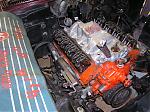
Here's some pics, one of the old linkage and the installed after setup.
Regards,
Jim
In God We Trust!
ps In the 1st directly overhead shot down on the motor, you'll notice how straight front to rear of the motor the accelerator rod is. Just another point of reference to assure yourself that there is no binding building up at the connection points of the rod.
I just went through replacing all the linkage in my '65. My car was originally a 300 HP and after pulling the original motor I replaced it with a "mule" 327 built up like a 365 HP version. This was done 2 years ago.
Long story short, was chasing why my secondaries were not opening and it was suggested that either the carpet padding and carpet were preventing full travel of the linkage under your foot or there was some slipping going on where the accelerator linkage passes through the trans tunnel and hooks to the arm which holds the rod at the carb (hope I'm clear on my descr here, LOL!).
Initially I had thought it was just an adjustment at the rod. Made some tweaks there and took it out for a spin. Went through the gears on 16 mile road and experienced some GREAT power shifting 1st to 2nd to 3rd...holy mackerel!! Well it was time to get out of it and that's when I realized (at about 90 mph) that the front end was still up in the air, meaning she's pulling hard). Now, I didn't think a split second about shutting her off. I immediately shut the key off and coasted over to the side of the road. It's because I was "tuned" to this possibility or keenly aware of this happening that I did this. My '5 is a manual steering, manual brake car and you know it's quite easy when rolling to steer her around. Obviously my adjustment tweaking the rod wasn't getting it.
I ended up replacing all of the 45 year old linkage along with a correct for a 365 HP rod.
You really have to pay attention to the total travel of this linkage to assure yourself there is no binding...anywhere.
The ground strap should be a non issue in binding. Just make sure you have enough "copper ribbon" on that strap to allow for travel. Oh, right or wrong, I attached the copper strap to the inside of the arm.
Here's some pics, one of the old linkage and the installed after setup.
Regards,
Jim
In God We Trust!
ps In the 1st directly overhead shot down on the motor, you'll notice how straight front to rear of the motor the accelerator rod is. Just another point of reference to assure yourself that there is no binding building up at the connection points of the rod.
Last edited by 6T5RUSH; Mar 1, 2010 at 11:25 AM.

Team Owner

Joined: Oct 2000
Posts: 38,897
Likes: 1,926
From: Washington Michigan
You really have to pay attention to the total travel of this linkage to assure yourself there is no binding...anywhere.
ps In the 1st directly overhead shot down on the motor, you'll notice how straight front to rear of the motor the accelerator rod is. Just another point of reference to assure yourself that there is no binding building up at the connection points of the rod.
ps In the 1st directly overhead shot down on the motor, you'll notice how straight front to rear of the motor the accelerator rod is. Just another point of reference to assure yourself that there is no binding building up at the connection points of the rod.

Safety Car
Joined: Nov 2000
Posts: 4,761
Likes: 138
From: Clinton Township MI
Cruise-In III Veteran
JohnZ,
Thank you!! It's amazing how much I can do things wrong and still have things work...somewhat!
Not obviously driving her right now so that issue as well as my interior is high on my TODO list!
Regards,
Jim
In God We Trust!
Thank you!! It's amazing how much I can do things wrong and still have things work...somewhat!
Not obviously driving her right now so that issue as well as my interior is high on my TODO list!
Regards,
Jim
In God We Trust!
Drifting
Joined: Feb 2010
Posts: 1,734
Likes: 267
From: Richmond Texas
Hey 62Jeff,not trying to pick on your car but you can stop those leaky intake bolts from putting oil on top of the intake. Remove one at a time and clean the bolt, I put permatex ultra copper on the threads and then thread them back in.
Tech Contributor
Joined: May 2005
Posts: 15,576
Likes: 118
From: Conroe Texas
Yeah, did that about 2 years ago. The picture predates the repair.
Melting Slicks

Joined: Oct 2005
Posts: 3,073
Likes: 3
From: New Jersey. The deer ate my Garden State.
This is one of the smartest moves any of us can make to help prevent throttle return problems:
When I first got my '64, I replaced a Bubba spring with a "correct" spring from one of the Corvette parts suppliers. It did not have enough tension to return the throttle even without a ground strap on the linkage. I decided to install dual springs like Jeff's for some peace of mind.
Todd
When I first got my '64, I replaced a Bubba spring with a "correct" spring from one of the Corvette parts suppliers. It did not have enough tension to return the throttle even without a ground strap on the linkage. I decided to install dual springs like Jeff's for some peace of mind.
Todd
Tech Contributor
Joined: May 2005
Posts: 15,576
Likes: 118
From: Conroe Texas
The photo of my 65 in the above post, should, I believe, show you what John is describing.
Jeff
Team Owner
Joined: Aug 2007
Posts: 58,061
Likes: 7,146
Army
I guess I trust my reactions more than most....but I've had a few runaway throttles over the years and have always just shut it off with the key. In each situation (probably 3 in a car and 1 on a motorcycle) I wasn't in imminent danger of hitting anything. I don't think putting the vehicle in neutral where the engine can redline until it blows is real smart unless there is no other choice.
I can't imagine a runaway 'fly by wire' modern car where you go through the 'shutdown drills' and nothing works! Having developed software for aviation systems for many years...EVERYthing has a failsafe that is tested, tested again and then tested once more in a simulator and then tested in real aircraft by test pilots before an ECP (Engineering Change Proposal) is ever moved into production.
If an aircraft is involved in any incident and the software is the suspected culprit ... it was late night/weekends and "asses and elbows" until it was corrected....not denials of the issue or foot dragging. Of course a dead pilot was a million dollars in lost training....a deceased motorist ? Not so much.
I can't imagine a runaway 'fly by wire' modern car where you go through the 'shutdown drills' and nothing works! Having developed software for aviation systems for many years...EVERYthing has a failsafe that is tested, tested again and then tested once more in a simulator and then tested in real aircraft by test pilots before an ECP (Engineering Change Proposal) is ever moved into production.
If an aircraft is involved in any incident and the software is the suspected culprit ... it was late night/weekends and "asses and elbows" until it was corrected....not denials of the issue or foot dragging. Of course a dead pilot was a million dollars in lost training....a deceased motorist ? Not so much.
Last edited by Frankie the Fink; Mar 2, 2010 at 07:38 AM.
