





Basic Question on Bellhousings

Melting Slicks


Joined: Jan 2005
Posts: 3,022
Likes: 94
From: Texas


Any missed gear can cause a problem aluminum can't fix....unless of course, you never wind it up and hammer the gears.
.. Of course if it's a numbers matching etc, etc, bla, bla, car...well you know.
I always ran a scatter shield with a 4 speed. Comes from a friend getting some shrapnel in his foot back in high school....he still walks wyth a lisp...
Stan...
Race Director


Joined: Mar 2001
Posts: 14,619
Likes: 4,671
From: Mustang OK
2026 Corvette of the Year Finalist - Modified
2025 c1 of the Year - Modified Winner
2024 C1 of the Year Finalist - Modified
2023 C1 of the Year Finalist - Modified
2015 C1 of the Year Finalist
Up through 1959 ALLLLLLLLLLLLLLLLL Corvette and pass cars had cast iron bell housings with an open bottom.
ALLLLLLLLLLLLL 1960-62 Corvettes ONLY had cast alum, open bottom bell housings.
In 1963-later, ALLLLLLLLLLLLL Corvettes went to the full enclosure, die cast alum bell housing.
The pass cars retained the open bottom cast iron bell housings through 1962----------EXCEPT--------the 1960-63 hi-perf 348 and 409 engines. The 63-later pass cars WITHOUT the hi-perf 409 got the same die cast, full enclosure alum housings that were the same as the 63-later Vettes.
ANY Chevy---car, Vette, truck----that had an open bottom bell housing (didn't matter if it was iron or alum) ONLY had the larger 168 teeth flywheel. THERE WAS NO SUCH COMBINATION AS AN OPEN BOTTOM BELL HOUSING AND THE SMALLER 153 TEETH FLYWHEEL.
The 1960 open bottom, cast alum bell housing that was on ALL Vettes and hi-perf 348 cars, was the same, and ONE YEAR ONLY housing. This particular housing is probably the highest value of all bell housings.
Probably the next highest value bell housing is the cast alum open bottom version on ALLLLLLLLLLLLL 61-2 Vettes and 61-3 hi-perf 348-409s in pass cars.
After that, it's probably a toss up between the 64-65 full enclosure alum housings used ONLY in full size cars and Chevelles (this housing WAS NOT used in Vettes) and the 444 full enclosure housing used on 66-VERY early 67 BB Vettes, Chevelles and MAYBE full size cars.
Tom Parsons
ALLLLLLLLLLLLL 1960-62 Corvettes ONLY had cast alum, open bottom bell housings.
In 1963-later, ALLLLLLLLLLLLL Corvettes went to the full enclosure, die cast alum bell housing.
The pass cars retained the open bottom cast iron bell housings through 1962----------EXCEPT--------the 1960-63 hi-perf 348 and 409 engines. The 63-later pass cars WITHOUT the hi-perf 409 got the same die cast, full enclosure alum housings that were the same as the 63-later Vettes.
ANY Chevy---car, Vette, truck----that had an open bottom bell housing (didn't matter if it was iron or alum) ONLY had the larger 168 teeth flywheel. THERE WAS NO SUCH COMBINATION AS AN OPEN BOTTOM BELL HOUSING AND THE SMALLER 153 TEETH FLYWHEEL.
The 1960 open bottom, cast alum bell housing that was on ALL Vettes and hi-perf 348 cars, was the same, and ONE YEAR ONLY housing. This particular housing is probably the highest value of all bell housings.
Probably the next highest value bell housing is the cast alum open bottom version on ALLLLLLLLLLLLL 61-2 Vettes and 61-3 hi-perf 348-409s in pass cars.
After that, it's probably a toss up between the 64-65 full enclosure alum housings used ONLY in full size cars and Chevelles (this housing WAS NOT used in Vettes) and the 444 full enclosure housing used on 66-VERY early 67 BB Vettes, Chevelles and MAYBE full size cars.
Tom Parsons
Last edited by DZAUTO; Jul 20, 2010 at 10:04 PM.
Thread Starter
Bud2


Joined: Jul 2005
Posts: 1,237
Likes: 4
From: Warrnambool Victoria
Mines a Girly Car...
AC and all so I expected a standard bellhousing. Actually took a look at it this last weekend and it has a pressed-steel housing. It's red so maybe a Lakewood or something else re-painted. Was surprised, can't figure out why the PO would make this upgrade. While its not NCRS, nothing indicates it was raced in its history.
Funny how you can look at things and not 'see'. I've looked at that housing dozens of times and it just never registered that it wasn't a cast item. Is that an old-age thing??
Bud.
Funny how you can look at things and not 'see'. I've looked at that housing dozens of times and it just never registered that it wasn't a cast item. Is that an old-age thing??
Bud.

Le Mans Master

Joined: Sep 2009
Posts: 9,151
Likes: 481
From: "You may all go to Hell- and I will go to Texas- Davy Crockett
St. Jude Donor '12
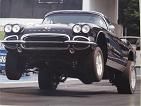
I remember seeing a picture VERY similar to this back in the day. I think it was a 55 or 56 Chevy that hand grenaded the flywheel. Same pic? One thing that is kinda confusing tho, what are all the hydraulic lines and fittings in the floor opening there?
Last edited by vettsplit 63; Jul 22, 2010 at 12:46 AM.
Corvette Stories
The Best of Corvette for Corvette Enthusiasts

10 Reasons the C6 Z06 is Still A Performance Benchmark After 20 Years
Joe Kucinski
How Much Horsepower Every Corvette Engine "LOST" in 1972
Joe Kucinski
Top 10 DOs and DON'Ts for Protecting Your Convertible Top!
Michael S. Palmer
Top 10 Most Explosive Corvettes Ever Made: Power-to-Weight Ratio Ranked!
Joe Kucinski
150 hp to 1,250 hp: Every Corvette Generation Compared by the Specs That Matter
Joe Kucinski
8 Coolest Corvette Pace Cars (and Replicas) of All Time
Verdad Gallardo
Top 10 Corvette Engines RANKED by Peak Torque (70+ Years of Muscle!)
Joe Kucinski
Corvette ZR1X Will Be Pacing the Indy 500, And Could Probably Race, Too!
Verdad Gallardo
Top 10 Corvettes Coming to Mecum Indy 2026!
Brett Foote
Pro

Joined: May 2010
Posts: 560
Likes: 2
From: North Las Vegas Nevada
Thread Starter
Bud2
Joined: Jul 2005
Posts: 1,237
Likes: 4
From: Warrnambool Victoria
Dunno...
I saw that too and was wondering the same. Was also wondering what the guage was on the passenger side dash was. First thought it was a oil pressure but it looks like it has an odometer too. Whatever, it would be hard to moniter from the passenger seat.
Bud
Bud

Race Director
Joined: Jan 2007
Posts: 13,671
Likes: 14
From: Down on the bayou in south Louisiana
St. Jude Donor '10
 It looks like another speedometer but I doubt this was a rally car.

Drifting


Joined: Feb 2006
Posts: 1,840
Likes: 29
From: Towaco NJ
The floor looks to have been cut earlier, to access the rear of the engine. The blown bell housing looks to be a steel scatter shield. Cast iron or alum. would crack off, not bend around.
Bottom line, if you have a solid lifter engine that revs, no stock flywheels.

Thread Starter
Bud2
Joined: Jul 2005
Posts: 1,237
Likes: 4
From: Warrnambool Victoria
If Only the Picture Could Talk...
I'm sure there are some good stories with that car!
Well spotted Vette62. It does look to be steel. I'm no expert but doesn't it look a little far back to be the bellhousing? I thought the flywheel would be a little further forward closer to the engine - as I said I'm no expert. But if it is a steel bellhousing and it didn't do the job of its intention, is it simply a hope and pray sort of situation if the flywheel does go? The reason I'm asking is most of the time spent in my 64 is at the track - I'm old but I still don't want to be looking at the family gems up on the roof liner!
Bud
Well spotted Vette62. It does look to be steel. I'm no expert but doesn't it look a little far back to be the bellhousing? I thought the flywheel would be a little further forward closer to the engine - as I said I'm no expert. But if it is a steel bellhousing and it didn't do the job of its intention, is it simply a hope and pray sort of situation if the flywheel does go? The reason I'm asking is most of the time spent in my 64 is at the track - I'm old but I still don't want to be looking at the family gems up on the roof liner!
Bud
Drifting
Joined: Feb 2006
Posts: 1,840
Likes: 29
From: Towaco NJ
I'm sure there are some good stories with that car!
Well spotted Vette62. It does look to be steel. I'm no expert but doesn't it look a little far back to be the bellhousing? I thought the flywheel would be a little further forward closer to the engine - as I said I'm no expert. But if it is a steel bellhousing and it didn't do the job of its intention, is it simply a hope and pray sort of situation if the flywheel does go? The reason I'm asking is most of the time spent in my 64 is at the track - I'm old but I still don't want to be looking at the family gems up on the roof liner!
Bud
Well spotted Vette62. It does look to be steel. I'm no expert but doesn't it look a little far back to be the bellhousing? I thought the flywheel would be a little further forward closer to the engine - as I said I'm no expert. But if it is a steel bellhousing and it didn't do the job of its intention, is it simply a hope and pray sort of situation if the flywheel does go? The reason I'm asking is most of the time spent in my 64 is at the track - I'm old but I still don't want to be looking at the family gems up on the roof liner!
Bud
I think the scatter shield is designed to contain the clutch if let loose. The flywheel is not expected to let go if within specs. Your family Gems should be safe if you are racing and have Billet flywheel.
Yes, the engine looks to be more rearward than stock. Hence the rear access cover. My question is what engine is that????? It does not look like a SBC. Remember we are talking 45-55 years ago. The heads look weird.
