


What does this mean?? CE Block

Thread Starter
Burning Brakes


Joined: Oct 2008
Posts: 884
Likes: 1
From: Blacksburg Virginia
 What does this mean?? CE Block
I was looking at an add for a 67 427 390 hp car and it says the following:
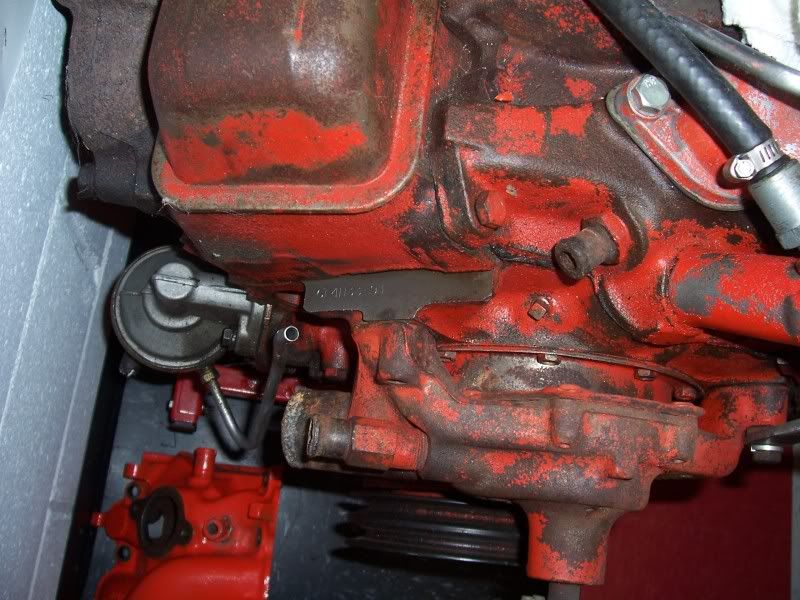
It has a service replacement CE block [it is a XXXX289 block], from Chevrolet. Do not have the original XXXXX351 block. This block is the same bore as the original [4.250] and is built with the same spec. cam, crank, rods, pistons comp ratio, etc., as original. It is a 390 HP engine.
Somebody please translate this??
It has a service replacement CE block [it is a XXXX289 block], from Chevrolet. Do not have the original XXXXX351 block. This block is the same bore as the original [4.250] and is built with the same spec. cam, crank, rods, pistons comp ratio, etc., as original. It is a 390 HP engine.
Somebody please translate this??

Le Mans Master


Joined: Nov 2008
Posts: 5,691
Likes: 12
From: columbus oh
I was looking at an add for a 67 427 390 hp car and it says the following:
It has a service replacement CE block [it is a XXXX289 block], from Chevrolet. Do not have the original XXXXX351 block. This block is the same bore as the original [4.250] and is built with the same spec. cam, crank, rods, pistons comp ratio, etc., as original. It is a 390 HP engine.
Somebody please translate this??
It has a service replacement CE block [it is a XXXX289 block], from Chevrolet. Do not have the original XXXXX351 block. This block is the same bore as the original [4.250] and is built with the same spec. cam, crank, rods, pistons comp ratio, etc., as original. It is a 390 HP engine.
Somebody please translate this??

Tech Contributor


Joined: May 2005
Posts: 15,576
Likes: 118
From: Conroe Texas

Burning Brakes
Joined: Feb 2008
Posts: 916
Likes: 2
From: prescott arizona
I was looking at an add for a 67 427 390 hp car and it says the following:
It has a service replacement CE block [it is a XXXX289 block], from Chevrolet. Do not have the original XXXXX351 block. This block is the same bore as the original [4.250] and is built with the same spec. cam, crank, rods, pistons comp ratio, etc., as original. It is a 390 HP engine.
Somebody please translate this??
It has a service replacement CE block [it is a XXXX289 block], from Chevrolet. Do not have the original XXXXX351 block. This block is the same bore as the original [4.250] and is built with the same spec. cam, crank, rods, pistons comp ratio, etc., as original. It is a 390 HP engine.
Somebody please translate this??


Race Director


Joined: Jul 2001
Posts: 15,892
Likes: 42


Racer

Joined: Jun 2009
Posts: 306
Likes: 3
From: Horseshoe Bay TX
 Counter Exchange
Chevy dealers sold a lot of Hi-Perf short blocks and long blocks over the parts counter long before todays "CRATE" motors.
Also as noted warranty - Dodge Plymouth went thur a bunch of 440's when that block came out in 1967 - Chevy / Pontiac guys bought new GTX's and Dodge RT's and tried to pull 6000 rpm like a GM small block
- MoPar fixed the problem by '69, but the early 440's did not like anything over 5,500 rpmBlue
Melting Slicks


Joined: Jan 2006
Posts: 2,487
Likes: 57
From: Williamsburg Virginia
Ce
Not 'probably', I'd say 'possibly'. There's tons of CE blocks around, being that they were not unique to Corvette, and it's a great temptation to slip one into a Corvette using the line that it was warranty replacement. In turn, this magically makes it a 'semi-matching number' car.

Earl
Corvette Stories
The Best of Corvette for Corvette Enthusiasts

Every 2027 Corvette Engine Explained
Joe Kucinski
Designer Imagines A Corvette That Looks More Like a Corvette Than the Corvette
Verdad Gallardo
10 Ugly Corvettes That We Still Kinda Love
Joe Kucinski
Top 10 Most Expensive Corvettes Ever Sold on Bring A Trailer
Brett Foote
10 Things Every Corvette Owner Needs (2026 Edition)
Michael S. Palmer
8 Most "Only Corvette Owners Understand" Quirks and Problems
Pouria Savadkouei
10 Reasons the C6 Z06 is Still A Performance Benchmark After 20 Years
Joe Kucinski
How Much Horsepower Every Corvette Engine "LOST" in 1972
Joe Kucinski
Top 10 DOs and DON'Ts for Protecting Your Convertible Top!
Michael S. Palmer
Race Director
Joined: Aug 2004
Posts: 15,328
Likes: 2,271
From: NorCal
I believe it stands for...........
............Crated Engine. Had one back in the day and was told that by the dealer/parts guy that I bought it from. Dealers installed them as warranty replacements for engines that "failed"; you could also buy them over the counter and install them in whatever.
Mine was a '70 LT-1 engine that I put in my '67. It came in a crate, not in a car! Hence the "CE" designation.
Just because a block has a "CE" designation doesn't mean it was a factory/dealer/warranty replacement, unless there is some other documentation ( service order, receipt, etc.) to prove it!
Admittedly, my understanding of the definition is second hand - and 40 years old! Since there are now two opinions - "Counter Exchange" and "Crated Engine",
Maybe a real expert like John Z could weigh in and set us all straight?

Mine was a '70 LT-1 engine that I put in my '67. It came in a crate, not in a car! Hence the "CE" designation.
Just because a block has a "CE" designation doesn't mean it was a factory/dealer/warranty replacement, unless there is some other documentation ( service order, receipt, etc.) to prove it!
Admittedly, my understanding of the definition is second hand - and 40 years old! Since there are now two opinions - "Counter Exchange" and "Crated Engine",
Maybe a real expert like John Z could weigh in and set us all straight?
Last edited by tuxnharley; Dec 1, 2010 at 04:09 PM. Reason: addl point
Race Director
Joined: Aug 2004
Posts: 15,328
Likes: 2,271
From: NorCal

Team Owner


Joined: Oct 2000
Posts: 38,897
Likes: 1,926
From: Washington Michigan
Race Director
Joined: Jul 2001
Posts: 15,892
Likes: 42
This is post #3, at least using metric numbers.
Did you read post #11
Did you read post #11

Race Director
Joined: Nov 2002
Posts: 12,142
Likes: 54
From: Taylor Michigan
Counter Exchange{nope! CE means Chevy engine}
Also as noted warranty - Dodge Plymouth went thur a bunch of 440's when that block came out in 1967 - Chevy / Pontiac guys bought new GTX's and Dodge RT's and tried to pull 6000 rpm like a GM small block
- MoPar fixed the problem by '69, but the early 440's did not like anything over 5,500 rpmBlue
Race Director
Joined: Aug 2004
Posts: 15,328
Likes: 2,271
From: NorCal
Thanks, I've got it now!

Intermediate
Joined: Mar 2017
Posts: 45
Likes: 5
From: Miami Fl
Is there a list or resource to date or get more info on "CEs". I've been told an engine is a "factory replacement" likely from 72, but I don't know where that info comes from. The older post states that the numbers could be the total number or a year code of some sort.
Thanks
Thanks
Team Owner
Joined: Oct 2000
Posts: 38,897
Likes: 1,926
From: Washington Michigan
Is there a list or resource to date or get more info on "CEs". I've been told an engine is a "factory replacement" likely from 72, but I don't know where that info comes from. The older post states that the numbers could be the total number or a year code of some sort.
Thanks
Thanks
http://www.camaros.org/engine.shtml#service
Drifting

Joined: Dec 2015
Posts: 1,319
Likes: 221
From: Dalton, Ma