



Ride Height.

Thread Starter
Drifting


Joined: Apr 2008
Posts: 1,540
Likes: 51
From: Lexington Park Maryland
 Ride Height.
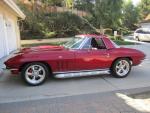
What's the proper height of a mid-year ? I'n not sure where to measure from nor how many inches it should be. The car seems to sag a bit in the back and I'm not sure if I need new shocks or springs (or both). I have P205-75-15 radial tires. Any help is appreciated.

Melting Slicks


Joined: Oct 2004
Posts: 3,345
Likes: 87
From: Northern MN
St. Jude Donor '13-'14-'15-'16-'17
Is it possible that the adjusting bolts on the rear leaf are pulled down to tight? For me, I like to see the wheel well openings at approximately the same height. I think it gives the car a clean look. I have set my lip on the fenders about 1" to 1 1/2" below the top of the tire. Just my preference and that is where the front sets, so I just matched it with the adjustmen to the rear. I hope this helps.

Team Owner


Joined: Oct 2000
Posts: 38,897
Likes: 1,926
From: Washington Michigan
The Engineering design ride height measurements (which are independent of tire size) are shown in your Assembly Manual, in UPC 3, sheet A6 ("Z" height) for the front, and in UPC 4, sheet B5 ("D" height) for the rear. All you need is a yo-yo.
If the "Z" and "D" heights are within specs, the bottom-of-rocker molding to ground measurements ("J" height at the front and "K" height at the rear) should be within specs too.
The correct 6"-long rear spring end-to-trailing arm link bolts with slotted nuts and cotter pins aren't adjustable. If you have longer ones with Nylok nuts on them, those are aftermarket, usually installed to compensate for an incorrect replacement rear spring with too much camber (arch).
If the "Z" and "D" heights are within specs, the bottom-of-rocker molding to ground measurements ("J" height at the front and "K" height at the rear) should be within specs too.
The correct 6"-long rear spring end-to-trailing arm link bolts with slotted nuts and cotter pins aren't adjustable. If you have longer ones with Nylok nuts on them, those are aftermarket, usually installed to compensate for an incorrect replacement rear spring with too much camber (arch).
Thread Starter
Drifting
Joined: Apr 2008
Posts: 1,540
Likes: 51
From: Lexington Park Maryland
The Engineering design ride height measurements (which are independent of tire size) are shown in your Assembly Manual, in UPC 3, sheet A6 ("Z" height) for the front, and in UPC 4, sheet B5 ("D" height) for the rear. All you need is a yo-yo.
If the "Z" and "D" heights are within specs, the bottom-of-rocker molding to ground measurements ("J" height at the front and "K" height at the rear) should be within specs too.
The correct 6"-long rear spring end-to-trailing arm link bolts with slotted nuts and cotter pins aren't adjustable. If you have longer ones with Nylok nuts on them, those are aftermarket, usually installed to compensate for an incorrect replacement rear spring with too much camber (arch).
If the "Z" and "D" heights are within specs, the bottom-of-rocker molding to ground measurements ("J" height at the front and "K" height at the rear) should be within specs too.
The correct 6"-long rear spring end-to-trailing arm link bolts with slotted nuts and cotter pins aren't adjustable. If you have longer ones with Nylok nuts on them, those are aftermarket, usually installed to compensate for an incorrect replacement rear spring with too much camber (arch).

Le Mans Master

Joined: Nov 2000
Posts: 7,246
Likes: 21
From: Going too fast over the hill. Iowa

Melting Slicks

Joined: Jun 2006
Posts: 2,660
Likes: 7
From: DFW
 8" should get you very close. If the rear is a little high, i wouldn't worry. My reference suggests a slight rake. 8.1 front and 8.4 rear. The measurement points are 42" apart and are for 27" tall tires (very close to what you are running).
 You can raise the rear by adding washers to the link bolts. Lowering it will require the longer bolts JohnZ mentions.
F40/41 springs are supposed to lower it a little. In my case it was about 1/2 inch.
Harry

Le Mans Master


Joined: Jul 2000
Posts: 5,408
Likes: 2,203
Cant answer your question....but you do see a a lot of restored cars that seem to sit too high. Mine was restored 20 years ago......I like the way it sits.
Last edited by gilbybarr; Mar 16, 2011 at 11:27 PM.
Corvette Stories
The Best of Corvette for Corvette Enthusiasts

Top 10 Most Expensive Corvettes Ever Sold on Bring A Trailer
Brett Foote
10 Things Every Corvette Owner Needs (2026 Edition)
Michael S. Palmer
8 Most "Only Corvette Owners Understand" Quirks and Problems
Pouria Savadkouei
10 Reasons the C6 Z06 is Still A Performance Benchmark After 20 Years
Joe Kucinski
How Much Horsepower Every Corvette Engine "LOST" in 1972
Joe Kucinski
Top 10 DOs and DON'Ts for Protecting Your Convertible Top!
Michael S. Palmer
Top 10 Most Explosive Corvettes Ever Made: Power-to-Weight Ratio Ranked!
Joe Kucinski
150 hp to 1,250 hp: Every Corvette Generation Compared by the Specs That Matter
Joe Kucinski
