



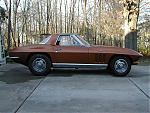


67 Overheating Need help PLEASE

Thread Starter
Heel & Toe

Joined: Apr 2007
Posts: 17
Likes: 0
 67 Overheating Need help PLEASE
My dad has 1967 Vette 327 4 speed, power nothing. The motor was rebuilt to stock specs in 2007. It ran fine with the original radiator... temp would slowly climb in traffic then immediately go back down upon the car moving. In AUG we replaced the radiator with a brass replacement from ecklers which cost under 400 bucks. It has been overheating (at idle, under power,) since then which leads me to believe the radiator is garbage. When I say overheating i mean blowing antifreeze from overflow. Just looking for some ideas/advise from those who have experienced this issue before, and what was done to fix problem. Do i need to buy him a 800-900 aluminum replacement
thanks
JR
thanks
JR

Burning Brakes


Joined: Mar 2008
Posts: 859
Likes: 53
From: Magnolia Texas
Give us a little more info... new thermostat? Good (new) hoses? Antifreeze? What pressure cap are you running? Did you do anything else to the car before this started?
There's really no reason why a (quality) replacement brass radiator shouldn't do the job although the DeWitts would have given you a bit more cooling capacity.
Steve
There's really no reason why a (quality) replacement brass radiator shouldn't do the job although the DeWitts would have given you a bit more cooling capacity.
Steve

CF Community Team


Joined: Oct 2004
Posts: 19,366
Likes: 5,244
From: Cape Cod, Mass.
2025 C6 of the Year Finalist - Unmodified
2025 C8 Z06/7/E-Ray of the Year Finalist - Unmodified
2023 C3 of the Year Finalist - Unmodified
2021 C8 of the Year Finalist Unmodified
2020 Corvette of the Year Finalist (performance mods)
2019 C1 of Year Winner (performance mods)
2017 Corvette of the Year Finalist
2016 C2 of Year
2015 C3 of Year Finalist
Go with a Dewitt's aluminum radiator. The copper/ brass radiators just don't do the job when ambient temps get over 70 degrees. Make sure your clutch fan is in good operating order.

Le Mans Master


Joined: Oct 2000
Posts: 5,227
Likes: 879
From: PERCUSSIVE MAINTENANCE: The art of whacking the crap out of an electronic device to get it to work.
A new copper radiator should work just fine in your car. Copper worked very well when these cars were built. You need to look elsewhere................Thermostat, fan clutch, timing and vacuum advance, and fan shroud and insulation.

Former Vendor
Joined: Jan 2000
Posts: 5,593
Likes: 631
From: Brighton
No you don't but you should stay with an aluminum radiator because that's what came with the car. You have three (3) options for you car, here are the heat rejection rates.
Copper/brass 3290btu/min $400
Replacement aluminum 4100/btu/min $525
Restoration aluminum 4600/btu/min $875
With the copper replacements 30% less capacity than the original it baffles me how anyone could say they "should be fine". I don't understand why dealers continue to even offer them.
If you are on a budget and need a good replacement this is the way to go. Our Direct Fit (A63M) is a nice looking radiator with similar performance (10% reduction) to the stock radiator.

Copper/brass 3290btu/min $400
Replacement aluminum 4100/btu/min $525
Restoration aluminum 4600/btu/min $875
With the copper replacements 30% less capacity than the original it baffles me how anyone could say they "should be fine". I don't understand why dealers continue to even offer them.
If you are on a budget and need a good replacement this is the way to go. Our Direct Fit (A63M) is a nice looking radiator with similar performance (10% reduction) to the stock radiator.
Last edited by Tom@Dewitt; Oct 9, 2011 at 09:17 AM.
Corvette Stories
The Best of Corvette for Corvette Enthusiasts

Top 10 Most Expensive Corvettes Ever Sold on Bring A Trailer
Brett Foote
10 Things Every Corvette Owner Needs (2026 Edition)
Michael S. Palmer
8 Most "Only Corvette Owners Understand" Quirks and Problems
Pouria Savadkouei
10 Reasons the C6 Z06 is Still A Performance Benchmark After 20 Years
Joe Kucinski
How Much Horsepower Every Corvette Engine "LOST" in 1972
Joe Kucinski
Top 10 DOs and DON'Ts for Protecting Your Convertible Top!
Michael S. Palmer
Top 10 Most Explosive Corvettes Ever Made: Power-to-Weight Ratio Ranked!
Joe Kucinski
150 hp to 1,250 hp: Every Corvette Generation Compared by the Specs That Matter
Joe Kucinski
8 Coolest Corvette Pace Cars (and Replicas) of All Time
Verdad Gallardo
Le Mans Master
Joined: Oct 2000
Posts: 5,227
Likes: 879
From: PERCUSSIVE MAINTENANCE: The art of whacking the crap out of an electronic device to get it to work.
No you don't but you should stay with an aluminum radiator because that's what came with the car. You have three (3) options for you car, here are the heat rejection rates.
Copper/brass 3290btu/min $400
Replacement aluminum 4100/btu/min $525
Restoration aluminum 4600/btu/min $875
With the copper replacements 30% less capacity than the original it baffles me how anyone could say they "should be fine". I don't understand why dealers continue to even offer them.
If you are on a budget and need a good replacement this is the way to go. Our Direct Fit (A63M) is a nice looking radiator with similar performance (10% reduction) to the stock radiator.
Copper/brass 3290btu/min $400
Replacement aluminum 4100/btu/min $525
Restoration aluminum 4600/btu/min $875
With the copper replacements 30% less capacity than the original it baffles me how anyone could say they "should be fine". I don't understand why dealers continue to even offer them.
If you are on a budget and need a good replacement this is the way to go. Our Direct Fit (A63M) is a nice looking radiator with similar performance (10% reduction) to the stock radiator.

Race Director


Joined: Mar 2009
Posts: 19,777
Likes: 4,592
From: Canada's capital
2020 Corvette of the Year Finalist (appearance mods)
C1 of Year Finalist (appearance mods) 2019
 with this. Get an infrared tester and get the right temp readings before you go spending tons of money! Take reading at lots of places on the motor (block) and rad. I hope the block was cleaned out well before being assembled, otherwise sediment and rust could be the problem. Good luck!

Le Mans Master


Joined: Jul 2000
Posts: 5,408
Likes: 2,203
Of course go thru all the basics of mechanical aspects that influence cooling....I did and ended up replacing the original rad with a DeWitts reproduction aluminum done to NCRS specs anyway. Worked great and did the trick.....

Team Owner

Joined: Aug 2007
Posts: 58,061
Likes: 7,146
Army
Le Mans Master
Joined: Oct 2000
Posts: 5,227
Likes: 879
From: PERCUSSIVE MAINTENANCE: The art of whacking the crap out of an electronic device to get it to work.
Because he said this about me "it baffles me how anyone could say they "should be fine". Copper radiators do work just fine but only if the rest of the cooling system is OK. That was my point. Check the rest of the system before spending money on another radiator that my not be the problem.

Team Owner
Joined: Mar 2003
Posts: 26,118
Likes: 1,874
From: Greenville, Indiana
Because he said this about me "it baffles me how anyone could say they "should be fine". Copper radiators do work just fine but only if the rest of the cooling system is OK. That was my point. Check the rest of the system before spending money on another radiator that my not be the problem.
Is that fine? Well, it is for me considering the money I saved. It hasn't ever boiled over or gotten any hotter than 205*. Also, when the temperature gets in the '90's, I don't consider it a pleasant experience to be driving around in a non-air coupe anyway.
Some people have to see the temp gauge on 180* max or they panic!
On the other hand, a new replacement aluminum radiator from DeWitt's isn't a bad idea.
Last edited by MikeM; Oct 9, 2011 at 11:54 AM.

Burning Brakes
Joined: Jun 2006
Posts: 765
Likes: 2
From: Hudson North Carolina
You say it is overheating because it is puking. What is the temp gauge reading? Only fill the expansion tank about 1/2 full after it burps any more and any system with any radiator will puke. A 30 % reduction in cooling is quite a bit and I agree with Tom they shouldn't be offered without at least disclosing that fact. How are the seals around the radiator?
Team Owner
Joined: Mar 2003
Posts: 26,118
Likes: 1,874
From: Greenville, Indiana

CF Community Team
Joined: Oct 2004
Posts: 19,366
Likes: 5,244
From: Cape Cod, Mass.
2025 C6 of the Year Finalist - Unmodified
2025 C8 Z06/7/E-Ray of the Year Finalist - Unmodified
2023 C3 of the Year Finalist - Unmodified
2021 C8 of the Year Finalist Unmodified
2020 Corvette of the Year Finalist (performance mods)
2019 C1 of Year Winner (performance mods)
2017 Corvette of the Year Finalist
2016 C2 of Year
2015 C3 of Year Finalist
Assuming everything else is set up properly ie: clutch fan, radiator seals, timing and vacuum advance you will benefit from an aluminum radiator. Tom knows of what he speaks. I would much rather run 180 than 205-210.

Team Owner


Joined: Oct 2000
Posts: 38,897
Likes: 1,926
From: Washington Michigan
1. Cap isn't holding rated pressure (15 psi), reducing boiling point.
2. Expansion tank is over-filled, expanding coolant has nowhere to go except out of the overflow (it should only be 1/2-full, cold).
3. Coolant won't boil until 265*F with the correct 50-50 mix of anti-freeze/water and the correct 15 psi cap; what does the temp gauge show when it pukes, and what does an I.R. gun "shot" of the upper radiator hose just above the thermostat housing show when that occurs, and how does the I.R. gun reading compare with the temp gauge reading at the same time?
Do you have the correct fan, clutch, and shroud? Everything in the cooling system better be in top shape if you have a copper/brass radiator. Read this if you're not familiar with how a Corvette cooling system works:
http://www.lbfun.com/warehouse/tech_...em/cooling.pdf
Former Vendor
Joined: Jan 2000
Posts: 5,593
Likes: 631
From: Brighton
When someone posts the car is "overheating" I assume they mean temperature and not expanding out due to being over filled. There are way to many previous threads in the history to ask all the obvious questions.
Zee, you have to understand that GM designed all midyear small block cars with the same 4600btu rated heat exchanger, that included a 250HP base motor and a 365HP FI car. Some cars generate less heat than others due to tons of variables, most of the variable modifications (IE overbores, stokers, special cams, trick stuff, tuning and timing). Then throw in different climate areas where one guy has 80 degree summers and the next has 110 degree days.
Everyones engine is different these days and the perception of "fine" is as well. This year at Carlisle someone said his copper radiator works fine as long as he didn't drive it when it was over 80 outside. Too me, that's not fine. Then you have the guy where the copper unit does the job and maintains the engine temps below 200, which is great. It doesn't change the fact his radiator is 2/3 the rating of the original. For him, 2/3 is enough and he might conclude that all this stuff about aluminum is just propaganda.
Le Mans Master
Joined: Oct 2000
Posts: 5,227
Likes: 879
From: PERCUSSIVE MAINTENANCE: The art of whacking the crap out of an electronic device to get it to work.
Absolutely, assuming it is over heating.
When someone posts the car is "overheating" I assume they mean temperature and not expanding out due to being over filled. There are way to many previous threads in the history to ask all the obvious questions.
Zee, you have to understand that GM designed all midyear small block cars with the same 4600btu rated heat exchanger, that included a 250HP base motor and a 365HP FI car. Some cars generate less heat than others due to tons of variables, most of the variable modifications (IE overbores, stokers, special cams, trick stuff, tuning and timing). Then throw in different climate areas where one guy has 80 degree summers and the next has 110 degree days.
Everyones engine is different these days and the perception of "fine" is as well. This year at Carlisle someone said his copper radiator works fine as long as he didn't drive it when it was over 80 outside. Too me, that's not fine. Then you have the guy where the copper unit does the job and maintains the engine temps below 200, which is great. It doesn't change the fact his radiator is 2/3 the rating of the original. For him, 2/3 is enough and he might conclude that all this stuff about aluminum is just propaganda.
When someone posts the car is "overheating" I assume they mean temperature and not expanding out due to being over filled. There are way to many previous threads in the history to ask all the obvious questions.
Zee, you have to understand that GM designed all midyear small block cars with the same 4600btu rated heat exchanger, that included a 250HP base motor and a 365HP FI car. Some cars generate less heat than others due to tons of variables, most of the variable modifications (IE overbores, stokers, special cams, trick stuff, tuning and timing). Then throw in different climate areas where one guy has 80 degree summers and the next has 110 degree days.
Everyones engine is different these days and the perception of "fine" is as well. This year at Carlisle someone said his copper radiator works fine as long as he didn't drive it when it was over 80 outside. Too me, that's not fine. Then you have the guy where the copper unit does the job and maintains the engine temps below 200, which is great. It doesn't change the fact his radiator is 2/3 the rating of the original. For him, 2/3 is enough and he might conclude that all this stuff about aluminum is just propaganda.