


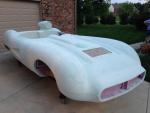









66 prototype

Thread Starter
Team Owner

Joined: May 2006
Posts: 37,671
Likes: 1,116
From: CA

Safety Car


Joined: Feb 2006
Posts: 4,367
Likes: 59
From: FL

It was also done in late 1962 as a possible face lift to the '64. Remember, body styles didn't stay for more than a couple of model years on cars back then. Corvette 1953-55, '56-'57, '58- '60, '61-'62. Full size '55- '56 9'57 ?), '59-'60, '61-'62, '63-'64, '65-'66, '67-'68, '69-'72, etc. The idea of 5 years with the same basic body and minor cleanup would have had many talking and the idea of a 15 year run on the '68 model would have horrified them.
Yet today, the C5 stayed essentially the same with no visible changes from 1997 to 2004 (8 years) and the C6 from 2005 to present (8 years). I know it is more economical, but I miss having some changes.
Yet today, the C5 stayed essentially the same with no visible changes from 1997 to 2004 (8 years) and the C6 from 2005 to present (8 years). I know it is more economical, but I miss having some changes.
Corvette Stories
The Best of Corvette for Corvette Enthusiasts

Corvette & Porsche 911: How Two Icons Conquered the Last 25 Years
Joe Kucinski
2027 Chevrolet Silverado 1500 First Look: Everything You NEED to Know!
Michael S. Palmer
5 Best & 5 Worst Corvette Daily Drivers
Joe Kucinski
The Headlights of Every Corvette Generation Explained
Joe Kucinski
5 Best & 5 Most Overrated Corvette Track Packages of All Time!
Joe Kucinski
Every 2027 Corvette Engine Explained
Joe Kucinski
Designer Imagines A Corvette That Looks More Like a Corvette Than the Corvette
Verdad Gallardo
10 Ugly Corvettes That We Still Kinda Love
Joe Kucinski
Top 10 Most Expensive Corvettes Ever Sold on Bring A Trailer
Brett Foote
Melting Slicks


Joined: Feb 2006
Posts: 3,044
Likes: 210
From: Toronto ON
John - surely those clay models were on bucks, right? I wonder how heavy and how maleable the final product was.
I also wonder to what extent style has been affected by the tools designers use ..if stylists of today have been freed to try/see see/try ... and how much the loss of the tangible, tactile full scale model in clay has affected designs (assuming they don't use full scale clay models today.)

Melting Slicks
Joined: Nov 2007
Posts: 2,162
Likes: 649
From: Chattanooga TN
It's so cool to see the "process" as it existed back pre-CAD/CAE and computer modeling.
John - surely those clay models were on bucks, right? I wonder how heavy and how maleable the final product was.
I also wonder to what extent style has been affected by the tools designers use ..if stylists of today have been freed to try/see see/try ... and how much the loss of the tangible, tactile full scale model in clay has affected designs (assuming they don't use full scale clay models today.)
John - surely those clay models were on bucks, right? I wonder how heavy and how maleable the final product was.
I also wonder to what extent style has been affected by the tools designers use ..if stylists of today have been freed to try/see see/try ... and how much the loss of the tangible, tactile full scale model in clay has affected designs (assuming they don't use full scale clay models today.)
While talking with a GM design employee at Detroit Autorama about my car, subject came up when we were talking about side vent on car as it's base designed was done in clay. I was shocked when he told me they still used clay, I thought they had gotten away from it.

Team Owner


Joined: Oct 2000
Posts: 38,897
Likes: 1,927
From: Washington Michigan

Team Owner
Joined: Oct 2000
Posts: 38,897
Likes: 1,927
From: Washington Michigan
It's so cool to see the "process" as it existed back pre-CAD/CAE and computer modeling.
John - surely those clay models were on bucks, right? I wonder how heavy and how maleable the final product was.
I also wonder to what extent style has been affected by the tools designers use ..if stylists of today have been freed to try/see see/try ... and how much the loss of the tangible, tactile full scale model in clay has affected designs (assuming they don't use full scale clay models today.)
John - surely those clay models were on bucks, right? I wonder how heavy and how maleable the final product was.
I also wonder to what extent style has been affected by the tools designers use ..if stylists of today have been freed to try/see see/try ... and how much the loss of the tangible, tactile full scale model in clay has affected designs (assuming they don't use full scale clay models today.)
Full-size clay models are still used today, but only as the final step in the process; 95% of the surface development is done on the tube, and that math data is used to mill the clay model. Frequently a splash is taken off the approved clay and used as a mold for a fiberglass model, which can be painted (or shown as a "concept").