


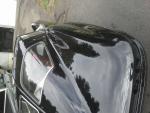

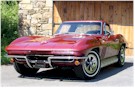


gel coat

Burning Brakes


Joined: Dec 2002
Posts: 789
Likes: 13
From: Winter Springs FL

Le Mans Master


Joined: Dec 2009
Posts: 5,516
Likes: 1,956
From: Plano IL
2026 Corvette of the Year Winner - Unmodified
2025 C1 of the Year - Unmodified Winner
2019 C1 of Year Finalist (stock)
2018 C1 of Year Finalist

early c1's didnt
they got a brown primer then paint
they got a brown primer then paint

Safety Car


Joined: Nov 2002
Posts: 4,462
Likes: 1,293
From: minneola fl
The panels were "press molded", not gelcoated. As the panels were pressed, the resins were drawn to the top and bottom surfaces, creating a smooth finish on both sides. Gel coat is what is used during the normal fiberglass molding process, ie: boat hulls. Mold release is applied to the mold, then gel coat (polyester resin), and then coated with several layers of fiberglass mat/cloth, with resin. The result is what you see on a hand layed fiberglass replacement part. The inside, or unfinished side is very rough, showing the fiberglass mat (like the inside of a boat). Gelcoat on a Corvette is a way to "surface" the fiberglass. It has NO strength, and is purely cosmetic. With the products available today, gelcoat is old technology. Much more solid results can be had with more modern products. I switched over to Epoxy surfacers about 6 years ago, and find that the holdout is much better. Here are some facts:
1. Gelcoat is polyester based, as is Slicksand, Featherfill, and a host of other high build surfacers.
2. Polyester and vinyl ester products shrink up to 7% volumetrically and
because it continues to cure over long periods of time this
effect may not be immediately obvious. This is what causes the "print through" or "dieback" effect on repaired areas. Epoxy shrinks 2% TOTAL (approx 90% during the first 5 days).
3.As a general rule epoxys are twice as expensive as vinyl esters
and vinyl esters are twice as expensive as polyesters.(I think that Corvette Image uses vinyl esters in the manufacture of their parts).
4.Epoxys have performance advantages over polyester and vinyl
esters in five major areas:
- Better adhesive properties (the ability to bond to the
reinforcement or core)
-Superior mechanical properties (particularly strength and
stiffness)
- Improved resistance to fatigue and micro cracking
- Reduced degradation from water ingress (diminution of
properties due to water penetration)
-Increased resistance to osmosis (surface degradation due to
water permeability)
5.Epoxys have far better adhesive properties than polyester and
vinyl esters. The superior adhesion of epoxy is due to two main reasons. The first is at the molecular level, where
the presence of polar hydroxyl and ether groups improves adhesion.
The second is at the physical level - as epoxies cure with low
shrinkage, the various surface contacts set up between the liquids and the reinforcement are not disturbed during cure. The result
is a more homogenous bond between fibers and resin and a better
transfer of load between the different components of the matrix.
6.After a cure period of seven days the tensile strength of the epoxy is 20 to 30% higher than those of
polyester and vinyl ester.
I could go on, and take no credit for the above information. It was part of a study done by a major resin manufacturer. While ALL repairs cannot be done with epoxy, my thought is that the ones that can.....should. I use a high quality body filler (low shrink). I use only ISOPHTHALIC poly resins (mold maker resin, low shrink). I use epoxy primer/sealer/surfacers under the paint.
If you have a car with little or no bodywork, then I suppose that one of the polyester surfacers will be ok. I used them for years. If you're doing a dark colored car, and have significant bodywork, I would use the epoxy vs. gelcoat or polyester surfacers. BTW, the volumetric shrink on polyester (not isophthalic), is about 5 percent over the first 5 years, and 2 percent over the next 2 years, which is why you see sanding scratches, bodywork, etc., coming through a paint job several years after it was painted.
These are my opinions and observations. I've painted hundreds of cars. Problems don't show up on every car, and as I've said, I used polyester products for years.....some with problems, and some without. I posted this for information only, and is certainly not intended to be for everybody.
Mike Coletta
1. Gelcoat is polyester based, as is Slicksand, Featherfill, and a host of other high build surfacers.
2. Polyester and vinyl ester products shrink up to 7% volumetrically and
because it continues to cure over long periods of time this
effect may not be immediately obvious. This is what causes the "print through" or "dieback" effect on repaired areas. Epoxy shrinks 2% TOTAL (approx 90% during the first 5 days).
3.As a general rule epoxys are twice as expensive as vinyl esters
and vinyl esters are twice as expensive as polyesters.(I think that Corvette Image uses vinyl esters in the manufacture of their parts).
4.Epoxys have performance advantages over polyester and vinyl
esters in five major areas:
- Better adhesive properties (the ability to bond to the
reinforcement or core)
-Superior mechanical properties (particularly strength and
stiffness)
- Improved resistance to fatigue and micro cracking
- Reduced degradation from water ingress (diminution of
properties due to water penetration)
-Increased resistance to osmosis (surface degradation due to
water permeability)
5.Epoxys have far better adhesive properties than polyester and
vinyl esters. The superior adhesion of epoxy is due to two main reasons. The first is at the molecular level, where
the presence of polar hydroxyl and ether groups improves adhesion.
The second is at the physical level - as epoxies cure with low
shrinkage, the various surface contacts set up between the liquids and the reinforcement are not disturbed during cure. The result
is a more homogenous bond between fibers and resin and a better
transfer of load between the different components of the matrix.
6.After a cure period of seven days the tensile strength of the epoxy is 20 to 30% higher than those of
polyester and vinyl ester.
I could go on, and take no credit for the above information. It was part of a study done by a major resin manufacturer. While ALL repairs cannot be done with epoxy, my thought is that the ones that can.....should. I use a high quality body filler (low shrink). I use only ISOPHTHALIC poly resins (mold maker resin, low shrink). I use epoxy primer/sealer/surfacers under the paint.
If you have a car with little or no bodywork, then I suppose that one of the polyester surfacers will be ok. I used them for years. If you're doing a dark colored car, and have significant bodywork, I would use the epoxy vs. gelcoat or polyester surfacers. BTW, the volumetric shrink on polyester (not isophthalic), is about 5 percent over the first 5 years, and 2 percent over the next 2 years, which is why you see sanding scratches, bodywork, etc., coming through a paint job several years after it was painted.
These are my opinions and observations. I've painted hundreds of cars. Problems don't show up on every car, and as I've said, I used polyester products for years.....some with problems, and some without. I posted this for information only, and is certainly not intended to be for everybody.
Mike Coletta
Last edited by mike coletta; May 29, 2012 at 08:15 AM.

Le Mans Master


Joined: Oct 2009
Posts: 5,941
Likes: 939
From: Chattanooga Tennessee
Thank you to Mike- I've used Epoxy in any recent paintwork as a base layer because of the adhesive properties it yields to surfaces above and below it, but I've never known as much about the strength and shrinkage aspects as you've shown.
I understand your use of high-quality fillers, but do you use a sort of "high build" epoxy for blocking one out? The epoxy I've used (the old ppg DP90 comes to mind) is paper thin when cured and shows everything, and is "non sanding."
I understand your use of high-quality fillers, but do you use a sort of "high build" epoxy for blocking one out? The epoxy I've used (the old ppg DP90 comes to mind) is paper thin when cured and shows everything, and is "non sanding."

Le Mans Master
Joined: Jan 2000
Posts: 8,918
Likes: 27
From: New Hill NC
True answer to the question. In general NO gel-coat, however, some parts of very early production, like 53, 63 etc. or very rare options that had very limited runs, were done with gel-coat. And there were some 54 bodies that were done with gel-coat as an experiment.
Corvette Stories
The Best of Corvette for Corvette Enthusiasts

Every 2027 Corvette Engine Explained
Joe Kucinski
Designer Imagines A Corvette That Looks More Like a Corvette Than the Corvette
Verdad Gallardo
10 Ugly Corvettes That We Still Kinda Love
Joe Kucinski
Top 10 Most Expensive Corvettes Ever Sold on Bring A Trailer
Brett Foote
10 Things Every Corvette Owner Needs (2026 Edition)
Michael S. Palmer
8 Most "Only Corvette Owners Understand" Quirks and Problems
Pouria Savadkouei
10 Reasons the C6 Z06 is Still A Performance Benchmark After 20 Years
Joe Kucinski
How Much Horsepower Every Corvette Engine "LOST" in 1972
Joe Kucinski
Top 10 DOs and DON'Ts for Protecting Your Convertible Top!
Michael S. Palmer
Safety Car
Joined: Nov 2002
Posts: 4,462
Likes: 1,293
From: minneola fl
I use PPG Global D822/823. It's a 3:1 mix. It is VERY high build as a surfacer. Then 3:1:1/2 for sealer, and 3:1:1 for primer. It sands like butter. I usually apply two wet coats, over 80 grit scratch, block with 80, apply two more coats, and block with 220. Shoot as a sealer, DA with 320, and paint!! One of the nice features is that you can spot it in if you have a particular spot that you're working on. It dries to sanding in about 1 hour. Pot life is short, about 2 hours.
Mike Coletta
Mike Coletta

Burning Brakes
Joined: Jul 2010
Posts: 755
Likes: 8
From: delco pa
I use PPG Global D822/823. It's a 3:1 mix. It is VERY high build as a surfacer. Then 3:1:1/2 for sealer, and 3:1:1 for primer. It sands like butter. I usually apply two wet coats, over 80 grit scratch, block with 80, apply two more coats, and block with 220. Shoot as a sealer, DA with 320, and paint!! One of the nice features is that you can spot it in if you have a particular spot that you're working on. It dries to sanding in about 1 hour. Pot life is short, about 2 hours.
Mike Coletta
Mike Coletta
i read ppg's instuctions, and have a couple questions,,, how long can the car stay in this primer before the top coat is necessary, or doesn't it matter? what do you use to clean the paint gun? will laquer thinner work, or does ppg have a special cleaner.,,,
thanks again for your help....
Safety Car
Joined: Nov 2002
Posts: 4,462
Likes: 1,293
From: minneola fl
8 hours to topcoat, or sand. I use a 3m fine or ultrafine sanding pad, or you could sand with 320/400 dry or wet. I suppose that you could leave it for years, and then sand before topcoat. Here is the P-sheet from PPG:
http://www.bapspaint.com/docs/psheet...obal/EU091.pdf
Lacquer thinner for cleanup.....but before it dries. NOTHING will cut it after it flashes....except sandpaper.
Mike Coletta
http://www.bapspaint.com/docs/psheet...obal/EU091.pdf
Lacquer thinner for cleanup.....but before it dries. NOTHING will cut it after it flashes....except sandpaper.
Mike Coletta
Burning Brakes
Joined: Jul 2010
Posts: 755
Likes: 8
From: delco pa
8 hours to topcoat, or sand. I use a 3m fine or ultrafine sanding pad, or you could sand with 320/400 dry or wet. I suppose that you could leave it for years, and then sand before topcoat. Here is the P-sheet from PPG:
http://www.bapspaint.com/docs/psheet...obal/EU091.pdf
Lacquer thinner for cleanup.....but before it dries. NOTHING will cut it after it flashes....except sandpaper.
Mike Coletta
http://www.bapspaint.com/docs/psheet...obal/EU091.pdf
Lacquer thinner for cleanup.....but before it dries. NOTHING will cut it after it flashes....except sandpaper.
Mike Coletta
excellent info,,, i appreciate your willingness to share your experience, and your time with us....
Last edited by knockbill; May 29, 2012 at 02:10 PM.

Race Director

Joined: Jan 2003
Posts: 17,724
Likes: 3,708
From: Central Arkansas
It seems that I remember hearing once that (at least on C2s) they initially shot a finer fiberglass fiber on to the outer mold when starting a new panel to give a smoother finish. And then switched to the normal size fiber to build up the full panel thickness before closing the mold for initial curing. Does anyone remember anything like that?
Burning Brakes
Joined: Jul 2010
Posts: 755
Likes: 8
From: delco pa
It seems that I remember hearing once that (at least on C2s) they initially shot a finer fiberglass fiber on to the outer mold when starting a new panel to give a smoother finish. And then switched to the normal size fiber to build up the full panel thickness before closing the mold for initial curing. Does anyone remember anything like that?

Team Owner


Joined: Oct 2000
Posts: 38,897
Likes: 1,926
From: Washington Michigan
It seems that I remember hearing once that (at least on C2s) they initially shot a finer fiberglass fiber on to the outer mold when starting a new panel to give a smoother finish. And then switched to the normal size fiber to build up the full panel thickness before closing the mold for initial curing. Does anyone remember anything like that?
 ) amount of resin on the preform, close heated mold, remove surround 5 minutes later, trim, and ship.

Team Owner

Joined: Apr 2012
Posts: 47,628
Likes: 65
"gel-coat"
Is it, or not?
Team Owner
Joined: Oct 2000
Posts: 38,897
Likes: 1,926
From: Washington Michigan
There was no gel-coat on any Corvette panels after 1954 (except for low-volume hand-laid parts like the wheelhouse inner panel caps on big-tank midyears).
Last edited by JohnZ; May 29, 2012 at 04:18 PM.
Team Owner
Joined: Apr 2012
Posts: 47,628
Likes: 65
I'll have to post a photo later when I get home. My paint, after long storage and a bad previous paint job, had cracked, bubbled and peeled on several areas down to some kind of reddish brown layer of something. I don't think it's primer but really don't know. It's the layer on top of the fiberglass, and it's most likely around the whole car (since on several sections). Any clue? Is it primer?
Team Owner
Joined: Oct 2000
Posts: 38,897
Likes: 1,926
From: Washington Michigan
I'll have to post a photo later when I get home. My paint, after long storage and a bad previous paint job, had cracked, bubbled and peeled on several areas down to some kind of reddish brown layer of something. I don't think it's primer but really don't know. It's the layer on top of the fiberglass, and it's most likely around the whole car (since on several sections). Any clue? Is it primer?