


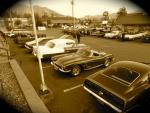


"Early" and "Late" ?

Administrator


Joined: Jul 2000
Posts: 53,982
Likes: 6,209
From: About 1100 miles from where I call home.

No. It absolutely depends on both the car and the design difference being discussed. I have what's generally considered a "late" '63, but when you determine this item vs that item, "early" and "late" are a matter of different dates, VINs, etc. 

Le Mans Master


Joined: Jan 2000
Posts: 8,918
Likes: 27
From: New Hill NC
The first day of production serial #1 is early and the last is late. Anything in between is relative.

Drifting

Joined: Jul 2009
Posts: 1,610
Likes: 11
From: Tampa, FL & Harleysville, PA
In generally speaking for the 1961 Corvette model year for instance “very early” production cars are built first 30 days of September 1960, “early” production may include the 60 days following from October 1960 to November 1960, “early midyear” production can include December 1960 to February 1961, “midyear” production from March 1961 to May 1961, and “late” production June to July 1961, “very late” production last month of August 1961. September 1961 starts production for 1962 model year Corvette.
Don't get mid-year production confused with mid-year Corvettes that's referred as the second generation Corvettes from 1963 to 1967 better known as C2’s.... Buuuut you knew that right!
rustylugnuts
Don't get mid-year production confused with mid-year Corvettes that's referred as the second generation Corvettes from 1963 to 1967 better known as C2’s.... Buuuut you knew that right!
rustylugnuts

Race Director


Joined: Mar 2001
Posts: 14,632
Likes: 4,683
From: Mustang OK
2026 Corvette of the Year Finalist - Modified
2025 c1 of the Year - Modified Winner
2024 C1 of the Year Finalist - Modified
2023 C1 of the Year Finalist - Modified
2015 C1 of the Year Finalist
Some year models had multiple changes occuring during the production of that model year.
The 57 is a fairly good example in some respects. Fuel injection is a good example. There were 4 different models of FI for 57, but he first FI units (4360) underwent several changes during the production run of those units. And it is difficult to break down just when the changes occured for the same model of FI unit as well as when the different FI models got installed during production of the car.
Below are just a few of the changes/options that occured during the 57 model year.
HD brakes
4sp tranny
Positraction,
internal structural reinforcement for the body
rear view mirror
rain gutter
Carburetor models
Distributors.
So, for some year models, it can be difficult to pinpoint when a change or option occured.
The 57 is a fairly good example in some respects. Fuel injection is a good example. There were 4 different models of FI for 57, but he first FI units (4360) underwent several changes during the production run of those units. And it is difficult to break down just when the changes occured for the same model of FI unit as well as when the different FI models got installed during production of the car.
Below are just a few of the changes/options that occured during the 57 model year.
HD brakes
4sp tranny
Positraction,
internal structural reinforcement for the body
rear view mirror
rain gutter
Carburetor models
Distributors.
So, for some year models, it can be difficult to pinpoint when a change or option occured.
Drifting
Joined: Jul 2009
Posts: 1,610
Likes: 11
From: Tampa, FL & Harleysville, PA
Some year models had multiple changes occuring during the production of that model year.
The 57 is a fairly good example in some respects. Fuel injection is a good example. There were 4 different models of FI for 57, but he first FI units (4360) underwent several changes during the production run of those units. And it is difficult to break down just when the changes occured for the same model of FI unit as well as when the different FI models got installed during production of the car.
Below are just a few of the changes/options that occured during the 57 model year.
HD brakes
4sp tranny
Positraction,
internal structural reinforcement for the body
rear view mirror
rain gutter
Carburetor models
Distributors.
So, for some year models, it can be difficult to pinpoint when a change or option occured.
The 57 is a fairly good example in some respects. Fuel injection is a good example. There were 4 different models of FI for 57, but he first FI units (4360) underwent several changes during the production run of those units. And it is difficult to break down just when the changes occured for the same model of FI unit as well as when the different FI models got installed during production of the car.
Below are just a few of the changes/options that occured during the 57 model year.
HD brakes
4sp tranny
Positraction,
internal structural reinforcement for the body
rear view mirror
rain gutter
Carburetor models
Distributors.
So, for some year models, it can be difficult to pinpoint when a change or option occured.
I’m speculating here assuming the next year 1958 options were addressed in relation to serial number/month of production, as in reference to the 1953-62 Vol 1 Corvette first edition.
rustylugnuts

Last edited by rustylugnuts; Dec 17, 2013 at 02:47 AM.

Team Owner

Joined: Aug 2007
Posts: 58,061
Likes: 7,146
Army
I have a very late 61 -- within 100 cars of the end of production and a late 63 SWC within the last 1000 cars. I prefer that in one sense because the later cars (I assume) have many of the kinks worked out over the production year. There is no definitive line as mentioned and EARLY/LATE designations vary with the model year of the car and even within individual parts. E.g. an early or late car may be by specific serial number for one part (radiator, water pump, body feature, etc.).
Very early '63s had the "toolbox" body depression under the seat for a power SEAT option and very late 63' had '64 dash clusters. It can get very confusing.
Very early '63s had the "toolbox" body depression under the seat for a power SEAT option and very late 63' had '64 dash clusters. It can get very confusing.
Last edited by Frankie the Fink; Dec 17, 2013 at 02:57 PM. Reason: Edited because MikeM said I needed to...
Corvette Stories
The Best of Corvette for Corvette Enthusiasts

Top 10 Most Expensive Corvettes Ever Sold on Bring A Trailer
Brett Foote
10 Things Every Corvette Owner Needs (2026 Edition)
Michael S. Palmer
8 Most "Only Corvette Owners Understand" Quirks and Problems
Pouria Savadkouei
10 Reasons the C6 Z06 is Still A Performance Benchmark After 20 Years
Joe Kucinski
How Much Horsepower Every Corvette Engine "LOST" in 1972
Joe Kucinski
Top 10 DOs and DON'Ts for Protecting Your Convertible Top!
Michael S. Palmer
Top 10 Most Explosive Corvettes Ever Made: Power-to-Weight Ratio Ranked!
Joe Kucinski
150 hp to 1,250 hp: Every Corvette Generation Compared by the Specs That Matter
Joe Kucinski
8 Coolest Corvette Pace Cars (and Replicas) of All Time
Verdad Gallardo
Race Director

Joined: Oct 2000
Posts: 12,678
Likes: 3,129
From: Shamong, NJ
Chevrolet regularly made what they called "Running Model Changes" to their cars. There was never a set date, during the year, when these changes took place. As a new, better or cheaper part became available, it would be fazed into production.
Chevrolet parts books never used the terms "early" or "late". When more than one version of a part was used during a model year, the variations are referred to as 1st Design, 2nd Design, etc.
Chevrolet parts books never used the terms "early" or "late". When more than one version of a part was used during a model year, the variations are referred to as 1st Design, 2nd Design, etc.
Team Owner
Joined: Aug 2007
Posts: 58,061
Likes: 7,146
Army
It reminds me of my flight line days - Navy fighters were constantly undergoing mods and upgrades...usually they were gathered up into large "block" changes (which included many, many individual changes) for configuration management purposes, but, there were still individual "running" changes for "safety of flight" issues, etc..
Even so, it was still handled better than these early Corvette changes....63s are particularly messy.
Even so, it was still handled better than these early Corvette changes....63s are particularly messy.

Team Owner
Joined: Mar 2003
Posts: 26,118
Likes: 1,874
From: Greenville, Indiana

Drifting
Joined: Jul 2009
Posts: 1,610
Likes: 11
From: Tampa, FL & Harleysville, PA
As previously stated, serial number/production month & day are implemented with production changes, in reference to (will give the long title) The Complete Corvette Restoration & Technical Guide Vol.1 1953-1962 First Edition Revised Updated Edition, Forth Printing 1980.
I’m sure some changes or parts cannot be accurately tracked, buuuut this book covers almost everything…. As for C2’s I would buy the 1963-1967 version. Unless someone can enlighten us with a more accurate reference book I’m all ears.
rustylugnuts
I’m sure some changes or parts cannot be accurately tracked, buuuut this book covers almost everything…. As for C2’s I would buy the 1963-1967 version. Unless someone can enlighten us with a more accurate reference book I’m all ears.
rustylugnuts
Team Owner
Joined: Aug 2007
Posts: 58,061
Likes: 7,146
Army
Probably cuz I got power windows on the brain since I have the 63 doors all apart - tough decision.
Last edited by Frankie the Fink; Dec 17, 2013 at 03:12 PM.

Drifting
Joined: Jul 2009
Posts: 1,610
Likes: 11
From: Tampa, FL & Harleysville, PA
Second question after this is extracted and proven to be correct, how can an NCRS judge properly authenticate a specific Corvette over another?
Has anyone encountered this?
That attests you can learn something new at an old age…
rustylugnuts

Last edited by rustylugnuts; Dec 18, 2013 at 12:12 AM.

Race Director

Joined: Jul 2001
Posts: 15,892
Likes: 42
And there are no factory documentations linking these early or late parts to a particular serial number verifying authenticity? Can someone give me a few examples? ........
Second question after this is extracted and proven to be correct, how can an NCRS judge properly authenticate a specific Corvette over another?
Has anyone encountered this?
That attests you can learn something new at an old age…
rustylugnuts
Second question after this is extracted and proven to be correct, how can an NCRS judge properly authenticate a specific Corvette over another?
Has anyone encountered this?
That attests you can learn something new at an old age…
rustylugnuts
NCRS doesn't certify or authenticate cars. There- you've learned something. Please spread the word.
As for early/late, I've got an example in mind of a car that was finished on July 5th. That makes it 'very late'. There were two running changes introduced AFTER this car was built, one to the intake manifold, the other involving the front grill. This means that the car is early with respect to these pieces.
But wait! There's more! An acquaintance has the same model year car but it was built in Sept. of the previous year. It's therefore an early car. His features a minor change to the wiring, so his is the late design.
Oh my.


Thread Starter
Burning Brakes


Joined: May 2004
Posts: 782
Likes: 27
From: Bend OR
The above is more like what I was wondering about.
So, are we sort of saying that as far as judging goes, anything before the midpoint of the production year (or S/N range) would be "early" and after is "late"? Or, is there ever a reference to "Mid" production for some period between early and late? Some vendors (notably Paragon) list parts as E or L for a given year.
So, are we sort of saying that as far as judging goes, anything before the midpoint of the production year (or S/N range) would be "early" and after is "late"? Or, is there ever a reference to "Mid" production for some period between early and late? Some vendors (notably Paragon) list parts as E or L for a given year.
Team Owner
Joined: Aug 2007
Posts: 58,061
Likes: 7,146
Army
Hence we have a circular argument now. Even the vendors (many of 'em anyhow) will cite early or late parts (e.g. 63E or 63L in a part listing) - in the fine print many times they state which VIN ranges a part is appropriate for.
This thread can have no succinct, all-encompassing definition for "early" and "late" IMO....but opinions are like bellybuttons (or whatever body part you prefer) -- everybody has one.
Melting Slicks

Joined: Feb 2011
Posts: 2,078
Likes: 206
From: Syracuse, NY and Clearwater, FL

If we look at a specific year, 1963 for example:
There were so many "running changes" spread throughout the production cycle that a definitive point between early and late does not exist.
Race Director
Joined: Jul 2001
Posts: 15,892
Likes: 42
The above is more like what I was wondering about.
So, are we sort of saying that as far as judging goes, anything before the midpoint of the production year (or S/N range) would be "early" and after is "late"? Or, is there ever a reference to "Mid" production for some period between early and late? Some vendors (notably Paragon) list parts as E or L for a given year.
So, are we sort of saying that as far as judging goes, anything before the midpoint of the production year (or S/N range) would be "early" and after is "late"? Or, is there ever a reference to "Mid" production for some period between early and late? Some vendors (notably Paragon) list parts as E or L for a given year.
Running changes happened throughout the production year. Some times they happened in bunches. most times individually. Life would be wonderful if there was documents from GM saying the 1st design part was used up to and including car serial XXX and 2nd design from there until the end of production.
But there isn't.
GM never used the terms 'early' and 'late'. The hobby invented those.
Vendors could be helpful by stating the serial number changeover, or at least the calendar date when it changed.
Intermixing early/late car production dates with early/late parts changeovers is bound to confuse.