


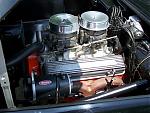



question about setting solid lifters on L72

Thread Starter
Drifting


Joined: Oct 2008
Posts: 1,369
Likes: 12
From: wichita kansas
 question about setting solid lifters on L72
getting real close to firing up this engine and breaking it in...i want to double check the lifter adjustment, as engine was rebuilt when i bought it, and has been sitting for years (never fired up or broke in)
i was told by previous owner, that cam was factory spec...what would be the correct valve lash for intake and exhaust for L72 engine? the procedure that i intend to use for adjusting valve lash is as follows:
1.Set intakes as exhaust opens
2.Set exhaust as intake just starts to close
(is this right??)
is it best to go around in firing order, or just do one side, and then go to other side? i do have remote starter switch so i will be able to "bump" the engine around. thanks, any input would be appreciated! Rick
i was told by previous owner, that cam was factory spec...what would be the correct valve lash for intake and exhaust for L72 engine? the procedure that i intend to use for adjusting valve lash is as follows:
1.Set intakes as exhaust opens
2.Set exhaust as intake just starts to close
(is this right??)
is it best to go around in firing order, or just do one side, and then go to other side? i do have remote starter switch so i will be able to "bump" the engine around. thanks, any input would be appreciated! Rick
Last edited by razman; Nov 17, 2015 at 02:42 PM.

Race Director


Joined: Jan 2003
Posts: 17,682
Likes: 3,678
From: Central Arkansas
I used the EOI and ICE method the last time I adjusted valves. I thought it would take a lot more time to go through each cylinder individually compared to the old rotate the motor until you have #1 cylinder at tdc of the compression stroke. Adjust clearance on intake valves 1,2,5,7 and exhaust valves 1,3,4,8. Then rotate the motor 1 revolution back to tdc and adjust intake valves 3,4,6,8 and exhaust valves 2,5,6,7.
Surprisingly it seemed to go just as fast because I wasn't hunting around for which valves I needed to set in each position and going back and forth around the car. Less chance for mis-adjusting a valve also.
Surprisingly it seemed to go just as fast because I wasn't hunting around for which valves I needed to set in each position and going back and forth around the car. Less chance for mis-adjusting a valve also.

Race Director
Joined: May 2000
Posts: 12,712
Likes: 2,270
Consider the Hinckley-Williams method described in the attached pdf - all inlet valves at 90 deg. ATC and all exhaust valves at 90 deg. BTC. You only have to turn the engine through two revolutions, and it's easy to keep track of where you are.
I've never measured or received accurate measurements for big block rocker ratio behavior, but the ratio likely varies through the cycle like small block rockers.
The top of the constant velocity clearance ramp is .012" above the base circle, calculated from the lobe data on the engineering drawing, and 1.7 x .012 = .204. Both sides share the same lobe.
The L-78 lash recommendation is .020/.024". It was changed to .024/.028" for L-72 despite the same lobes. I don't know why.
My recommendation is .020/.022". You want clearance taken up while the cam is still on the constant velocity clearance ramp.
I have never measured a difference between "hot" (idlling) and cold lash on a cast iron block/head pushrod engine. Aluminum block and/or heads is a different story.
Eighty percent of heat transfer is through the valve seat, but when the engine is run hard the stems will heat up and expand a bit, especially on the exhaust side, however it's tough to measure clearance at WOT, 6000 revs, and that's why mechanical lifter cams have clearance ramps - to allow for valve stem expansion so the valve will always seat despite stem expansion.
Duke
I've never measured or received accurate measurements for big block rocker ratio behavior, but the ratio likely varies through the cycle like small block rockers.
The top of the constant velocity clearance ramp is .012" above the base circle, calculated from the lobe data on the engineering drawing, and 1.7 x .012 = .204. Both sides share the same lobe.
The L-78 lash recommendation is .020/.024". It was changed to .024/.028" for L-72 despite the same lobes. I don't know why.
My recommendation is .020/.022". You want clearance taken up while the cam is still on the constant velocity clearance ramp.
I have never measured a difference between "hot" (idlling) and cold lash on a cast iron block/head pushrod engine. Aluminum block and/or heads is a different story.
Eighty percent of heat transfer is through the valve seat, but when the engine is run hard the stems will heat up and expand a bit, especially on the exhaust side, however it's tough to measure clearance at WOT, 6000 revs, and that's why mechanical lifter cams have clearance ramps - to allow for valve stem expansion so the valve will always seat despite stem expansion.
Duke
Last edited by SWCDuke; Nov 18, 2015 at 11:00 AM.
Race Director
Joined: Jan 2003
Posts: 17,682
Likes: 3,678
From: Central Arkansas
Which ever method you use - you might consider placing two long strips of wide masking tape along either side of the intake manifold and mark on it the cylinder numbers, and I above intake valves and E above exhaust valves. Yes, it's pretty easy to identify the intake and exhaust valves from studying if they are in line with the intake runner or the exhaust runner and once you know where #1 cylinder is, all the others are easily figured out (damn Fords for being opposite Chevy). But if you don't have occassion to be adjusting valves a couple times a year and have it all engrained in your memory it kind of speeds up things by not having to constantly think about it and figure out where you are.
Corvette Stories
The Best of Corvette for Corvette Enthusiasts

Top 10 Most Expensive Corvettes Ever Sold on Bring A Trailer
Brett Foote
10 Things Every Corvette Owner Needs (2026 Edition)
Michael S. Palmer
8 Most "Only Corvette Owners Understand" Quirks and Problems
Pouria Savadkouei
10 Reasons the C6 Z06 is Still A Performance Benchmark After 20 Years
Joe Kucinski
How Much Horsepower Every Corvette Engine "LOST" in 1972
Joe Kucinski
Top 10 DOs and DON'Ts for Protecting Your Convertible Top!
Michael S. Palmer
Top 10 Most Explosive Corvettes Ever Made: Power-to-Weight Ratio Ranked!
Joe Kucinski
150 hp to 1,250 hp: Every Corvette Generation Compared by the Specs That Matter
Joe Kucinski
8 Coolest Corvette Pace Cars (and Replicas) of All Time
Verdad Gallardo
Le Mans Master


Joined: Mar 1999
Posts: 5,399
Likes: 985
From: Itasca IL
Consider the Hinckley-Williams method described in the attached pdf - all inlet valves at 90 deg. ATC and all exhaust valves at 90 deg. BTC. You only have to turn the engine through two revolutions, and it's easy to keep track of where you are.
I've never measured or received accurate measurements for big block rocker ratio behavior, but the ratio likely varies through the cycle like small block rockers.
The top of the constant velocity clearance ramp is .012" above the base circle, calculated from the lobe data on the engineering drawing, and 1.7 x .012 = .204. Both sides share the same lobe.
The L-78 lash recommendation is .020/.024". It was changed to .024/.028" for L-72 despite the same lobes. I don't know why.
My recommendation is .020/.022". You want clearance taken up while the cam is still on the constant velocity clearance ramp.
I have never measured a difference between "hot" (idlling) and cold lash on a cast iron block/head pushrod engine. Aluminum block and/or heads is a different story.
Eighty percent of heat transfer is through the valve seat, but when the engine is run hard the stems will heat up and expand a bit, especially on the exhaust side, however it's tough to measure clearance at WOT, 6000 revs, and that's why mechanical lifter cams have clearance ramps - to allow for valve stem expansion so the valve will always seat despite stem expansion.
Duke
I've never measured or received accurate measurements for big block rocker ratio behavior, but the ratio likely varies through the cycle like small block rockers.
The top of the constant velocity clearance ramp is .012" above the base circle, calculated from the lobe data on the engineering drawing, and 1.7 x .012 = .204. Both sides share the same lobe.
The L-78 lash recommendation is .020/.024". It was changed to .024/.028" for L-72 despite the same lobes. I don't know why.
My recommendation is .020/.022". You want clearance taken up while the cam is still on the constant velocity clearance ramp.
I have never measured a difference between "hot" (idlling) and cold lash on a cast iron block/head pushrod engine. Aluminum block and/or heads is a different story.
Eighty percent of heat transfer is through the valve seat, but when the engine is run hard the stems will heat up and expand a bit, especially on the exhaust side, however it's tough to measure clearance at WOT, 6000 revs, and that's why mechanical lifter cams have clearance ramps - to allow for valve stem expansion so the valve will always seat despite stem expansion.
Duke
Interested in your input regarding the L-71 cam.
Some background first: Stock rebuild (0.030" overbore). My normal process is to locate max lift on #1 Intake using a dial indicator, and use that position to set #6 Intake clearance. Subsequently, I rotate by increments of 90 degrees (have 90 degree graduations marked on my balancer) and work my way through the firing order. Repeat for exhaust valves. It's slightly time consuming, but not a process that needs done frequently.
I applied your procedure to cold-setting the lash in my L-71 last year. There was considerably more valvetrain noise than usual. I went back and checked my work using my "standard" process. Found in most positions I had at least 0.004" more clearance (at the middle of the base circle) than I set the valves to. This suggests to me that that while in the adjustment positions indicated, the cam is already experiencing some extent of lift of the true base circle.
I was intrigued by my findings, but without access to the manufacturing prints I couldn't science it out further.
Would love to hear your feedback.

Nick