


[C2] 327 question

Thread Starter
Le Mans Master


Joined: Sep 2002
Posts: 6,569
Likes: 2,403
From: Redacted
 327 question
Can someone give me a rundown of the differences between the various 327 motors that were available in the C2? Im mostly curious about the block and rotating assembly between various options as far as horsepower rating....as far as I can tell, the variances are mostly related to cam/valvetrain and induction type.
What Im getting at, if you're going to do a performance rebuild of an original motor, is there any downside to starting with a base model, 250 horse engine assuming you're looking at aftermarket heads/cam/intake?
Thanks!
What Im getting at, if you're going to do a performance rebuild of an original motor, is there any downside to starting with a base model, 250 horse engine assuming you're looking at aftermarket heads/cam/intake?
Thanks!
Le Mans Master


Joined: Feb 2008
Posts: 6,463
Likes: 1,889
From: Folsom CA
The high horsepower 327s ran domed pistons to bump up compression.
As far as I know the block up to 67 is the same, newer blocks use 350 main journal size and don't have the vent tube in the rear of the block. You might want to make sure what years used a forged crankshaft and 66 and newer had stronger connecting rods.
Mark
As far as I know the block up to 67 is the same, newer blocks use 350 main journal size and don't have the vent tube in the rear of the block. You might want to make sure what years used a forged crankshaft and 66 and newer had stronger connecting rods.
Mark

Race Director

Joined: May 2000
Posts: 12,712
Likes: 2,270
All '62-'67 327s used the same ...870 block. All cranks are forged but SHP/FI engines used a different forging with slighty different counterweights because of the heavier forged pistons, and the SHP/FI cranks were also treated to a Tufftride surface hardening, which is why they should never be ground unless absolutely necessary.
If they are straight, pass Magnaflux inspection, and have the original journal dimensions, which means the Tufftride is still intact SHP/FI cranks are virtually bulletproof as long as the bearings don't get oil starved.
The big weak link in all these engines are the connecting rods, particularly the first design that were used from '62 to '65. The second design were improved, but for any high output configuration with a design speed of 6000 or more, buy aftermarket rods and the Eagle SIR5700 is a good choice for design speeds up to about 7500.
For about $250 a set they are the cheapest insurance policy you will ever buy.
Duke
If they are straight, pass Magnaflux inspection, and have the original journal dimensions, which means the Tufftride is still intact SHP/FI cranks are virtually bulletproof as long as the bearings don't get oil starved.
The big weak link in all these engines are the connecting rods, particularly the first design that were used from '62 to '65. The second design were improved, but for any high output configuration with a design speed of 6000 or more, buy aftermarket rods and the Eagle SIR5700 is a good choice for design speeds up to about 7500.
For about $250 a set they are the cheapest insurance policy you will ever buy.
Duke
Last edited by SWCDuke; Nov 5, 2016 at 01:36 PM.

Team Owner

Joined: Mar 2003
Posts: 26,118
Likes: 1,874
From: Greenville, Indiana
Can someone give me a rundown of the differences between the various 327 motors that were available in the C2?
What Im getting at, if you're going to do a performance rebuild of an original motor, is there any downside to starting with a base model, 250 horse engine assuming you're looking at aftermarket heads/cam/intake?
Thanks!
Just be advised that almost every part in a SHP engine carried a different GM part number than the standard 327 engine and that includes the block ASSEMBLY.
The list is long and I'm too lazy to type it all out. Besides, my memory might fail and somebody would call my hand on something.
Last edited by MikeM; Nov 5, 2016 at 01:38 PM.
Thread Starter
Le Mans Master
Joined: Sep 2002
Posts: 6,569
Likes: 2,403
From: Redacted
so it sounds like if you're looking for a performance street motor good to 7000 RPM, you can reuse the stock block and crank but should go aftermarket rods for strength, pistons to bump compression towards the 11:1 number, and then choose your own adventure on heads, cam, intake, valve train.
Team Owner
Joined: Mar 2003
Posts: 26,118
Likes: 1,874
From: Greenville, Indiana
so it sounds like if you're looking for a performance street motor good to 7000 RPM, you can reuse the stock block and crank but should go aftermarket rods for strength, pistons to bump compression towards the 11:1 number, and then choose your own adventure on heads, cam, intake, valve train.
7000 rpm presents other reliability problems like valve gear issues. Driveability issues.
6000 is a much better limit and more cubic inches is a cheaper way to get the same seat of the pants without the risk and the expense.
You can do what you wish on the rods. I'm happy with the '66-'67 and '67 Z28 style rods. But I've known the history on the ones I've used.
Race Director
Joined: May 2000
Posts: 12,712
Likes: 2,270
They were both documented here about ten years ago. I lost track of Dave McDufford, but ghostrider20 still buzzes his to 7000 regularly.
Duke
Last edited by SWCDuke; Nov 5, 2016 at 05:36 PM.
Team Owner
Joined: Mar 2003
Posts: 26,118
Likes: 1,874
From: Greenville, Indiana
A couple of "327 LT-1s" - massaged OE heads, Crower Sportsman rods, LT-1 cam, and all OE valve train parts including valve springs with OE exhaust systems made useable power to 7200, which is about valve train limiting speed while achieving 80 percent peak torque at 2000 and easily pulling from 1000 revs in top gear, so they don't feel soggy down low like a OE 365 HP engine.
They were both documented here about ten years ago. I lost track of Dave McDufford, but ghostrider20 still buzzes his to 7000 regularly.
Duke
They were both documented here about ten years ago. I lost track of Dave McDufford, but ghostrider20 still buzzes his to 7000 regularly.
Duke
Most cops if they hear an engine going 7000 rpm on the street will give you a big fat ticket, just because. Fast street engines are much better with cubes if you want power instead of all this stuff about fine tuning the smaller engines.
IMO, running a street engine for a grown adult to 7200 rpm is absolutely ridiculous and given enough cycles will result in downtime, but it is something I used to do 55+ years ago when I was a late teenager/early 20's with my SBC's. I found that was hard on parts and I quit. Never broke a rod though.
I had a LT1 cam in a 350 LT1 in my '64 Corvette. It reminded me of trying to make love to a woman asleep compared to the rest of the good cams available from Chevy OTC. Maybe it was just me?
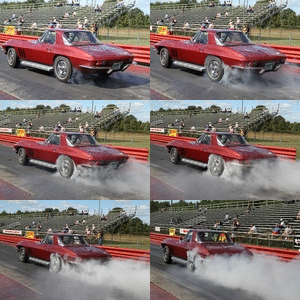
That said, a 327, whether it tops out at 6 or 7000 rpm will still squeal the tires just fine. A 383 or 400 will do it better.
Last edited by MikeM; Nov 5, 2016 at 06:10 PM.
Corvette Stories
The Best of Corvette for Corvette Enthusiasts

How Much Horsepower Every Corvette Engine "LOST" in 1972
Joe Kucinski
Top 10 DOs and DON'Ts for Protecting Your Convertible Top!
Michael S. Palmer
Top 10 Most Explosive Corvettes Ever Made: Power-to-Weight Ratio Ranked!
Joe Kucinski
150 hp to 1,250 hp: Every Corvette Generation Compared by the Specs That Matter
Joe Kucinski
8 Coolest Corvette Pace Cars (and Replicas) of All Time
Verdad Gallardo
Top 10 Corvette Engines RANKED by Peak Torque (70+ Years of Muscle!)
Joe Kucinski
Corvette ZR1X Will Be Pacing the Indy 500, And Could Probably Race, Too!
Verdad Gallardo
Top 10 Corvettes Coming to Mecum Indy 2026!
Brett Foote
Top 10 C9 Corvette MUST-HAVES to Fix These C8 Generation Flaws!
Michael S. Palmer
Race Director

Joined: Jun 2006
Posts: 17,901
Likes: 751
From: Inverness FL
St. Jude Donor '07
Dave is quietly retired on the farm in Cincinnati. I have never heard him say he took his engine that far but he did say his transmission was making a bad noise.
Most cops if they hear an engine going 7000 rpm on the street will give you a big fat ticket, just because. Fast street engines are much better with cubes if you want power instead of all this stuff about fine tuning the smaller engines.
IMO, running a street engine for a grown adult to 7200 rpm is absolutely ridiculous and given enough cycles will result in downtime, but it is something I used to do 55+ years ago when I was a late teenager/early 20's with my SBC's. I found that was hard on parts and I quit. Never broke a rod though.
I had a LT1 cam in a 350 LT1 in my '64 Corvette. It reminded me of trying to make love to a woman asleep compared to the rest of the good cams available from Chevy OTC. Maybe it was just me?
That said, a 327, whether it tops out at 6 or 7000 rpm will still squeal the tires just fine. A 383 or 400 will do it better.
Most cops if they hear an engine going 7000 rpm on the street will give you a big fat ticket, just because. Fast street engines are much better with cubes if you want power instead of all this stuff about fine tuning the smaller engines.
IMO, running a street engine for a grown adult to 7200 rpm is absolutely ridiculous and given enough cycles will result in downtime, but it is something I used to do 55+ years ago when I was a late teenager/early 20's with my SBC's. I found that was hard on parts and I quit. Never broke a rod though.
I had a LT1 cam in a 350 LT1 in my '64 Corvette. It reminded me of trying to make love to a woman asleep compared to the rest of the good cams available from Chevy OTC. Maybe it was just me?
That said, a 327, whether it tops out at 6 or 7000 rpm will still squeal the tires just fine. A 383 or 400 will do it better.
 on all points... especially on the 55+... I sure wish I had all that $$$ now....
Bill
Last edited by wmf62; Nov 5, 2016 at 06:06 PM.
Team Owner
Joined: Mar 2003
Posts: 26,118
Likes: 1,874
From: Greenville, Indiana
A complete crate 327/365 for about $550. Carburetor to clutch.



Race Director

Joined: Nov 2002
Posts: 12,142
Likes: 54
From: Taylor Michigan
I wish I could still buy a new SHP 327 shortblock from the dealer for $222.50/$232.50. Solid lifters for about $0.75/ea. Complete 270 distributor including the cap, points, rotor for about (was it $12 or $18?) the price as a set of points, condenser and cap. A 270 camshaft for $18.
A complete crate 327/365 for about $550. Carburetor to clutch.
A complete crate 327/365 for about $550. Carburetor to clutch.

Melting Slicks

Joined: Jan 2007
Posts: 2,842
Likes: 622
From: Pasco Florida

Drifting


Joined: Jul 2014
Posts: 1,545
Likes: 783
From: Massachusetts
so it sounds like if you're looking for a performance street motor good to 7000 RPM, you can reuse the stock block and crank but should go aftermarket rods for strength, pistons to bump compression towards the 11:1 number, and then choose your own adventure on heads, cam, intake, valve train.
I agree with Mike M that a 6000 RPM target would be much less likely to break things than a 7000 RPM target. An easy way to move the power peak down to 6000 RPM is to increase displacement. You can buy a forged 350 crank and have the mains journals turned down to the 327 size, and essentially convert your 327 to a 350. Stroking to 383 is also possible, but that requires some careful clearance grinding on the block to clear the rods, and careful attention to the rod-to-cam clearance.
Aside from displacement and compression, all the rest of the power production will come from the cam, intake, heads, and exhaust.
Race Director
Joined: Aug 2004
Posts: 15,300
Likes: 2,262
From: NorCal
Last edited by tuxnharley; Nov 6, 2016 at 11:09 AM. Reason: Typo

Team Owner
Joined: Aug 2007
Posts: 58,061
Likes: 7,145
Army
FLYNAVY30 - IIRC you were headed to Pensacola last week to inspect a car, did you find something ? If so, is it under-powered or have a non-original motor....?
Sounds like you are wanting to blow out a period correct engine for some performance gains...
Sounds like you are wanting to blow out a period correct engine for some performance gains...
Thread Starter
Le Mans Master
Joined: Sep 2002
Posts: 6,569
Likes: 2,403
From: Redacted
I did....great car....lousy drivetrain....2 spd power glide and 250 horse base model. IF I buy the car, a 5 spd conversion will happen....the next question is while Im at it, rebuild the base 327, or go LS motor. The cars not unique, or original enough to worry about originality....Im going for fun, reliable driver. Again, lots of IFs, just doing some research into my options.
Race Director
Joined: Jun 2006
Posts: 17,901
Likes: 751
From: Inverness FL
St. Jude Donor '07
I did....great car....lousy drivetrain....2 spd power glide and 250 horse base model. IF I buy the car, a 5 spd conversion will happen....the next question is while Im at it, rebuild the base 327, or go LS motor. The cars not unique, or original enough to worry about originality....Im going for fun, reliable driver. Again, lots of IFs, just doing some research into my options.
Bill