


original engine?
Thread Starter
Advanced


Joined: Feb 2003
Posts: 95
Likes: 0
From: Stafford VA


However, keep this in mind with the ethics and moral fiber that exists today even if it had the VIN stamped on the pad there is more than an even chance that it is not original to that car.
In the Corvette world of restamping, fake tags and fake date coding is considered normal activity, in the real world some of those actions would be considered fraud.
Bill


Race Director


Joined: Aug 2004
Posts: 15,301
Likes: 2,262
From: NorCal
In 1972 who thought the original motor would add so much value?
As posted above, I hope you and your son enjoy the car. I am kind of happy my 70 Chevelle SS396 is not an original motor car, as I am free to modernize the driveline without any thought of modifying a survivor.
As posted above, I hope you and your son enjoy the car. I am kind of happy my 70 Chevelle SS396 is not an original motor car, as I am free to modernize the driveline without any thought of modifying a survivor.
I bought my 67 in 71. The original L79 was trashed, so I took it out, THREW IT AWAY FOR SCRAP, and dropped in a LT-1 crate engine.
Back then these were just a fun used car. NCRS didn't even exist, and the "matching numbers" hysteria hadn't even been dreamed up by the investors, speculators, and dealers. Nobody cared about such details back then. I stlll don't.


Team Owner


Joined: Oct 1999
Posts: 31,976
Likes: 487
From: Guinness Its whats for B'fast JAWGA
CI 3-4-5-9 Veteran
Things like this were common back then. My experience is similar but even more direct.
I bought my 67 in 71. The original L79 was trashed, so I took it out, THREW IT AWAY FOR SCRAP, and dropped in a LT-1 crate engine.
Back then these were just a fun used car. NCRS didn't even exist, and the "matching numbers" hysteria hadn't even been dreamed up by the investors, speculators, and dealers. Nobody cared about such details back then. I stlll don't.
I bought my 67 in 71. The original L79 was trashed, so I took it out, THREW IT AWAY FOR SCRAP, and dropped in a LT-1 crate engine.
Back then these were just a fun used car. NCRS didn't even exist, and the "matching numbers" hysteria hadn't even been dreamed up by the investors, speculators, and dealers. Nobody cared about such details back then. I stlll don't.
My father however was around and I am not sure where he sourced a 327 from when he threw a rod nor do I know what he did with the original motor. I would imagine it was much like you and the LT-1.
I have posted I am a bit cynical on all these original motored cars. However, it doesn't matter to me as I won't be spending the money for a NCRS level car.
Last edited by 93Polo; Jul 27, 2017 at 03:52 PM.

Race Director
Joined: Nov 2003
Posts: 10,696
Likes: 3,090
From: Cottonwood AZ
C1 of Year Finalist (performance mods) 2019
This is obviously not the case with your engine. People that are faking engines first look for the correct casting number, casting date for the build time of the car and then stamp it with the correct characters and V.I.N. to match the car.

Team Owner

Joined: Jul 2006
Posts: 22,167
Likes: 4,172
From: Kannapolis NC

Melting Slicks


Joined: Apr 2010
Posts: 2,142
Likes: 282
2018 C2 of Year Finalist
2015 C2 of the Year Finalist
lilesv – you definitely have a ’67 model year block. The stamp looks good, so I suspect you have a complete service replacement engine. Service replacement engines were available while they were still in production. So, based on there being no VIN stamp, I suspect someone put a complete service replacement engine in your car when it was available during the ’67 model year (very late ’66 or ’67), prior to CE service engines beginning in 1968.
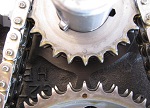
The pic you posted in post #13 looks like the area behind the timing cover. Look for the date code on the driver’s side rear flange of the block above the bellhousing. It will have a letter for the month, one or two numbers for the day, and one more number for the year of the casting. It should be a late '66 date to be consistent with the engine assembly date of November 7, 1966.

Last edited by Mike67nv; Jul 27, 2017 at 05:01 PM.

Le Mans Master


Joined: Feb 2014
Posts: 8,897
Likes: 5,435
From: Richardson Texas
Larry is correct on the availability of the 657 block.
lilesv – you definitely have a ’67 model year block. The stamp looks good, so I suspect you have a complete service replacement engine. Service replacement engines were available while they were still in production. So, based on there being no VIN stamp, I suspect someone put a complete service replacement engine in your car when it was available during the ’67 model year (very late ’66 or ’67), prior to CE service engines beginning in 1968.
The pic you posted in post #13 looks like the area behind the timing cover. Look for the date code on the driver’s side rear flange of the block above the bellhousing. It will have a letter for the month, one or two numbers for the day, and one more number for the year of the casting. It should be a late '66 date to be consistent with the engine assembly date of November 7, 1966.
lilesv – you definitely have a ’67 model year block. The stamp looks good, so I suspect you have a complete service replacement engine. Service replacement engines were available while they were still in production. So, based on there being no VIN stamp, I suspect someone put a complete service replacement engine in your car when it was available during the ’67 model year (very late ’66 or ’67), prior to CE service engines beginning in 1968.
The pic you posted in post #13 looks like the area behind the timing cover. Look for the date code on the driver’s side rear flange of the block above the bellhousing. It will have a letter for the month, one or two numbers for the day, and one more number for the year of the casting. It should be a late '66 date to be consistent with the engine assembly date of November 7, 1966.
I know you meant "passenger side"...don't want the OP to go crazy looking in the wrong place
Last edited by leif.anderson93; Jul 27, 2017 at 06:24 PM.
Corvette Stories
The Best of Corvette for Corvette Enthusiasts

10 Reasons the C6 Z06 is Still A Performance Benchmark After 20 Years
Joe Kucinski
How Much Horsepower Every Corvette Engine "LOST" in 1972
Joe Kucinski
Top 10 DOs and DON'Ts for Protecting Your Convertible Top!
Michael S. Palmer
Top 10 Most Explosive Corvettes Ever Made: Power-to-Weight Ratio Ranked!
Joe Kucinski
150 hp to 1,250 hp: Every Corvette Generation Compared by the Specs That Matter
Joe Kucinski
8 Coolest Corvette Pace Cars (and Replicas) of All Time
Verdad Gallardo
Top 10 Corvette Engines RANKED by Peak Torque (70+ Years of Muscle!)
Joe Kucinski
Corvette ZR1X Will Be Pacing the Indy 500, And Could Probably Race, Too!
Verdad Gallardo
Top 10 Corvettes Coming to Mecum Indy 2026!
Brett Foote
Melting Slicks
Joined: Apr 2010
Posts: 2,142
Likes: 282
2018 C2 of Year Finalist
2015 C2 of the Year Finalist
Race Director
Joined: Aug 2004
Posts: 15,301
Likes: 2,262
From: NorCal
No robotics, no laser guided placement - just good old manual labor!

Le Mans Master
Joined: Feb 2012
Posts: 5,633
Likes: 537
From: SE Pa
Gotcha, I thought perhaps you still had an avenue of contact
Thread Starter
Advanced
Joined: Feb 2003
Posts: 95
Likes: 0
From: Stafford VA
Thread Starter
Advanced
Joined: Feb 2003
Posts: 95
Likes: 0
From: Stafford VA
Larry is correct on the availability of the 657 block.
lilesv – you definitely have a ’67 model year block. The stamp looks good, so I suspect you have a complete service replacement engine. Service replacement engines were available while they were still in production. So, based on there being no VIN stamp, I suspect someone put a complete service replacement engine in your car when it was available during the ’67 model year (very late ’66 or ’67), prior to CE service engines beginning in 1968.
The pic you posted in post #13 looks like the area behind the timing cover. Look for the date code on the driver’s side rear flange of the block above the bellhousing. It will have a letter for the month, one or two numbers for the day, and one more number for the year of the casting. It should be a late '66 date to be consistent with the engine assembly date of November 7, 1966.
lilesv – you definitely have a ’67 model year block. The stamp looks good, so I suspect you have a complete service replacement engine. Service replacement engines were available while they were still in production. So, based on there being no VIN stamp, I suspect someone put a complete service replacement engine in your car when it was available during the ’67 model year (very late ’66 or ’67), prior to CE service engines beginning in 1968.
The pic you posted in post #13 looks like the area behind the timing cover. Look for the date code on the driver’s side rear flange of the block above the bellhousing. It will have a letter for the month, one or two numbers for the day, and one more number for the year of the casting. It should be a late '66 date to be consistent with the engine assembly date of November 7, 1966.
Melting Slicks
Joined: Apr 2010
Posts: 2,142
Likes: 282
2018 C2 of Year Finalist
2015 C2 of the Year Finalist
Drifting

Joined: Jul 2014
Posts: 1,545
Likes: 783
From: Massachusetts
Larry is correct on the availability of the 657 block.
lilesv – you definitely have a ’67 model year block. The stamp looks good, so I suspect you have a complete service replacement engine. Service replacement engines were available while they were still in production. So, based on there being no VIN stamp, I suspect someone put a complete service replacement engine in your car when it was available during the ’67 model year (very late ’66 or ’67), prior to CE service engines beginning in 1968.
The pic you posted in post #13 looks like the area behind the timing cover. Look for the date code on the driver’s side rear flange of the block above the bellhousing. It will have a letter for the month, one or two numbers for the day, and one more number for the year of the casting. It should be a late '66 date to be consistent with the engine assembly date of November 7, 1966.
lilesv – you definitely have a ’67 model year block. The stamp looks good, so I suspect you have a complete service replacement engine. Service replacement engines were available while they were still in production. So, based on there being no VIN stamp, I suspect someone put a complete service replacement engine in your car when it was available during the ’67 model year (very late ’66 or ’67), prior to CE service engines beginning in 1968.
The pic you posted in post #13 looks like the area behind the timing cover. Look for the date code on the driver’s side rear flange of the block above the bellhousing. It will have a letter for the month, one or two numbers for the day, and one more number for the year of the casting. It should be a late '66 date to be consistent with the engine assembly date of November 7, 1966.
The engine assembly stamping was applied at the Flint plant where the engine was assembled. The fact that is doesn't have a VIN derivative stamped on the pad indicates that this engine was not installed on the production line at St. Louis (which is where the VIN derivative was added).
Service replacement engines that have "correct" casting numbers, casting dates, and engine assembly stampings are rare, but not controversial. They were an ordinary aspect of the way that GM made replacement engines.
Apparently the original engine in your '66 failed or was stolen in late 1966, and was replaced with a complete engine assembly that was in production at Flint at that time. This just happened to be an engine that would be correct for a 1967 Corvette that was produced in St. Louis around December 1966.
While this engine is not original to your car and does not add value to your car, it would be *highly desirable* to someone who has an early 1967 Corvette produced between November 1966 and April 1967 that no longer has its original engine. NCRS judging standards allow an engine to be dated as much as six months prior to the assembly of the car, although something in the range of a few weeks is more typical.
For a 1967 Corvette assembled in the November-April time frame, your engine block would get 325 out of 350 possible points because it has the "correct" casting number, casting date, Flint assembly stamping, and factory broach marks on the surface of the pad. All it would lack for getting full credit of 350 points is the "correct" VIN stamping on the pad. The pad could be left as-is or the VIN stamping could be added by someone who has the correct stamping tools.
I suggest that you consider selling this rare and valuable engine block to someone is trying to restore an early 1967 Corvette that lacks its original engine. For the right buyer, I think this block would be worth at least $2000. While this block adds no particular value to your '66, it would be very valuable to the right owner of a an early '67 that does not have its original engine.
You could apply that $2000 toward a new crate motor or even a re-stamped "restoration bock" that would be correct for your '66.

Safety Car

Joined: Aug 2000
Posts: 4,148
Likes: 642
From: Bandera Texas
Larry is correct on the availability of the 657 block.
lilesv – you definitely have a ’67 model year block. The stamp looks good, so I suspect you have a complete service replacement engine. Service replacement engines were available while they were still in production. So, based on there being no VIN stamp, I suspect someone put a complete service replacement engine in your car when it was available during the ’67 model year (very late ’66 or ’67), prior to CE service engines beginning in 1968.
The pic you posted in post #13 looks like the area behind the timing cover. Look for the date code on the driver’s side rear flange of the block above the bellhousing. It will have a letter for the month, one or two numbers for the day, and one more number for the year of the casting. It should be a late '66 date to be consistent with the engine assembly date of November 7, 1966.
lilesv – you definitely have a ’67 model year block. The stamp looks good, so I suspect you have a complete service replacement engine. Service replacement engines were available while they were still in production. So, based on there being no VIN stamp, I suspect someone put a complete service replacement engine in your car when it was available during the ’67 model year (very late ’66 or ’67), prior to CE service engines beginning in 1968.
The pic you posted in post #13 looks like the area behind the timing cover. Look for the date code on the driver’s side rear flange of the block above the bellhousing. It will have a letter for the month, one or two numbers for the day, and one more number for the year of the casting. It should be a late '66 date to be consistent with the engine assembly date of November 7, 1966.
. My bet is a dealer warrantee in 1967. It is the history of the car, so leave it alone. Everyone today seems to be about the money, and not ''the car''. My son has a 69 Original Z-28 with a CE dated 1970 302 motor. We think it was also a warrantee , so it is back in the restored car. Runs great and when driving to an event, it is ''the car'', not the numbers
Last edited by jimgessner; Jul 30, 2017 at 07:29 AM.
Thread Starter
Advanced
Joined: Feb 2003
Posts: 95
Likes: 0
From: Stafford VA
It was my car from Apr '72 until Aug '08, and when I turned it over to him, it went with all of its history (like the rod bolt out of a '55 Ford that's still holding the linkage together). Er, maybe some things shouldn't be shared... 


Melting Slicks
Joined: Dec 2005
Posts: 2,576
Likes: 32
From: Sarasota Florida
In 1972 who thought the original motor would add so much value?
As posted above, I hope you and your son enjoy the car. I am kind of happy my 70 Chevelle SS396 is not an original motor car, as I am free to modernize the driveline without any thought of modifying a survivor.
As posted above, I hope you and your son enjoy the car. I am kind of happy my 70 Chevelle SS396 is not an original motor car, as I am free to modernize the driveline without any thought of modifying a survivor.
I remember pulling a 427 out of a 1969 Impala SS convertible in a junkyard to put in my uncles 1967 Corvette to replace the one he blew up...Point is they were raced wrecked and enjoyed...when they were just "cars"...you only go around the world once might as well enjoy it!
Last edited by Blk63Vette; Aug 2, 2017 at 09:58 PM.
