




swapping blocks

Thread Starter
Melting Slicks


Joined: Sep 2013
Posts: 2,882
Likes: 2,178
From: Chicopee MA.
 swapping blocks
I have a 350 with a cracked water jacket.
This engine has just been rebuilt and I am wondering if I could just swap all components into the new block, bearings and all (with new rings)
It might not be the best way but I am trying to keep the cost down to the minimum for a quick new project.
This engine has just been rebuilt and I am wondering if I could just swap all components into the new block, bearings and all (with new rings)
It might not be the best way but I am trying to keep the cost down to the minimum for a quick new project.
Last edited by Roger Walling; Aug 16, 2018 at 08:08 PM.

Le Mans Master


Joined: Nov 2015
Posts: 7,437
Likes: 2,619
From: Really Central IL Illinois
Bearings have a crush when the torque is applied on the main caps. I would not try to reuse them as the main bearing bore on one block to another may vary and the cost of new bearings is not that great.
Reusing the rod bearings on the same rod and crank location should not poise a problem. I would still plastigage them on reinstallation.
Rings - how many miles before the cracked block?? More than 50, I would not try it. They probably have worn to fit the bore which may not be the same as the new block bore.
Cam, lifters, pushrods, etc. I would swap them out as long as the lifter position on the cam is not altered. New cam bearings of course.
Heads - no problem, unless they contributed to the split cylinder.
Reusing the rod bearings on the same rod and crank location should not poise a problem. I would still plastigage them on reinstallation.
Rings - how many miles before the cracked block?? More than 50, I would not try it. They probably have worn to fit the bore which may not be the same as the new block bore.
Cam, lifters, pushrods, etc. I would swap them out as long as the lifter position on the cam is not altered. New cam bearings of course.
Heads - no problem, unless they contributed to the split cylinder.

Le Mans Master


Joined: Apr 2001
Posts: 5,433
Likes: 1,249
From: Sarver Pa
2021 C1 of the Year Finalist - Modified
If it's just an external crack , then get it welded up. As far as swapping things over---Hey, it's a Chevy. Back when I had no money, I would do stuff like that and it would live a long time. keep everything clean and IN ORDER.

Safety Car

Joined: Oct 2016
Posts: 4,617
Likes: 1,547
From: Olive branch Ms
I think this is called engine roulette. 1. I would not reuse bearings unless they are perfect. 2 swapping lifters from one block to another you may as well dump them all in a box and.pull them back out one at a time. Maybe just maybe if both blocks were blueprinted you might get away with it but by swapping blocks the location and break in patterns are going to be different. 3. Rings I would measure the end gap if its below .020" I'd reuse them in a heart beat. So now the question is how lucky do you feel?
Last edited by Robert61; Aug 17, 2018 at 10:09 AM.

Melting Slicks

Joined: Jul 2004
Posts: 2,451
Likes: 315
From: Scottsdale AZ
How sure are you of this diagnosis? Can you describe all the symptoms? Have you pressure tested and personally seen your block leaking? And from where exactly. You could always try block sealers magic sauces. I have seen them work.

Team Owner


Joined: Mar 2003
Posts: 26,118
Likes: 1,874
From: Greenville, Indiana
I had an engine block crack diagnosed about 600 miles out of the 12k mile warranty. All the factory would do was provide and new block and labor to switch all the parts over from the first engine. That included rings, bearings, cam, lifters, pistons/rods.
It ran the same as before.
I wasn't happy with it but that's the deal I was offered. I'd consider that a risky repair.
It ran the same as before.
I wasn't happy with it but that's the deal I was offered. I'd consider that a risky repair.
Corvette Stories
The Best of Corvette for Corvette Enthusiasts

Top 10 Most Explosive Corvettes Ever Made: Power-to-Weight Ratio Ranked!
Joe Kucinski
150 hp to 1,250 hp: Every Corvette Generation Compared by the Specs That Matter
Joe Kucinski
8 Coolest Corvette Pace Cars (and Replicas) of All Time
Verdad Gallardo
Top 10 Corvette Engines RANKED by Peak Torque (70+ Years of Muscle!)
Joe Kucinski
Corvette ZR1X Will Be Pacing the Indy 500, And Could Probably Race, Too!
Verdad Gallardo
Top 10 Corvettes Coming to Mecum Indy 2026!
Brett Foote
Top 10 C9 Corvette MUST-HAVES to Fix These C8 Generation Flaws!
Michael S. Palmer
10 Revolutionary 'Corvette Firsts' Most People Don't Know
Joe Kucinski
5 Reasons to Upgrade to an LS6-Powered Corvette; 5 Reasons to Stay LT2
Michael S. Palmer
Safety Car
Joined: Oct 2016
Posts: 4,617
Likes: 1,547
From: Olive branch Ms
Some cracks are repairable with a stich repair. Externally is a lot easier and more likely to be repairable. Some internal cracks can be repaired. You CAN NOT repair it by welding. There is a process for welding cast iron but it has to be heated cherry red and every surface will coke over from carbon coming to the surface. And everything would need to be remachined. Just not worth it.
Thread Starter
Melting Slicks
Joined: Sep 2013
Posts: 2,882
Likes: 2,178
From: Chicopee MA.
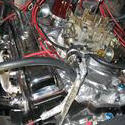
The crack is on the exterior of the block and it runs into a core plug hole.
I has sandblasted it and applied fiberglass over the crack, but I think it is leaking right at the hole where the plug makes contact.
I am going to try a rubber plug with a flexible bonding agent first.
I has sandblasted it and applied fiberglass over the crack, but I think it is leaking right at the hole where the plug makes contact.
I am going to try a rubber plug with a flexible bonding agent first.


Le Mans Master
Joined: Oct 2002
Posts: 7,098
Likes: 378
From: Las Vegas - Just stop perpetuating myths please.
Well if you don't want to have it welded then you could have it brazed or brass welded shut. It does need to be ground out enough for brass filler to fill the crack completely. Don't know how to handle the freeze plug hole though and that could be tricky. But that area is not really a stressful or load bearing area and should be repairable. Much easier than replacing the block.

Race Director

Joined: Feb 2004
Posts: 11,030
Likes: 2,587
From: Del Boca Vista FL
Agreed. Irontite makes the cast iron, tapered plugs and tapered tap for this purpose. Repaired many Model A blocks this way.
We called it “stitching”. Also used the plugs for cylinder head repairs.
The plugs are made in both cast iron and aluminum. In the OP’s case cast iron would be the material to use.
Safety Car
Joined: Oct 2016
Posts: 4,617
Likes: 1,547
From: Olive branch Ms
You can purchase the kit to do this your self. And there's nothing to it. Just drill tap install the tapered plug. On a crack I don't like to screw the plug in until it snaps off. Score it and let it snap. Then install the next plug. When you get to the freeze plug hole let it over lap and finish the hole with a air grinder then JB weld the hole and install the freeze plug. It will be a permanent repair. If you need more info pm me.
Last edited by Robert61; Aug 18, 2018 at 01:08 AM.

Burning Brakes


Joined: Aug 2013
Posts: 1,071
Likes: 322
From: palm springs ca
GM did fit each piston to bore. #'s were stamped on pan surface of block. if you saw a 12 that would be .0012 and not cylinder #12. I believe the #'s were in tenths of thousants.
Dom
Dom
Race Director
Joined: Feb 2004
Posts: 11,030
Likes: 2,587
From: Del Boca Vista FL
they fit/supplied piston, wrist pin, piston ring assemblies in what we referred to as “builder blocks” in the old days. A bare block gave you finished bores at standard and camshaft bearings installed.
Burning Brakes
Joined: Aug 2013
Posts: 1,071
Likes: 322
From: palm springs ca
We did a bunch of 413 Dodge engines that had piston slap. Chysler said it was cheaper to replace the engine than employ quality controll. Every short GM block I replaced was piston fitted to block. NOW that was in 1971!
Dom
Race Director
Joined: Feb 2004
Posts: 11,030
Likes: 2,587
From: Del Boca Vista FL
Actually there was quality controll @ GM, which Chysler didn't do . Fit the pistons to the bore. GM, If I understood what you were saying , did fit each piston to bore.
We did a bunch of 413 Dodge engines that had piston slap. Chysler said it was cheaper to replace the engine than employ quality controll. Every short GM block I replaced was piston fitted to block. NOW that was in 1971!
Dom
We did a bunch of 413 Dodge engines that had piston slap. Chysler said it was cheaper to replace the engine than employ quality controll. Every short GM block I replaced was piston fitted to block. NOW that was in 1971!
Dom
We are talking the same era. I was in the automotive machine shop business from 1969 through 1981.
No factory piston fitting on a replacement “bare block” as it came without internals. You got a block with cylinder bores finished to standard, camshaft bearings installed and main caps torqued in place. Ready for assembly with your parts after inspection.
“Builder blocks” (as we called them) were supplied from Chevrolet with piston/wrist pin/ring assemblies in the bores and you had to remove them from the cylinders and attach them to your connecting rods. Then you assembled the rest of the engine.
Short blocks were assemblies lacking cylinder heads, timing covers and oil pans. Had crankshaft, connecting rods, pistons, rings, rear main seal, camshaft, timing chain and sprockets. I don’t remember if the oil pump and intermediate shaft was supplied or not. If it was you had to install it.
In 1982 I decided I wanted to eat regularly and left the trade for a different “career”. Good move on my part as the trade didn’t reward you financially as it does today.
Team Owner
Joined: Mar 2003
Posts: 26,118
Likes: 1,874
From: Greenville, Indiana
If I remember right (and I might not) GM also supplied various sized standard and over sized pistons as listed in the parts book. As in various sizes of standard, various sizes of .010 OS and etc.
I believe they may have custom fit crankshaft main bearings as well.
MoPar at one time used to send new engines out of the engine plant with undersize crankshaft journals. Engine like this had an extra digit added to the engine ID type.
Last edited by MikeM; Aug 19, 2018 at 08:18 PM.
Race Director
Joined: Feb 2004
Posts: 11,030
Likes: 2,587
From: Del Boca Vista FL
What you're calling"builder blocks", GM called, "fitted blocks" and the pistons were custom fitted to the finished bore of the block. No rods, no crankshaft.
If I remember right (and I might not) GM also supplied various sized standard and over sized pistons as listed in the parts book. As in various sizes of standard, various sizes of .010 OS and etc.
I believe they may have custom fit crankshaft main bearings as well.
MoPar at one time used to send new engines out of the engine plant with undersize crankshaft journals. Engine like this had an extra digit added to the engine ID type.
If I remember right (and I might not) GM also supplied various sized standard and over sized pistons as listed in the parts book. As in various sizes of standard, various sizes of .010 OS and etc.
I believe they may have custom fit crankshaft main bearings as well.
MoPar at one time used to send new engines out of the engine plant with undersize crankshaft journals. Engine like this had an extra digit added to the engine ID type.
Thanks Mike. I had forgotten the “fitted” term but that is it.
On Corvairs, VWs and Porsches we called the replacement cylinder assemblies jugs and slugs.
Last edited by BADBIRDCAGE; Aug 19, 2018 at 09:47 PM.