When you click on links to various merchants on this site and make a purchase, this can result in this site earning a commission. Affiliate programs and affiliations include, but are not limited to, the eBay Partner Network.
These cars were the "King of the Hill" until the 427's found there way into the '66 and '67's...even then, if you got caught napping you would not catch up !!
Last edited by sprink94; Dec 16, 2019 at 07:07 PM.
These cars were the "King of the Hill" until the 427's found there way into the '66 and '67's...even then, if you got caught napping you would not catch up !!
If you believe the recent documentaries. Shelby ended Corvette racing domination.
283 C1s dominated SCCA B-production in the fifties and early sixties. Don Yenko won the BP National Championship with a '57 in '64. Then the Shelby GT350R arrived on the scene in '65... game over!
283 C1s dominated SCCA B-production in the fifties and early sixties. Don Yenko won the BP National Championship with a '57 in '64. Then the Shelby GT350R arrived on the scene in '65... game over!
Duke
Duke, was the game over because the GT350/GT350R were such a great car or because it was a great car for so much less money? In other words were we already at the point price wise where the costs were not practical to compete with a Corvette modified to compete with the GT350/GT350R modifications?
Obviously, I am no historical expert like some of you (with personal experience - I say this humbly)...I saw in the one of the Shelby history videos Peter Brock did say, (words to the effect of) if Chevy would have stayed in racing with factory backing, things would have been different...and that was based on the C2 with IRS; more specifically early experiences with the Grand Sport. One could surely argue, and (it seems) prove that a GS handles much better than a GT350.
Duke, was the game over because the GT350/GT350R were such a great car or because it was a great car for so much less money? In other words were we already at the point price wise where the costs were not practical to compete with a Corvette modified to compete with the GT350/GT350R modifications?
With the Cobras dominating AP Shelby developed the GT350, particularly the R-model to go after the BP championship, and they knew what had to be done... lighten it, more power, better brakes, etc., and they only had to build 100 go get it homologated as a production car, and any special parts needed to get the job done were just added to the options and parts lists with the stroke of a pen and inform SCCA. I think back then to qualify for SCCA production (sports) car status, they had to be two-seaters. So Shelby just removed the back seat on the R models and basic GT 350s could be modified to R configuration from the parts catalog.
The R-models were turn-key BP race cars that just needed a decent set of racing tires to be very competitive in BP.
In contrast the 283 Corvettes were approaching five years of age, and GM had no interest in going through their complicated release process to add better parts for a car no longer current, and privateers couldn't homologate parts... just the manufacturer, and Shelby was a recognized "manufacturer".
So BP was a sitting duck for Shelby, and he took advantage of it. If the requirement for "production car" status was more realistic, like 500 or 1000 examples it would have been a different story.
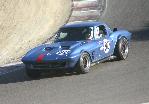
Of course GM took advantage of the low "production" requirement by planning to build 125 Grand Sports to qualify them as SCCA production cars and FIA GT cars, but then management shut the program down.
Obviously, I am no historical expert like some of you (with personal experience - I say this humbly)...I saw in the one of the Shelby history videos Peter Brock did say, (words to the effect of) if Chevy would have stayed in racing with factory backing, things would have been different...and that was based on the C2 with IRS; more specifically early experiences with the Grand Sport. One could surely argue, and (it seems) prove that a GS handles much better than a GT350.
The best evidence that "things would have been different" is the results of the Grand Sports running at Nassau in late '63. At that event the Grand Sports got the greatest amount of factory support they ever got.
According to Shelby's own photo historian, Dave Friedman, at Nassau the Grand Sports were 11 seconds per lap faster than the Cobras. That's huge!
The best evidence that "things would have been different" is the results of the Grand Sports running at Nassau in late '63. At that event the Grand Sports got the greatest amount of factory support they ever got.
According to Shelby's own photo historian, Dave Friedman, at Nassau the Grand Sports were 11 seconds per lap faster than the Cobras. That's huge!
OK, What was the Turd? My history does not include that one.
Mark
The next Bahamas 1964, they brought the ringer NASCAR engines 390 Cobra Turd! It looked like crap, as they were having cooling issues, so they cut into the nose to improve that! The second 427 prototype CSX2196, also called the Flip Top. 1600lbs. Some dispute as to whether it was punched to 427 yet at that race!
CSX2166 Sebring 1964, also a converted leaf spring 289 car, also lead the Grand Sports!
Last edited by TCracingCA; Dec 17, 2019 at 03:39 PM.
The next Bahamas they brought the ringer NASCAR engines 390 Cobra Turd! It looked like crap, as they were having cooling issues, so they cut into the nose to improve that!
I believe the 390 had an aluminum block and the overall vehicle weight was around 1400 - 1500 lbs, less than even the Grand Sports.
I believe the 390 had an aluminum block and the overall vehicle weight was around 1400 - 1500 lbs, less than even the Grand Sports.
I just added more, as you were posting.
People like to yell cheat, but the Grand Sport was a non-homologated Car too! It was lightweight and sporting a non-production engine in 377 size, against the 289 Cobras. The next go around at Sebring, they upped the ante too, but it didn’t finish.
The 390 being aluminum is wrong, my opinion. It was called a lightweight 390 sporting aluminum heads, aluminum water pump, aluminum crank dampener, magnesium intake, etc. total weight 565lbs.
The 427 were hard to get, as most built were allocated. They decided on a former NASCAR engine. It Has side Oiler configuration mods.
Last edited by TCracingCA; Dec 17, 2019 at 03:29 PM.
They had planned 4 cars with aluminum 390 engines.
As said disputed. Some say they were aluminum and some say not. As the word lightweight was thrown around, so many assume aluminum.
I never ran down this mystery to settle the dispute, and probably could.
I go deep on Corvette stuff still, and just stopped sharing as much, as I have enemies that don’t like my posts. I do this type of research on all car Marques- Ferrari, Ford, Bizzarini, Lola, etc., etc etc.
Last edited by TCracingCA; Dec 17, 2019 at 03:23 PM.
Shelby actually got two FE engines. One aluminum and one iron to test against each other! At Riverside they figured out that the iron head with the lightweight components was the way to go, prior to Nassau.
Last edited by TCracingCA; Dec 17, 2019 at 03:54 PM.
The actual press introduction for the 427 Cobra was January 27th, 1965!
The Sebring 1964 1st prototype (red #1- Miles) crashed in practice hitting a tree and also the 289 Daytona Coupes were overall superior in that race newly introduced a month before the opening Daytona Race. It was getting all of the attention.
Last edited by TCracingCA; Dec 17, 2019 at 03:54 PM.
I worked with their Registry and even the CSX2166/2196 are disputed. They now lean toward the flip top Turd being the Sebring car. But that kind of debunks 4 early prototype cars.
Last edited by TCracingCA; Dec 17, 2019 at 04:08 PM.



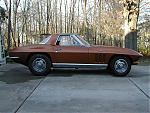
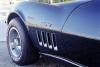
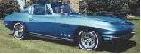




 The "Duntov Factor"