When you click on links to various merchants on this site and make a purchase, this can result in this site earning a commission. Affiliate programs and affiliations include, but are not limited to, the eBay Partner Network.
Looking back at your early pictures I'm surprised you got the motor out with the fuel pump in place. I've never been able to remove or install mine with it in place and I hate that because it's a royal PITA to install in the car.
I've pulled mine out with the fuel pump still on. It was harder going back in.
It's a lousy day when you have to pull a recently rebuilt engine. Been there and sadly done that. Here's to hoping this next engine is flawless and puts big smiles on your face. Then it will all be worth it. Just money and time.
I agree with the others, I always run an engine before I'll install it in a car. Better to find an oil leak or other issues. For years I used a cheep engine stand and made a front support. I connect the garden hose to it but rust was apparent when draining the block.
Today I'm working on a better system. The old engine stand sat too low to the ground and my engine hoist would not slide under it so I have bigger castering wheels set wider to resist torque, I have a permanent radiator mount and I use antifreeze to prevent corrosion, a plywood base for the battery and fuel tank. The 'panel' has a tach, oil pressure, water temp and volt meter as well as a key start switch and a throttle lever. The header pipes at 2.5" and I use mufflers to keep peace with my neighbors. Al
I've pulled mine out with the fuel pump still on. It was harder going back in.
The thing I can never get out easily is the radiator and/or shroud.... One doesn't want to come out without the other one being out first. There's got to be an easier way.
From: Las Vegas - Just stop perpetuating myths please.
Please unbag it so we can see it. But what I can see looks like the shop did a nice paint job. Pocket porting gives you the most bang for your buck and I expect you will feel the results. I read you gained some experience with this motor and glad you posted it rather than remaining in denial. There of plenty of critical parts and skills required building or even rebuilding an engine that are taken for granted. I read too much of bandwagon encouragement and assumptions when caution and research is needed.
Yes it was nice of you to post your experience and I hope the new motor works well for you.
Thanks, .... Live, learn, work some more.
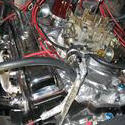
I already have the engine back in the car. Kids came to visit today and I couldn't work on it, so I am going to work tomorrow and getting plugs, gear oil, coolant and a new thermostat on the way home. Still have some work to do, but hopefully have it running by next weekend.
So I got it running Wednesday night, Ran it for 20 minutes at 2000 rpm, No major leaks but as usual there is issues with stuff not fitting the way it did when you took them out. So I got all the issues worked and it's ready for a test run. Too bad it's raining cats and dogs here. Idles well with no valvetrain noise.
Haven't decided yet if I am going to try the hood install by myself or wait for my son to get home on break to help.
So in a totally unrelated matter with the engine install......
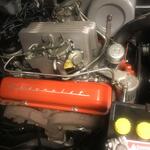
What do you think of my engine stamp pad? I have owned this car since 1988 (ish) (30+) years. I purchased the car as a non running project but the engine and transmission both have the serial number on them.
From: Las Vegas - Just stop perpetuating myths please.
You need to verify the stamped date code with the cast date code. I read the stamped code as F03I5HE when the I should be an 1 (for the 15th of March).
Really need to provide block cast number, block cast date and the block stamped number to make sense of things.
And don't forget to put new 327 turbofire 300 HP stickers on the valve covers Sledge.
From: Las Vegas - Just stop perpetuating myths please.
Okay casting number 3858174 is good for 1966 corvette and C96 says it was cast on March 9, 1966 which matches your intake March 4, 1966 (C46). A March 9 cast date and assemble date of March 15 would make sense but I can't explain why they stamped with an I rather than a correct 1 number stamp.
Alan Colvin says the stamped code letters/number should be 3/16" where the VIN numbers will be only 5/64" high. You could verify that also to insure the correct stamp was used.
Dang, it's already in the car.
I was just posting them for entertainment value anyway.
Seeing it's a 300hp, the date I bought it, the condition I bought it and the person I purchased it from (actually traded it) , I pretty dang sure it's the original engine or at least nobody went to the trouble of finding a block and restamping it to fool someone. I was a 25 year old kid just happy to get a corvette. I went to high school with the guy who traded me for it. Heck, back then all we knew was that there was a big block and a small block corvette. We didn't care.
Last edited by SledgeHammer 2.0; Nov 29, 2020 at 10:33 PM.
Reason: added material
From: Las Vegas - Just stop perpetuating myths please.
Pretty easy to measure the size of the engine code with the engine in the car. But if you have good history on the car & engine before rebuild(s) then most likely a quirk the letter I was used to replace a number 1.
I am dumping that new flywheel I purchased that was 153 tooth and getting the original "bigger" flywheel.
Original Engine
Hopefully, It doesn't take me as long this time as mostly everything is still clean.. I will keep y'all informed on my progress.
Small-block midyears never used the "bigger" (14" diameter, 168teeth) flywheel; they all used the "small" (12-3/4" diameter, 153 teeth) flywheel and a 10.5" clutch. Using the 14" flywheel on a small-block introduces other complications like starter fitment.
Small-block midyears never used the "bigger" (14" diameter, 168teeth) flywheel; they all used the "small" (12-3/4" diameter, 153 teeth) flywheel and a 10.5" clutch. Using the 14" flywheel on a small-block introduces other complications like starter fitment.
Thanks John, but I have no idea. I've read on this forum that in 1966 that there where two different flywheels used on small blocks, early and late maybe... don't remember and I would have to search.
Thanks John, but I have no idea. I've read on this forum that in 1966 that there where two different flywheels used on small blocks, early and late maybe... don't remember and I would have to search.
Read the link I attached to post #34; that's how it was.