






Exhaust

Thread Starter
Heel & Toe

Joined: May 2020
Posts: 15
Likes: 0
 Exhaust
Our car has been stored for approx. 25 to 30 years, it's a 327, 300 hp. Thanks to the advice of many members on this forum, we were able to get it started and running. For some reason the exhaust out of one tail pipe is much stronger than the other side. The side where its coming out stronger appears to be dry, where is the side with less pressure appears to have some moisture. We are not mechanics and are learning as we go along, any advice would be appreciated.

Le Mans Master


Joined: Sep 2003
Posts: 8,812
Likes: 2,029
From: eastern NC
If the stronger side is on the driver's side, it is probably the result of a stuck heat riser valve on the passenger down pipe.
The heat riser valve is spring loaded closed (and can rust in that position if not moved over an extended period) and designed to direct exhaust gas from the passenger exhaust manifold through a channel below the intake plenum to the driver's side exhaust to warm the engine sooner. If the valve is stuck it can significantly resist exhaust flow and impact engine performance.
Look for the valve at the exhaust manifold and try to move it to break it loose.
Good luck... GUSTO
The heat riser valve is spring loaded closed (and can rust in that position if not moved over an extended period) and designed to direct exhaust gas from the passenger exhaust manifold through a channel below the intake plenum to the driver's side exhaust to warm the engine sooner. If the valve is stuck it can significantly resist exhaust flow and impact engine performance.
Look for the valve at the exhaust manifold and try to move it to break it loose.
Good luck... GUSTO
Last edited by GUSTO14; Jun 14, 2020 at 11:38 PM.
Team Owner


Joined: Aug 2008
Posts: 33,046
Likes: 6,555
From: Rochester NY
St. Jude Donor '09 thru '26
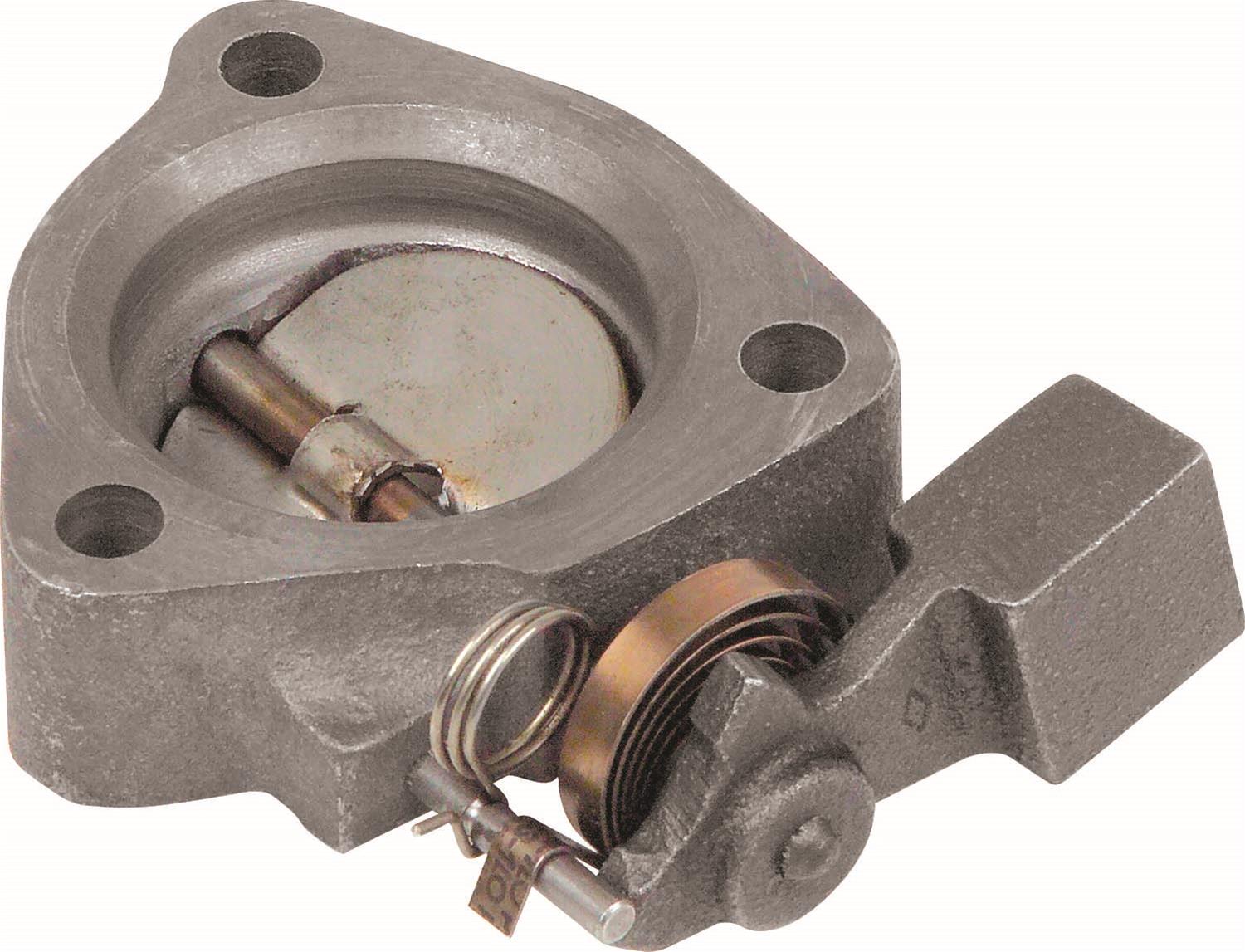
Here's what one looks like - of course the exhaust manifold is above it and the pipe is below but what GUSTO is talking about is that square weight. That should be loose and able to be moved up and down. You can see what effect that will have on the exhaust flow as the butterfly either opens or closes.
Last edited by Railroadman; Jun 14, 2020 at 11:39 PM.
Thread Starter
Heel & Toe
Joined: May 2020
Posts: 15
Likes: 0
Thank you Gusto and Railroadman, you're right, the exhaust is coming out stronger on the drivers side. We did actually see the valve you're referring to on the passenger side under the exhaust manifold and was able to move it up and down, but had no idea what it was until you explained it. We moved it by hand, again, had no idea what it was and not sure what position we left it in but will try moving it again the next time we're able to work on the car, and check the exhaust on the passenger side. Thank you again, we really appreciate your help.

Instructor
Joined: Jun 2015
Posts: 171
Likes: 29
From: Germany - Rheinland/Pfalz
Here's what one looks like - of course the exhaust manifold is above it and the pipe is below but what GUSTO is talking about is that square weight. That should be loose and able to be moved up and down. You can see what effect that will have on the exhaust flow as the butterfly either opens or closes.
I thought the valve was supposed to have a control function for the choke.
My engine has an electric choke and so I opened the valve permanently, because I don't see any sense in its function.
Maybe I'm wrong, but my car is only moved in nice weather and warm temperatures.
Team Owner
Joined: Aug 2008
Posts: 33,046
Likes: 6,555
From: Rochester NY
St. Jude Donor '09 thru '26
Brookdale, the purpose of that doohicky is to help the car warm up faster. When it's cold, it should be shut and thus sends the RIGHT side exhaust up, through the intake manifold, and down out the driver's side. As the car reaches operating temperature, it should open allowing more equal flow.
So if the car is cold (as in "not having been driven for a while", NOT as in "15 degree weather") it may still be OK - try letting the car idle for a while, or take it for a short ride, and see if the pressure is more equal.
So if the car is cold (as in "not having been driven for a while", NOT as in "15 degree weather") it may still be OK - try letting the car idle for a while, or take it for a short ride, and see if the pressure is more equal.

Race Director


Joined: Apr 1999
Posts: 10,866
Likes: 717
From: Beverly Hills/Pine Ridge Florida
Our car has been stored for approx. 25 to 30 years, it's a 327, 300 hp. Thanks to the advice of many members on this forum, we were able to get it started and running. For some reason the exhaust out of one tail pipe is much stronger than the other side. The side where its coming out stronger appears to be dry, where is the side with less pressure appears to have some moisture. We are not mechanics and are learning as we go along, any advice would be appreciated.
I've blown several mouse nests out of tailpipes starting cars that have been sitting for a few years.
Corvette Stories
The Best of Corvette for Corvette Enthusiasts

Top 10 Most Expensive Corvettes Ever Sold on Bring A Trailer
Brett Foote
10 Things Every Corvette Owner Needs (2026 Edition)
Michael S. Palmer
8 Most "Only Corvette Owners Understand" Quirks and Problems
Pouria Savadkouei
10 Reasons the C6 Z06 is Still A Performance Benchmark After 20 Years
Joe Kucinski
How Much Horsepower Every Corvette Engine "LOST" in 1972
Joe Kucinski
Top 10 DOs and DON'Ts for Protecting Your Convertible Top!
Michael S. Palmer
Top 10 Most Explosive Corvettes Ever Made: Power-to-Weight Ratio Ranked!
Joe Kucinski
150 hp to 1,250 hp: Every Corvette Generation Compared by the Specs That Matter
Joe Kucinski
8 Coolest Corvette Pace Cars (and Replicas) of All Time
Verdad Gallardo
Drifting


Joined: Mar 2014
Posts: 1,744
Likes: 278
From: Akron OH
I had the same symptom on my '67 with side pipes. Instead of wiring the heat riser in the open position, I replaced it with a spacer that has the same thickness. After doing that, condensation no longer drips from the right side pipe.
Team Owner
Joined: Aug 2008
Posts: 33,046
Likes: 6,555
From: Rochester NY
St. Jude Donor '09 thru '26
