When you click on links to various merchants on this site and make a purchase, this can result in this site earning a commission. Affiliate programs and affiliations include, but are not limited to, the eBay Partner Network.
I do not know if a combination of letters and numbers were used in the casting date of a 1954 cast 265.
If someone can please tell me how to read this casting date code, if would be much appreciated. 1954 cast 265 cu. in.
the orientation of the screws that hold on the date plate. If the screw heads are both horizontal it’s first shift. If both are vertical it’s second. If one of each it’s third shift. This holds true for all GM casting
the orientation of the screws that hold on the date plate. If the screw heads are both horizontal it’s first shift. If both are vertical it’s second. If one of each it’s third shift. This holds true for all GM casting
I never heard or knew that. Excellent information!
Thanks.
It has always been as it is in the picture. I don't think it has ever had one. It is not plugged.
Do you know if the area was machined out to accept the draft tube?
Thanks.
It has always been as it is in the picture. I don't think it has ever had one. It is not plugged.
Do you know if the area was machined out to accept the draft tube?
Thanks.
Draft tubes on '55 265s are configured differently from all other year SBCs.
There should be one but instead of mounting on top of the block, it connects to the block inside the chamber formed by the back of the block and the bell housing. It is not visible from above.
Last edited by jim lockwood; Aug 14, 2020 at 09:52 AM.
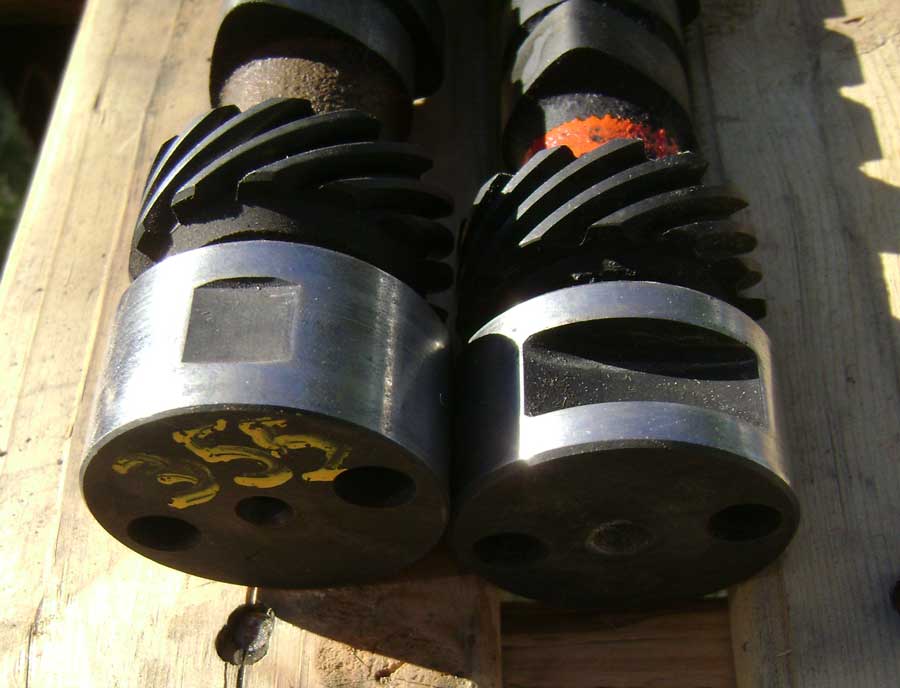
Just remember, too, that camshafts are not interchangeable between the 265 and later larger CID blocks. The rear cam journal has a notch in it for oiling that is not present in later Chevrolet engines (.510 X 1/2).
Last edited by Dan Hampton; Aug 14, 2020 at 12:27 PM.
Just remember, too, that camshafts are not interchangeable between the 265 and later larger CID blocks. The rear cam journal has a notch in it for oiling that is not present in later Chevrolet engines.
isn’t just a grove like on 65-66 BB engines. If so then any machine shop can cut one in it
Draft tubes on '55 265s are configured differently from all other year SBCs.
There should be one but instead of mounting on top of the block, it connects to the block inside the chamber formed by the back of the block and the bell housing. It is not visible from above.
Actually, here's the quote from my article: "The shape of the screw heads on the ends of the casting date tag indicated the shift during which the casting was poured; two flat head screws was the first shift, one flat and one round head screw was second shift, and two round head screws was the very rare third shift."
From: Putnam Valley, New York. Amateur Radio Operator K2NS
Originally Posted by Nowhere Man
isn’t just a grove like on 65-66 BB engines. If so then any machine shop can cut one in it
I found this on chevytalk.org .
The factory notches that are shown in all the previous posts are for hydraulic cams. If the cam was an original solid lifter 55-56 the notch was very small.
The cam on the left is a factory 210-225 HP solid lifter cam. Since solids didn't need oil to operate, the notch allowed enough oil to lube the tip of the pushrod, rocker ball socket and tip of the valve. Since the oil delivery is impulse rather than full time flow, the 55-56 lifters didn't restrict the flow from the lifter. In 57 the lifter was redesigned to restrict the flow because the oil flow was constant. So if you have original 55-56 lifters you don't want to make the cam bearing a full time flow as it will flood the top end with oil. The full time internal oiling with the later lifters never changed after 57( on small blocks. 65-66 big blocks had a full grooved camshaft. Go figure.). The easiest way to install your rear cam bearing is to line up the holes in the block with the holes in the bearing checking the alignment with a nail or wire. That will put it at the correct depth to align with the notch in the cam.
Designer Imagines A Corvette That Looks More Like a Corvette Than the Corvette
Slideshow: A Jaguar designer's personal project imagines what a modern front-engined Corvette might look like if Chevrolet revisited the golden age of the Stingray.





 265 Date Code